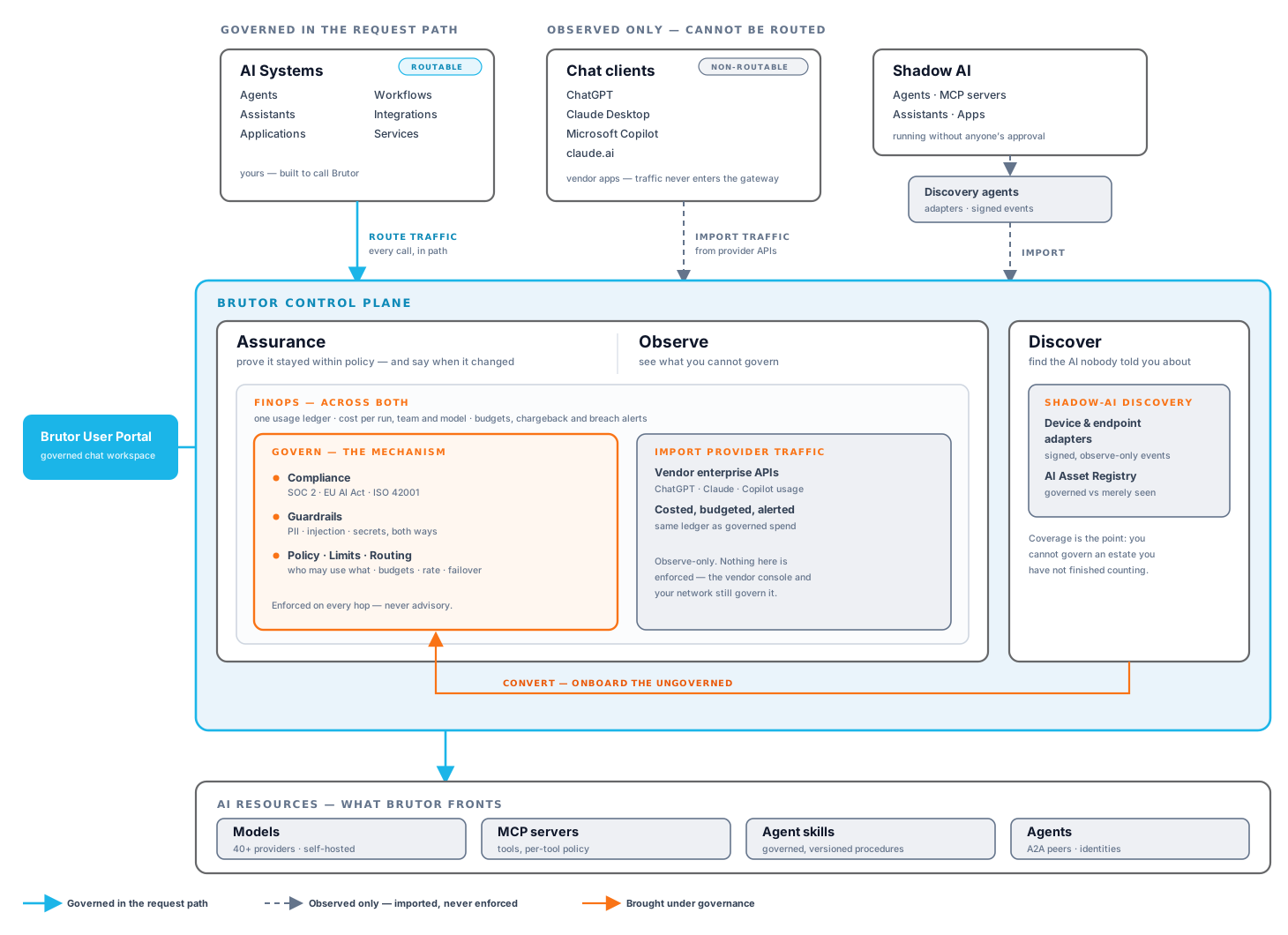
Brutor is a multi-tenant AI control plane: one platform through which your
organization runs, watches and answers for its AI. Agents, chat clients, internal
apps and pipelines point at Brutor instead of calling OpenAI, Anthropic, Bedrock or
your self-hosted models directly — and the usage you cannot route (provider seats,
consumer chat clients, shadow projects) is imported and discovered so it lands in the
same picture.
What makes Brutor different from a plain LLM gateway is AI System Assurance: the
platform doesn’t stop at enforcing rules on individual requests — it keeps evidence
that each deployed AI System, as a whole, is still doing its job, still behaving the
way it did at sign-off, and still alive.
Three kinds of AI traffic reach the platform, and it is honest about the difference:
Traffic
How it arrives
What Brutor can do with it
Routable AI Systems — agents, assistants, applications, workflows, services
Their base URL is the gateway
Governed — every call is enforced in the request path
Bought AI — ChatGPT, Claude Desktop, Microsoft Copilot, claude.ai seats
Usage imported from provider enterprise APIs
Observed — costed and attributed, never enforced
Shadow AI — ungoverned agents, MCP servers, apps nobody registered
Discovery agents and adapters send signed events
Discovered — inventoried, then converted into governed systems
The question a dashboard cannot answer is not “did the requests succeed?” — it is
“is the agent still doing its job, the way we approved it?” Assurance is the layer
that answers it with evidence:
Every governed call lands in the run ledger, grouped
by task into runs with honest terminal states — cost per completed task, not per request.
Five signals — liveness, behaviour, reliability, cost,
conformance — are scored continuously against each system’s own baseline, and
combine worst-of (never an average) into one
health verdict. Absence of evidence is never green.
A hash-pinned contract records what the system was
allowed to do at sign-off, and replay rehearses any
change against recorded production traffic before it ships — dispatching nothing.
The Assurance Report rolls all of it
into the artifact an auditor reads — and states what it does not cover.
Enforcement happens in the request path, not in a report after the fact:
One credential model. Developers get Brutor API keys scoped to a
resource group — provider keys are stored encrypted
in the gateway and never leave it.
One usage ledger across everything — routed and imported alike — wrapped in FinOps:
Mission Control shows spend, usage, health
and governance posture per system, team, model and provider — including cost per
run, the number a budget conversation actually turns on.
Traffic Data Import pulls usage from
provider enterprise APIs, so the ChatGPT and Claude seats you buy appear in the same
ledger as the traffic you route — observed and costed, never enforced.
Shadow AI Discovery — discovery agents
and adapters send signed events about AI usage that never touches the gateway:
unregistered agents, MCP servers, assistants and apps.
The Asset Register inventories everything —
governed and discovered — in one place.
The loop closes back into Govern: converting a discovered system means pointing
it at the gateway and bringing it under enforcement.
You build agents, chat clients and internal apps. You point your existing OpenAI or Anthropic SDK at the gateway, call MCP tools through one governed endpoint, or build a full custom portal on the Portal API. Guardrails, budgets and audit come for free — you never handle provider keys.
You install and operate the gateway, decide which models and tools each team may use, set budgets and guardrails, and answer “what did we spend?”, “who did what?” — and “can we prove it?” — from Mission Control, the audit logs and the assurance reports.