

Contracts
A contract is a hash-pinned, versioned snapshot of every control that applies to an AI System — generated from the resolved live configuration, never hand-authored. A policy document that can disagree with reality is worse than none.
Because an AI System is a resource group, the contract
is the resolved closure of that group: resources compose additively up the parent
chain gated by inherit_from_parent; limits and policies compose restrictively,
min-wins. Both are rules the platform already implements, so a contract is a rendering
of an existing computation rather than a second opinion about it.
contract_hash = SHA256(canonical_json(resolved_closure))It covers composition (models, MCP servers, skills, agent identities), resolved limits and governance, guardrail and argument-policy bindings, autonomy level, risk tier and intended use. Secrets are never included — a contract names which key binding applies, never the key.
The Contract tab has three sub-tabs — Active (versions, closure, diff), Operating envelope (the declared-bounds half of the same signature) and External evidence (what a third party attached). The lifecycle gate is not on it any more: promoting a contract is not a lifecycle transition, and the two sets of buttons on one screen said otherwise. The stage and its gates live on the Lifecycle tab.
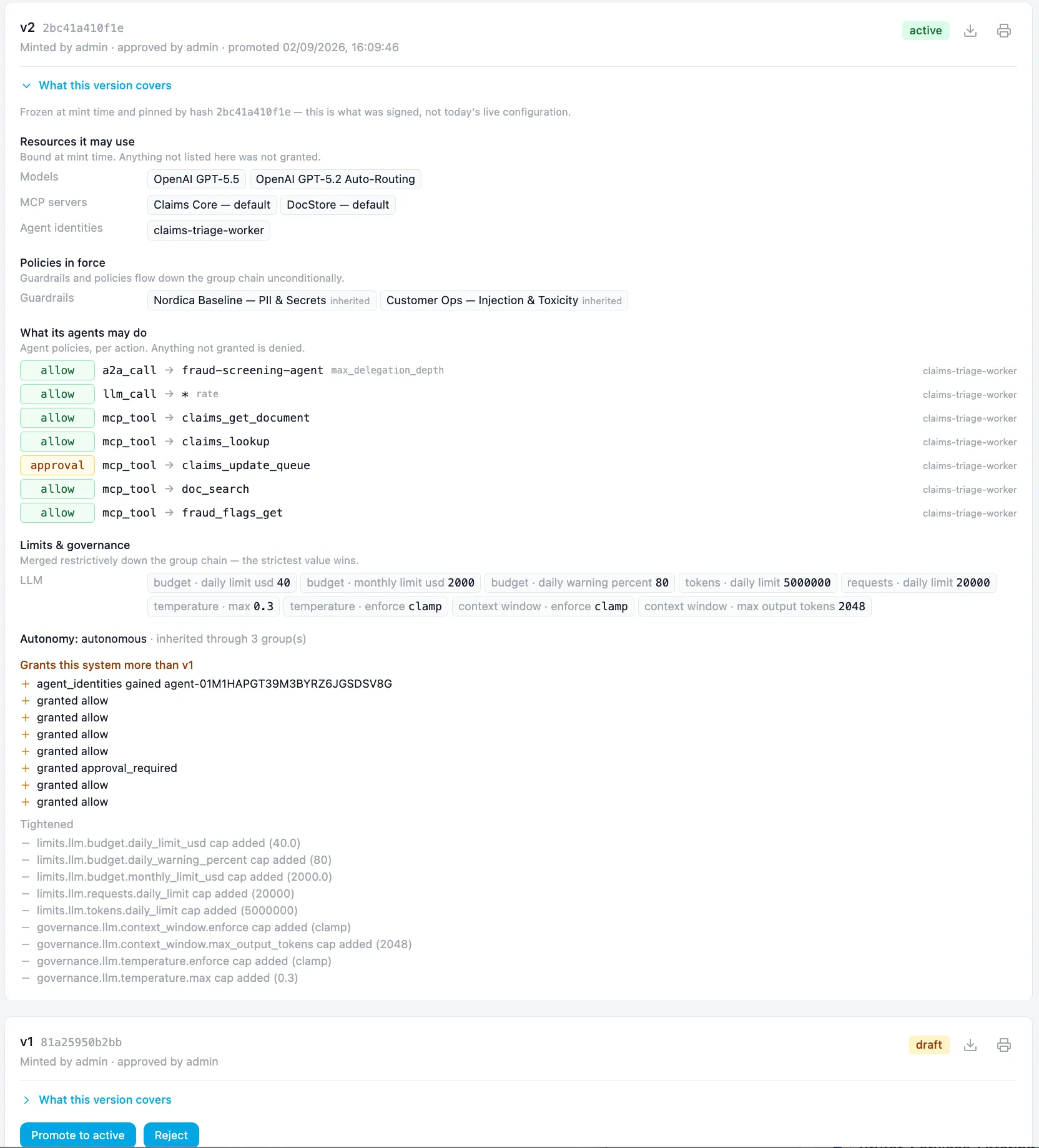
The closure is readable, not just hashed. Each version in the Contract tab expands
to show exactly what it froze — models, MCP servers, skills and agent identities;
guardrails, argument policies and armed automatic responses; the merged limits and
governance; and the autonomy level, with inherited grants marked as such. That matters
most for a first contract: v1 has no predecessor and therefore no diff, so without it
an approver would be promoting a hash-pinned document whose entire body was invisible.
The panel reads the stored closure, never a recomputed one — re-deriving from
today’s configuration would show an approver something they never signed. The same
bytes are available at GET /v1/admin/ai-systems/{id}/contracts/{version}.
Every finished run is stamped with the contract it ran under, so “what governed this run?” has a provable answer. If you have run change management, this is your change-approval process — made executable.
Versions are append-only
Section titled “Versions are append-only”Minting is idempotent: if live configuration still hashes to the latest contract, nothing new is created. A superseded contract is kept, because it is the only record of what the rules were while historical runs executed.
Exactly one contract per system is active, enforced by a database constraint rather than
by application logic.
The diff answers one question
Section titled “The diff answers one question”Not “what changed” — a change list is easy and nearly useless. The diff separates widened from narrowed:
| Direction | Examples |
|---|---|
| Widened | A new MCP server or skill; a raised cap; a removed cap; autonomy relaxed |
| Narrowed | A removed resource; a lowered or newly added cap; autonomy tightened |
| Changed | Owner, intended use, risk tier — documentation, not permission |
A version that adds three MCP servers and tightens a token cap is not “four changes”; it is one thing that needs scrutiny and one that does not.
The diff shown to an approver is stored on the contract, not recomputed later. Recomputing it against today’s configuration would show a reviewer something they never approved.
The operating envelope
Section titled “The operating envelope”The closure pins what a system may do. The envelope adds what it should achieve — declared bounds, signed off with the rest of the contract and evaluated continuously against the run ledger:
Envelope terms come in two kinds, and the form groups them accordingly, because a number an operator believes will protect them must not merely describe them.
Enforced ceilings apply to a single run and are checked at the gateway before each call. When a run reaches one, its next call is refused — the runaway stops at its own expense instead of draining the whole resource group’s daily budget and 429-ing every other system in that group until UTC midnight:
| Term | Ceiling for one run |
|---|---|
max_cost_per_run_usd |
Spend |
max_tokens_per_run |
Total tokens across all its calls |
max_llm_calls_per_run |
Model calls — the k in T(n·k) |
max_delegation_depth_per_run |
Agent-to-agent hops — the a in T(n·k·a) |
max_duration_seconds_per_run |
Wall-clock before further calls are refused |
Set the token ceiling first. It is the one bound a vendor price change cannot loosen underneath you; dollars are the business limit, tokens are the safety limit. Depth tightens a global rail that always applies (32 hops maximum, regardless).
Graded bounds are measured over the reporting window and appear in the Assurance Report as met, breached or insufficient evidence. They never refuse a call:
| Term | Bound |
|---|---|
max_avg_cost_per_completed_task_usd |
Mean cost of a completed task |
max_monthly_cost_usd |
Spend over the trailing 30 days |
min_completion_rate |
Share of finished tasks that completed |
max_error_rate / max_abandoned_rate |
Shares that errored / went quiet unfinished |
max_approval_escalation_rate |
Share escalated for human approval |
Enforcement reads the system’s live envelope, not the copy frozen in its active contract — otherwise the systems that most need a runaway guard, the ones with no approved contract at all, would have none. Assurance still grades the signed copy, and a live edit that has not been approved shows up as configuration drift in the report.
Baselines learn what normal is; the envelope declares what acceptable was agreed to
be. A system can drift without breaching its envelope, and breach it without drifting —
the two questions are scored separately, and only the envelope produces contract
violations: findings that response policies can act on, and
that force the report’s verdict to violations.
Three honesty rules carry over from everywhere else:
- There is deliberately no correctness term. “≥95% correct decisions” is not something a proxy can verify — no ground truth — and an envelope that mixes verifiable terms with unverifiable ones poisons trust in the verifiable ones.
- Rates need evidence. Below 20 finished runs in the window a rate term reads
insufficient_evidence— a different verdict frommet, and never rolled up as assured. Spend caps are the exception: spend is a sum, not an estimate. - The envelope counts once signed. Declaring or editing terms drifts live config from the active contract; the terms are evaluated from the version an approver actually signed. In the diff, loosening a bound (or removing a term) is a widening the approver must read; tightening is not.
Conformance
Section titled “Conformance”Because contracts are generated, “is this system running configuration nobody approved?” is computable. The Contracts panel states it plainly when live config no longer matches the active contract.
A document standard, not an API response
Section titled “A document standard, not an API response”An exported contract is a specified, portable document —
spec: ai.brutor/ai-system-contract, semantic spec_version, validated by a published
JSON Schema (GET /v1/admin/standards/ai-system-contract/schema). It is
self-contained: closure, hash, approval trail — so a third party can check that the
closure hashes to what the approval names without an API call back to the platform.
Download it per version from the Contract panel, or
GET /v1/admin/ai-systems/{id}/contracts/{version}/export. Within 1.x the format only
gains optional fields; anything breaking moves the major version.
Related
Section titled “Related”- The gate & replay — where a contract needs an approver, and where a candidate contract is rehearsed against recorded traffic
- Health & the Assurance Report — contract history and conformance in the evidence artifact