

What is an AI System?
An AI system is a deployed piece of software that delegates part of its work to an AI model. Not “an app that happens to call an API”: in an AI system the model’s output decides what happens next — which tool runs, which record changes, which email goes out, whether the loop continues. That delegation is what makes AI systems powerful, and it is also exactly what makes them harder to operate than the software you ran before — more on that in why AI systems are different.
The agent — today’s most common AI System
Section titled “The agent — today’s most common AI System”The AI system you are most likely to run in 2026 is an agent: a program that repeatedly asks a model “what should I do next?”, executes the answer — often by calling a tool over MCP — feeds the result back, and loops until the task is done.
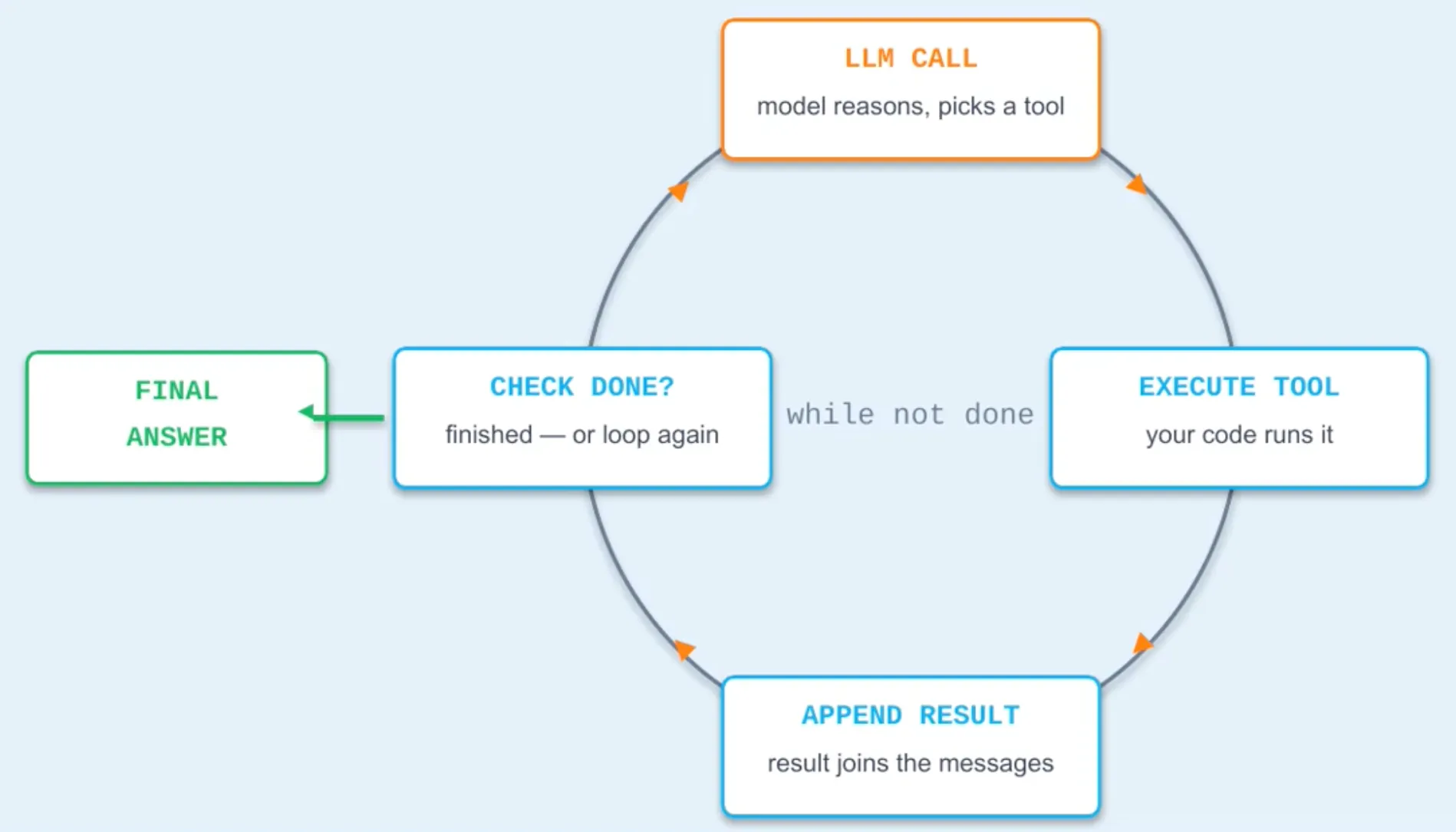
Maybe the loop runs twice; maybe forty times. It runs in your process, with real side effects — emails, refunds, database writes. The vocabulary for what one trip around (and one whole task) is called — runs, steps, turns, actions — has its own page: the anatomy of a run.
But agents are not the only kind
Section titled “But agents are not the only kind”Anything that delegates work to a model is an AI system, and the differences matter
operationally — silence overnight is an incident for a nightly pipeline and perfectly
normal for a chat assistant. Brutor records the shape as system_kind:
| Kind | What it describes | Example |
|---|---|---|
agent (most common) |
Autonomous or semi-autonomous goal pursuit — the loop above | A support agent that resolves tickets end to end |
assistant |
Human-in-the-loop conversational system | An internal copilot in the User Portal |
application |
A product feature that calls models | Single-shot summarization in your app |
integration |
Scheduled or event-driven pipeline | Nightly ticket classification |
workflow |
Orchestrated, deterministic control flow with model steps | A document-processing chain |
service |
Internal shared AI capability | A company-wide embedding or extraction service |
The kind tunes what gets watched and how hard: action-count drift is a headline signal for an agent and meaningless noise for a single-shot application — and a product that alerts on noise gets turned off.
The AI System as the governed unit
Section titled “The AI System as the governed unit”Brutor’s design decision is to make this thing — the agent, the assistant, the pipeline — a first-class entity with an owner, an intended use, a lifecycle stage and a risk tier, and to key everything on it: access, credentials, budget, audit trail, contract and health. Think of it as the “application” in your CMDB, rather than the process ID or the API key.
Technically an AI System is a resource group with
group_type: "ai_system", so it already composes resources, carries limits and
inherits policy. One system may contain several actors — API keys, agent identities,
human users — all rolling up to the same ledger and the same verdict.