

Tokenomics & Big-T workload classes
Tokenomics is the economics of AI tokens — what a unit of finished work costs, and how that cost grows as usage grows. The Tokenomics Foundation (Linux Foundation, 2026) standardises the vocabulary; Brutor measures the numbers, because the gateway already sits in the request path of every model call, tool call, skill and delegation an AI System makes.
Big-T notation: cost has a shape, not just a size
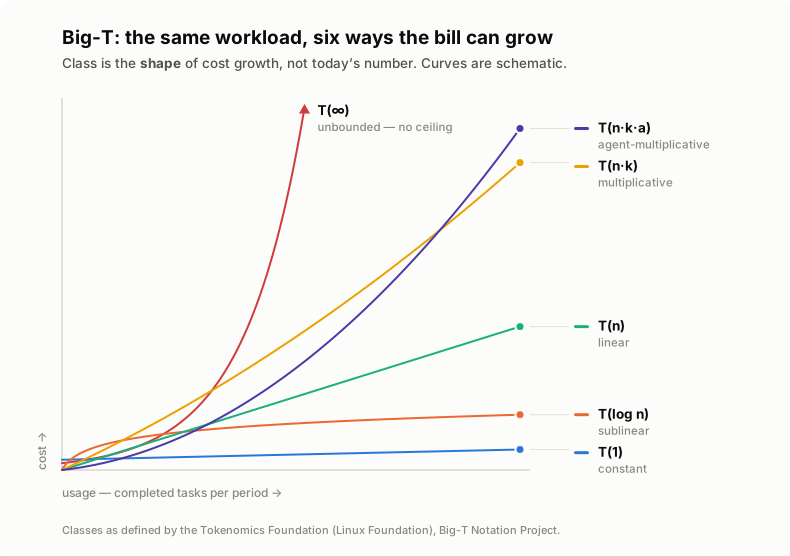
Section titled “Big-T notation: cost has a shape, not just a size”Big-O notation describes how an algorithm’s work grows with its input. Big-T notation does the same for AI cost: it classifies a workload not by what it costs today, but by how its cost grows as usage grows.
| Class | What’s going on | How the bill grows |
|---|---|---|
T(1) |
A cache answers most requests; the model is rarely called | Barely grows with usage |
T(log n) |
Plain code trims the input before the model sees it | Grows slower than usage |
T(n) |
One model call per task | With usage, predictably — the healthy default |
T(n·k) |
The system makes k model calls per task — reasoning steps, tool calls, replayed context. k is invisible on the invoice | Usage × k |
T(n·k·a) |
Agents hand work to other agents; a second multiplier compounds the first | Compounds with usage |
T(∞) |
A loop with no exit condition | No ceiling at all |
The violet curve is why agent workloads get underestimated in pilots:
T(n·k·a) runs below T(n·k) for most of the range and only overtakes
it late. A workload that is comfortable at ten users and ruinous at a
thousand didn’t change — it was T(n·k) all along and was budgeted as if
it were T(n).
How Brutor derives the class — measured, not estimated
Section titled “How Brutor derives the class — measured, not estimated”The standard assigns a class by reading a workload’s architecture. Brutor derives it from what actually ran, using the run ledger:
| Symbol | Source |
|---|---|
n |
Finished runs (replays excluded) |
k |
Median model calls per run — the median, so one outlier run cannot reclassify a system |
a |
Maximum delegation depth observed |
| cache share | Cache hits ÷ governed actions |
Classification precedence: delegation on ≥ 5% of runs → T(n·k·a);
median k > 2 → T(n·k); cache share ≥ 50% → T(1); otherwise T(n).
A chatty loop with a good cache is still a chatty loop.
Two classes are never asserted: T(log n) (the ledger cannot see
deterministic pre-filtering that happens before the gateway) and T(∞)
(delegation-depth caps and budgets make an unbounded loop structurally
impossible on governed traffic — the class exists to be prevented, not
observed).
The 30-day judgment window
Section titled “The 30-day judgment window”The class — like health and the verdict — is always computed on a fixed 30-day window, whatever time range you pick on the dashboard. The window selector scales measurements (spend, runs); it never changes judgments, so there is no view in which a struggling system looks fine.
What the card shows
Section titled “What the card shows”Every AI System card in Mission Control carries three tokenomics numbers:
- Spend over the selected window.
- Cost per completed task — total spend ÷ runs that actually
finished. If the system’s contract declares a
max_avg_cost_per_completed_task_usdbound in its operating envelope, the number turns red the moment it crosses. (The card figure is a mean, so it is compared against the mean bound — the separatemax_cost_per_run_usdceiling is enforced per run at the gateway.) No provider can compute this figure: only the system orchestrating the work knows where one task ends and the next begins. - The class chip. On group cards the chip shows the worst class in the subtree — rendered as “contains T(…)” — never an average.
Cost-complexity findings
Section titled “Cost-complexity findings”Because the class is recomputed continuously, a change in class is a finding, in the same list as behavioural drift and liveness:
- Moving up the ladder (say
T(n)→T(n·k)) raises acost-class drift event — severity high when the arrival class isT(n·k·a). - The event carries a cause when one lines up (a contract minted or a
binding changed within the preceding 72 hours); otherwise it says
unexplainedplainly rather than dressing up a guess. - Moving down the ladder is recorded too, at low severity — that is your levers working, not an alarm.
- A standing class finding never stacks, and a further transition supersedes it.
You respond the way you respond to any finding: tighten a limit, change the routing, or accept it and raise the ceiling.
The levers, in Big-T terms
Section titled “The levers, in Big-T terms”| Lever | What it does to the class |
|---|---|
| Semantic cache | Moves repeat traffic toward T(1) |
| Cheaper / routed models | Lowers the price of every T(n) call |
| Budgets, quotas & rate limits | Bound the bill before the money is spent |
| Delegation-depth caps | Put a hard ceiling on a |
| Batch processing | Provider batch rates for off-peak T(n·k) work |
Limits without measurement keep you solvent but teach you nothing; measurement without limits explains the overrun beautifully, afterwards. The gateway’s ledger feeds both from the same record.