AI System Assurance is Brutor’s answer to the question no request dashboard can
answer: is this AI System still operating according to what we signed off? It is
built for the failure modes that are
quiet instead of loud, and it is keyed on
the AI System — the agent, assistant or pipeline — not on individual
requests.
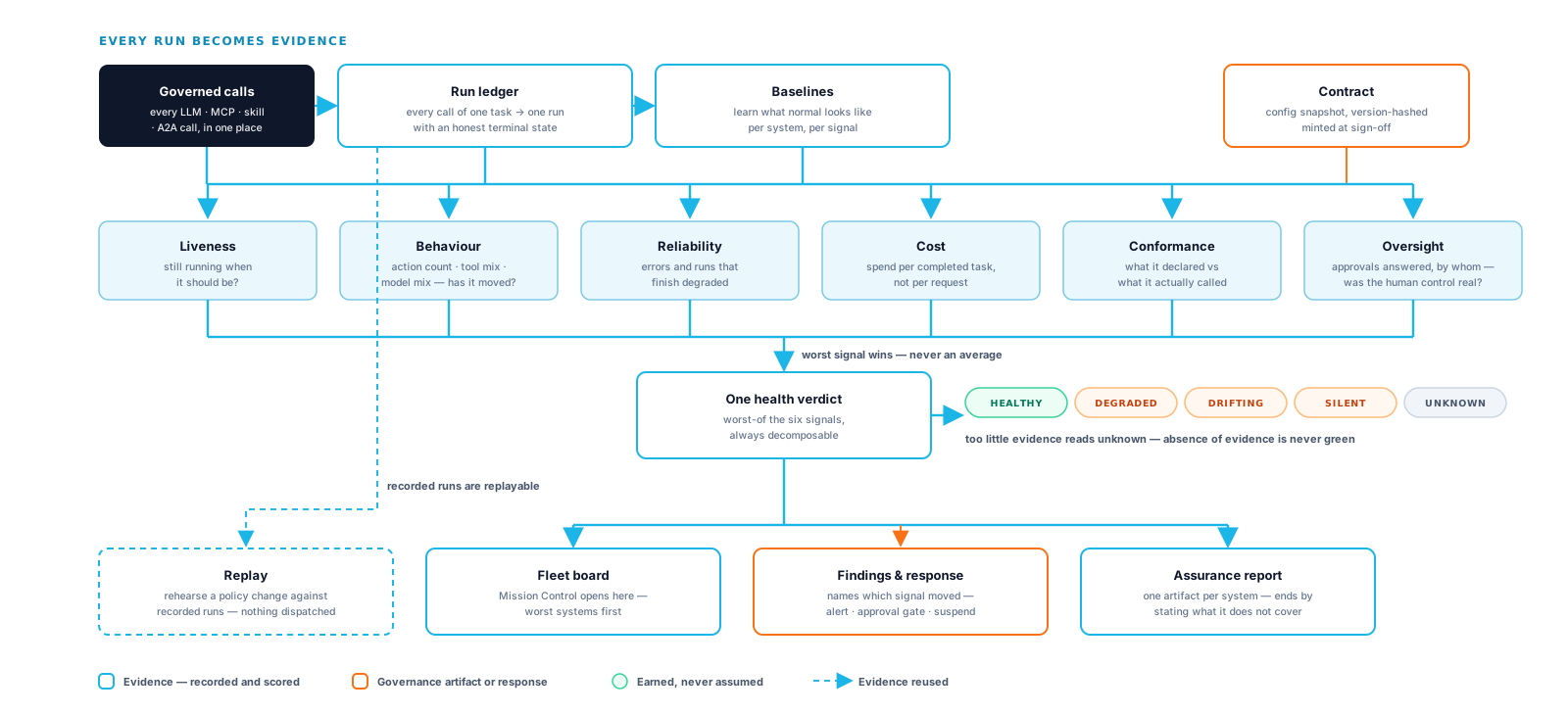
The whole discipline fits in one picture:
Read it top to bottom:
Every run becomes evidence. Governed calls — every LLM, MCP, skill and A2A
call — are grouped by task into the run ledger, each run
with an honest terminal state. Baselines learn what normal looks like per system,
and a version-hashed contract records what the system
declared at sign-off.
Seven signals score it continuously.Liveness (still
running when it should be?), behaviour (has how it works
moved?), reliability, cost per completed task,
conformance (what it
declared vs what it actually called), oversight (were approvals answered, and
by whom?) and review (were raised findings read and decided in time?).
One verdict — worst-of, never an average. A system that is cheap, fast and
dead is not 80% healthy. And unknown is a real verdict: too little evidence never
reads as green. See health.
The verdict drives three outputs. The fleet board in Mission Control;
findings and response — alerts, approval gates, or
automatic tightening of autonomy; and the
Assurance Report, which ends by stating
what it does not cover.
Recorded runs are reusable.Replay rehearses a
policy change against real recorded traffic offline — nothing dispatched upstream,
no tokens spent — before the lifecycle gate lets the
change promote.
Deploy an AI System through Brutor and the platform commits to four things. Every
assurance feature exists to make exactly one of them true.
G1 — Bounded
It operates within policy, and the policy is enforced in the request path, not
advised. What it was allowed to do is provable after the fact, via
contracts.
G2 — Non-drifting
It will not drift without you being told — and told why. Behavioural baselines,
drift detection and cause attribution:
behavioural drift.
G3 — Doing its job
You find out when it stops doing what it should. Recorded production traffic becomes
an eval set, and changes are diffed against it before promotion:
replay.
G4 — Alive
You find out when it stops working at all — including when it goes silent, the
failure every request-driven metric misses:
liveness.
Register — declare the system: owner, kind, intended use, risk tier. From this
moment every call is attributed to it; traffic matching no system lands in an
“Unattributed runs” funnel rather than being lost silently.
Contract — freeze the rules: a hash-pinned snapshot of
everything the system may do, append-only, one active per system.
Gate — prove before promoting: promotion to
active requires evidence, and a bound replay suite must pass — with the verdict
being an outcome change, so tightening never blocks a release.
Run — enforce and record: every action policy-checked in-path and written to
the run ledger with an honest terminal state.
Observe — watch it against itself: liveness fires on
the absence of traffic; drift compares behaviour against the
system’s own history and leads with the likely cause.
Respond — tighten automatically: an armed response
policy can downgrade autonomy on findings — it can only tighten, never loosen, and
restore is always human.
Report — show the evidence: six components, one worst-of
health verdict, and an immutable Assurance Report the engineer opens at 09:00 and
the auditor exports in December. The same document.
Then a change arrives — a new model, a new tool, a policy edit — a new contract is
minted, the gate asks for evidence, and the loop repeats.
The run ledgerHow actions become runs: signed chains, the run-id header, terminal states, integrity, the Trajectory Explorer.
Evidence sourcesWitnessed versus reported — the OpenTelemetry GenAI inlet for systems that do not route through the gateway, and why the two never blur.
LivenessThe only signal that fires on the absence of traffic — expectations, detectors, learned cadences.
Behavioural driftRobust statistics, sustained-change detection, cause attribution, consequence-ranked severity.
ContractsHash-pinned snapshots of what a system may do — append-only versions and widened-vs-narrowed diffs.
Autonomy & responseHow much a system may do without a human, and the closed loop that tightens it automatically.
The gate & replayEvidence-gated lifecycle transitions, and rehearsing changes against recorded traffic.
Health & the Assurance ReportOne worst-of verdict from six components, conformance, human oversight, and the immutable evidence artifact.