

Liveness
The failure every request-driven metric misses is the system that stops producing requests entirely — zero errors, because zero traffic. Liveness is the dead-man’s switch: the only signal that fires on the absence of traffic.
Set an expectation
Section titled “Set an expectation”Set an expectation per system under AI Estate → AI Systems → (a system) → Signals → Liveness:
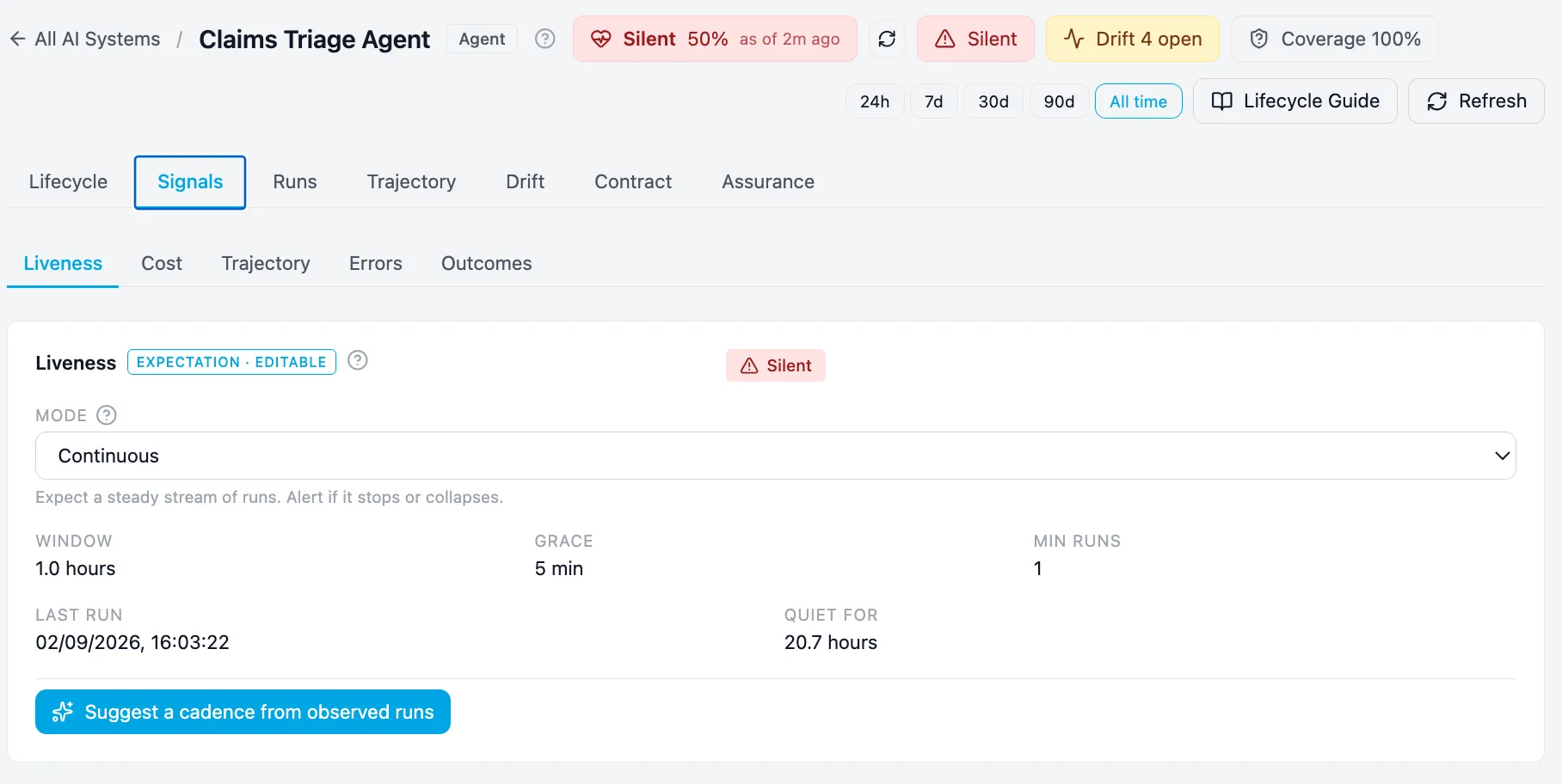
| Mode | Meaning |
|---|---|
continuous |
Should be producing runs steadily |
scheduled |
Should run within a recurring window |
sporadic |
Runs irregularly — never silence-alerted |
on_demand |
Driven by a human — never silence-alerted (the default for assistants) |
Five detectors run against it: silence, missed_schedule, volume_collapse, stall
and hard_fail_cliff. Findings arrive as ai_system_liveness alerts and surface in
usage alerts.
Learned, not guessed
Section titled “Learned, not guessed”Brutor can learn the cadence from history rather than making you guess: the window is
sized from the p95 inter-run gap, not the median, so a system with occasional long gaps is
not paged every time one occurs. If there is too little history the API returns
confident: false and refuses to accept a learned value.
Three states, kept distinct
Section titled “Three states, kept distinct”Three states are shown distinctly, and the distinction matters: silent (it used to run and has stopped), never run (it has never started), and never checked (nobody has set an expectation). Only the first is an incident.
Related
Section titled “Related”- The run ledger — the traffic record liveness is computed from
- Autonomy & response — what can fire automatically on a liveness finding
- Health — where liveness lands as one of the five components