

1 · Set the evidence key
Set BRUTOR_EVIDENCE_SIGNING_KEY on the Core Proxy. Without it nothing is sealed and
traffic is unaffected. See Signed statements & keys.
Every framework a Brutor customer is audited against asks an AI System the same three questions: what did it do, who was in the loop, and can you prove the record is honest? The EU AI Act (Arts 12, 14, 19, 26, 50), ISO/IEC 42001 (A.6.2.6, A.6.2.8, A.8), SOC 2 (CC4, CC6, CC7, CC8), HIPAA (§164.312(b), (c)), GDPR (Arts 5(2), 22, 32), DORA and NIS2 word them differently; the evidence they ask for is the same.
So the AI control plane builds one evidence substrate and treats every framework as data over it. The substrate is made of published standards, so a party outside your organisation — an auditor, a regulator, a customer — can check it with tooling Brutor does not ship.
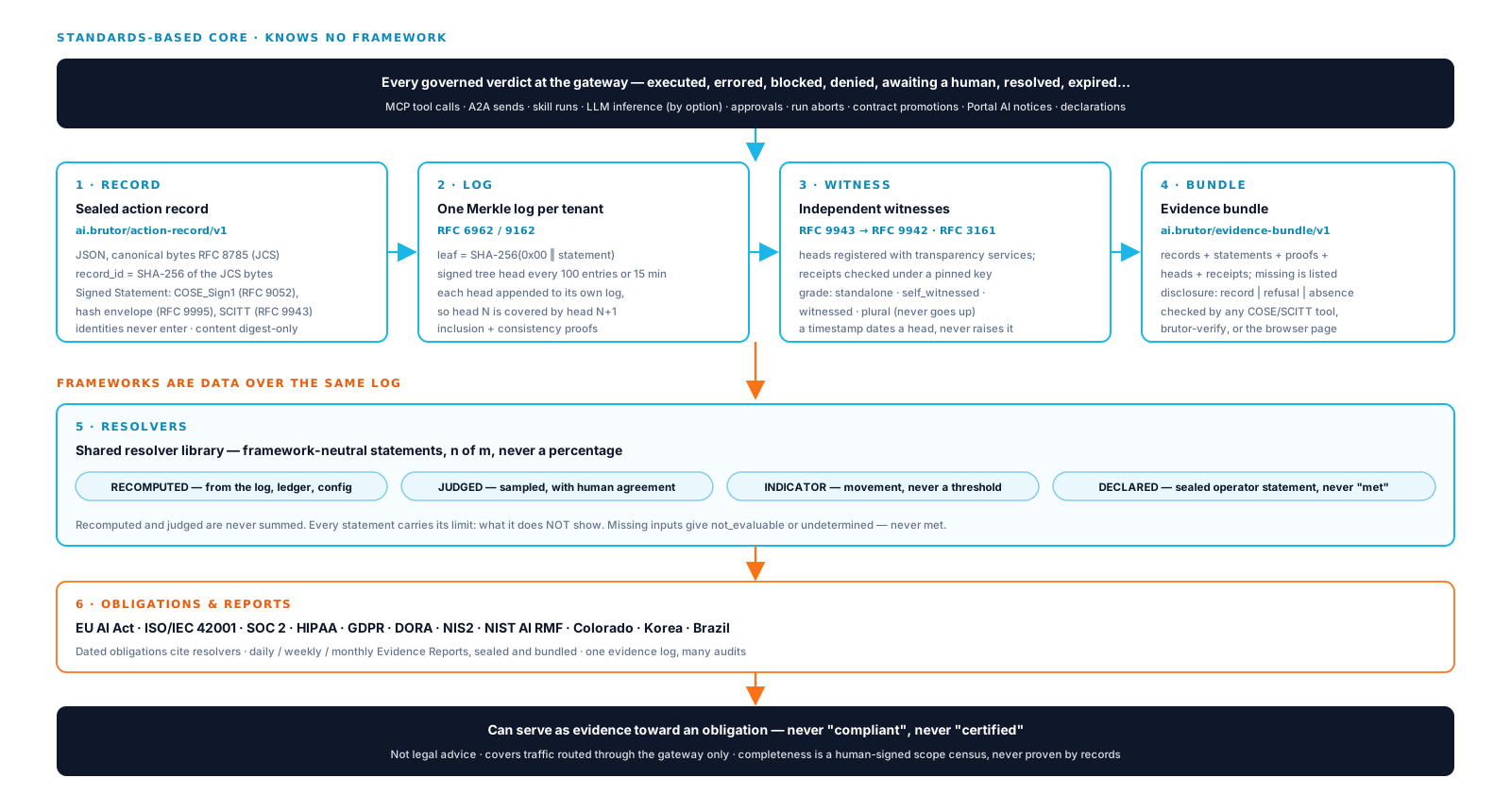
| Layer | What it is | Standard | Page |
|---|---|---|---|
| 1 · Records | Every governed verdict — refusals included — becomes an ai.brutor/action-record/v1 record, signed as a Signed Statement |
RFC 8785 (JCS), RFC 9052 (COSE_Sign1), RFC 9995 (hash envelope), RFC 9943 (SCITT) | Action records, Signed statements & keys |
| 2 · Logs | One append-only Merkle log per tenant; signed tree heads every 100 entries or 15 minutes | RFC 6962 / RFC 9162 | Tenant logs & witnesses |
| 3 · Witnesses | Tree heads registered with transparency services and timestamp authorities; receipts checked under pinned keys | RFC 9943 registration, RFC 9942 receipts, RFC 3161 | Tenant logs & witnesses |
| 4 · Bundles | Portable packages of records, inclusion proofs, heads, receipts and completeness claims; disclosure records | the above, plus ai.brutor/evidence-bundle/v1 |
Bundles, disclosure & verification |
| Obligations | A framework registry (data, not code) whose obligations cite shared resolvers; per-framework Evidence Reports | framework catalogs — EU AI Act, ISO/IEC 42001, SOC 2, HIPAA, GDPR, DORA, NIS2, NIST AI RMF, Colorado, Korea, Brazil | Framework registry, catalogs |
Layers 1–4 know nothing about any regulation. A framework is a catalog entry naming obligations and, for each, which resolvers evidence it. Adding a jurisdiction is data entry plus, at most, one new resolver.
| Tier | Component | Used for |
|---|---|---|
| Published standard | COSE_Sign1 — RFC 9052 | every signature |
| Published standard | COSE Hash Envelope — RFC 9995 | the statement payload is the digest of the record |
| Published standard | SCITT architecture — RFC 9943 | how records and tree heads are signed and registered |
| Published standard | COSE Receipts — RFC 9942 | witness receipts and inclusion-proof encoding |
| Published standard | Certificate Transparency Merkle tree — RFC 6962 / RFC 9162 | the tenant log, inclusion and consistency proofs |
| Published standard | JSON Canonicalization Scheme — RFC 8785 | canonical record bytes |
| Published standard | Time-Stamp Protocol — RFC 3161 | an independent date anchor for tree heads |
| Brutor-versioned | ai.brutor/action-record/v1, the tree-head payload, ai.brutor/evidence-bundle/v1, the framework registry |
record vocabulary and semantics, pinned by the published verifier rules and vectors |
| Optional profile | Agent Action Capsule (draft-mih-scitt-agent-action-capsule-04) |
an off-by-default export for parties that ask for that format — an individual Internet-Draft, not WG-adopted (AAC profile) |
Integrity is checkable by anyone with a COSE/SCITT library. Record semantics (the
honesty rules below) are checked by brutor-verify — the CLI and the
in-browser verifier — and the rules and finding codes are published so a
third party can reimplement them.
These are product rules, enforced in code and in the console’s copy:
met 57 of 60, with m the
population it is about. A rounded 95 % hides the three.met; an indicator is never met or not met.not_evaluable or undetermined, not met.standalone until an independently operated
witness countersigns it; a witness you run yourself makes it self_witnessed, never
witnessed; a timestamp dates a head but never raises its grade.1 · Set the evidence key
Set BRUTOR_EVIDENCE_SIGNING_KEY on the Core Proxy. Without it nothing is sealed and
traffic is unaffected. See Signed statements & keys.
2 · Add a witness
Register at least one independent RFC 9943 transparency service under
Settings → Evidence. The trial bundle’s brutor-witness is same-operator. See
witnesses.
3 · Enable frameworks
Compliance → Frameworks: enable the frameworks you are audited against. See the registry.
4 · Declare profiles
Compliance → Profiles: declare each AI System’s role, classification and facts. Every save is sealed. See the compliance profile.
Assurance answers is this system still operating as signed off? — health, drift, liveness, contracts. The compliance programme answers can we prove what it did to someone outside the organisation, against a named obligation? It reuses assurance data as inputs (daily health, contract promotions, approvals, the run ledger) and seals them. The Assurance Report keeps its behavioural role; obligation evidence lives in the Evidence Reports.