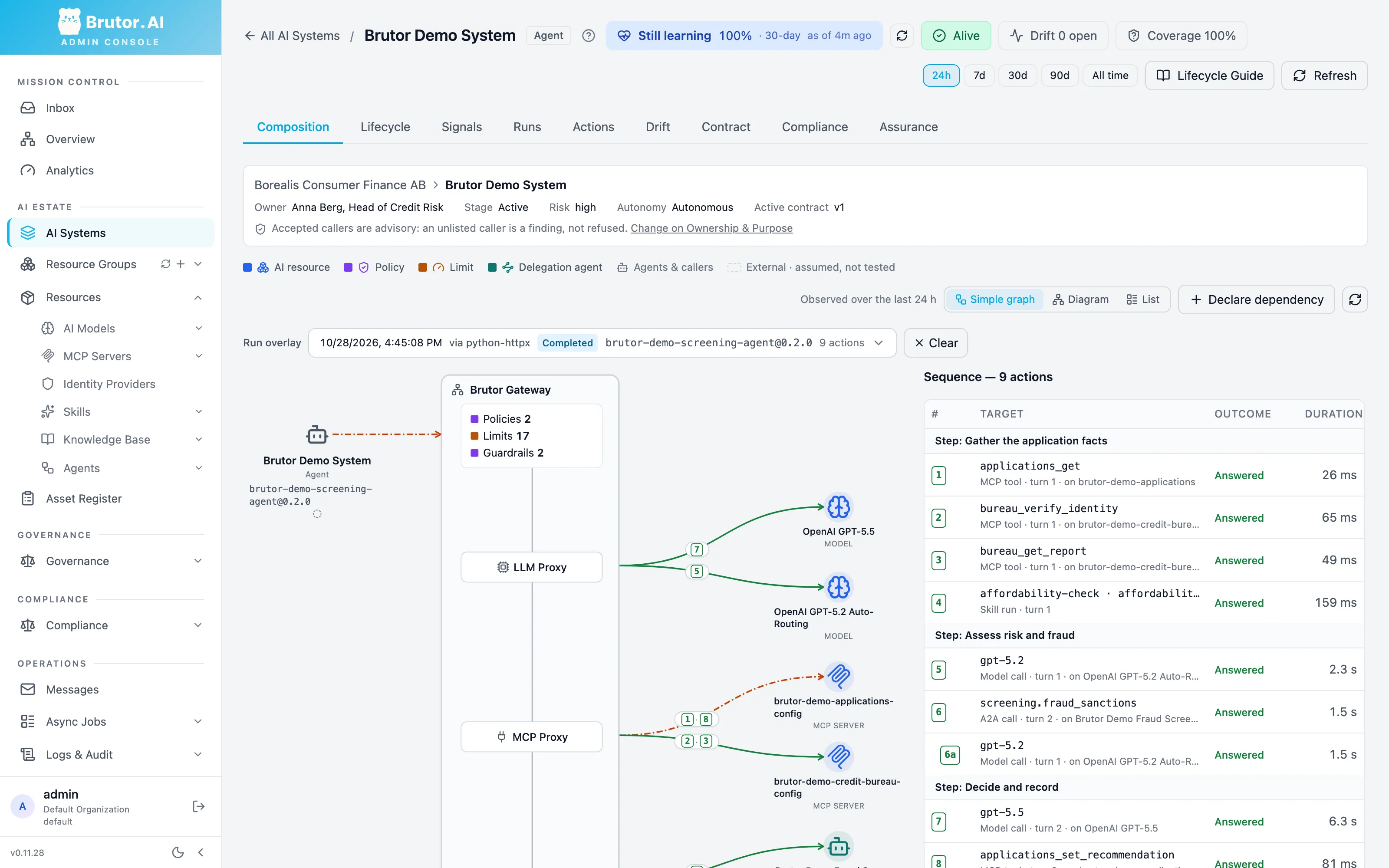
Delegate over A2A
Fraud and sanctions screening is somebody else’s job at Borealis: Financial Crime owns it, runs it and answers for it. So the screening agent does not screen for fraud. It asks the Fraud Screener, an A2A 1.0 agent that is its own AI System, and it asks through the gateway:
screening agent ──▶ /v1/proxy/a2a/outbound ──▶ brutor-demo-fraud-screener-agent:9200 (Demo System) grants · guardrails · (Fraud Screener AI System) signs the delegation chain │ its own model call, checks the delegate's outcome │ echoing the chain ◀── X-Brutor-Outcome-Id ───────────┘ X-Brutor-Outcome-ConformanceGoing through the gateway buys what a direct HTTP call cannot: the caller is authorised against a grant with a depth limit, the call is guardrailed in both directions, the delegate’s own model call joins the caller’s run at depth 1 with a cryptographically verified chain, and the delegate’s answer is checked against the delegate’s contract before the caller acts on it.
Register the agent card
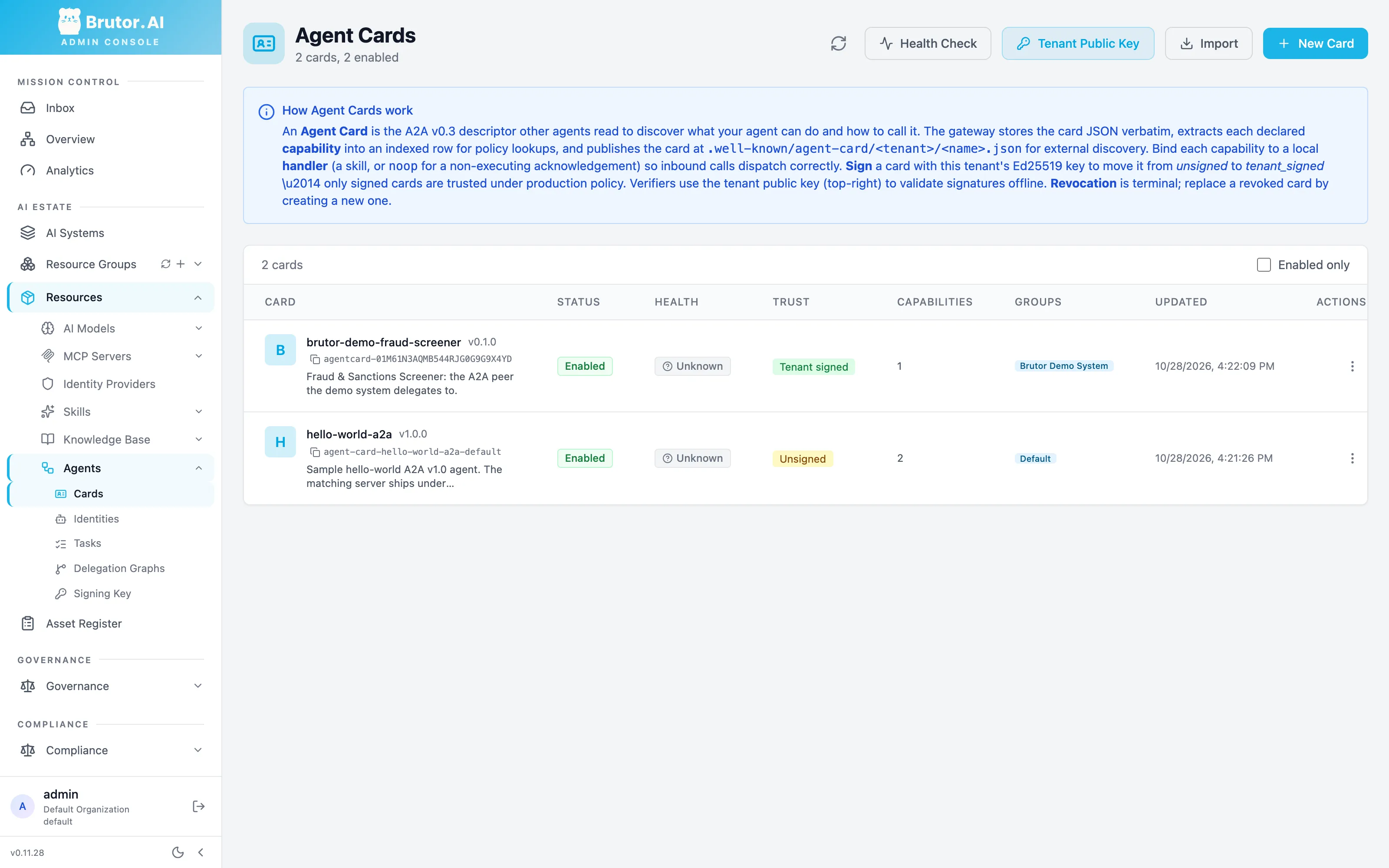
Section titled “Register the agent card”setup.py step 8. Start the fraud screener first, then register the card it publishes
itself, so the registered card can never drift from the running agent:
-
Fetch the live card from the agent:
Terminal window curl -s http://127.0.0.1:9200/.well-known/agent-card.json{"name": "Brutor Demo Fraud Screener","version": "0.1.0","protocolVersion": "1.0","url": "http://brutor-demo-fraud-screener-agent:9200","supportedInterfaces": [{"url": "http://brutor-demo-fraud-screener-agent:9200","protocolBinding": "JSONRPC", "protocolVersion": "1.0"}],"capabilities": {"streaming": false},"defaultInputModes": ["text"], "defaultOutputModes": ["text"],"data_classification": ["PII"],"skills": [{"id": "screening.fraud_sanctions", "name": "screening.fraud_sanctions","tags": ["screening", "fraud", "sanctions"],"description": "Screen an applicant for sanctions-list matches and fraud indicators. ..."}]}The card’s
versionis the screener’s release version, so the card, itsX-Brutor-Agent-Versionheader and its identity’sapproved_versionsall name the same release. -
Register it.
Terminal window curl -X POST http://localhost:5050/v1/admin/agent-cards \-H "Authorization: Bearer $ADMIN_TOKEN" -H "Content-Type: application/json" \-d "$(jq -n --argjson card "$(curl -s http://127.0.0.1:9200/.well-known/agent-card.json)" '{name: "brutor-demo-fraud-screener", version: $card.version,description: "Fraud & Sanctions Screener: the A2A peer the demo system delegates to.",card_json: $card, enabled: true}')"{"card": {"id": "agentcard-01M61N3AQMB544RJG0G9G9X4YD","name": "brutor-demo-fraud-screener", "version": "0.1.0", "enabled": true}}The
idisFRAUD_CARD_IDin the agent’s environment. -
Sign it with the tenant’s Ed25519 key, so callers can verify the card they resolve:
Terminal window C=agentcard-01M61N3AQMB544RJG0G9G9X4YDcurl -X POST http://localhost:5050/v1/admin/agent-cards/$C/sign \-H "Authorization: Bearer $ADMIN_TOKEN" -H "Content-Type: application/json" -d '{}'Replacing
card_jsonlater (a new release) drops the signature; sign again. -
Bind it to the calling AI System. This is a PUT that replaces the system’s full set of agent cards:
Terminal window curl -X PUT http://localhost:5050/v1/admin/resource-groups/$G/agent-cards \-H "Authorization: Bearer $ADMIN_TOKEN" -H "Content-Type: application/json" \-d '{"agent_card_ids": ["agentcard-01M61N3AQMB544RJG0G9G9X4YD"]}'
Admin UI: AI Estate → Resources → Agents → Cards.
Grant it, with a depth limit
Section titled “Grant it, with a depth limit”curl -X POST http://localhost:5050/v1/admin/agent-identities/$A/grants \ -H "Authorization: Bearer $ADMIN_TOKEN" -H "Content-Type: application/json" \ -d '{"action_type": "a2a_call", "target": "agentcard-01M61N3AQMB544RJG0G9G9X4YD", "effect": "allow", "constraints": {"max_delegation_depth": 2}}'max_delegation_depth bounds how deep a chain that starts with this agent may go. The
AI System carries the same bound (a2a_global_limits.chain.max_delegation_depth: 2), the
operating envelope a third (max_delegation_depth_per_run), and a continuous check raises
a critical finding if a run ever goes deeper.
Declare the dependency
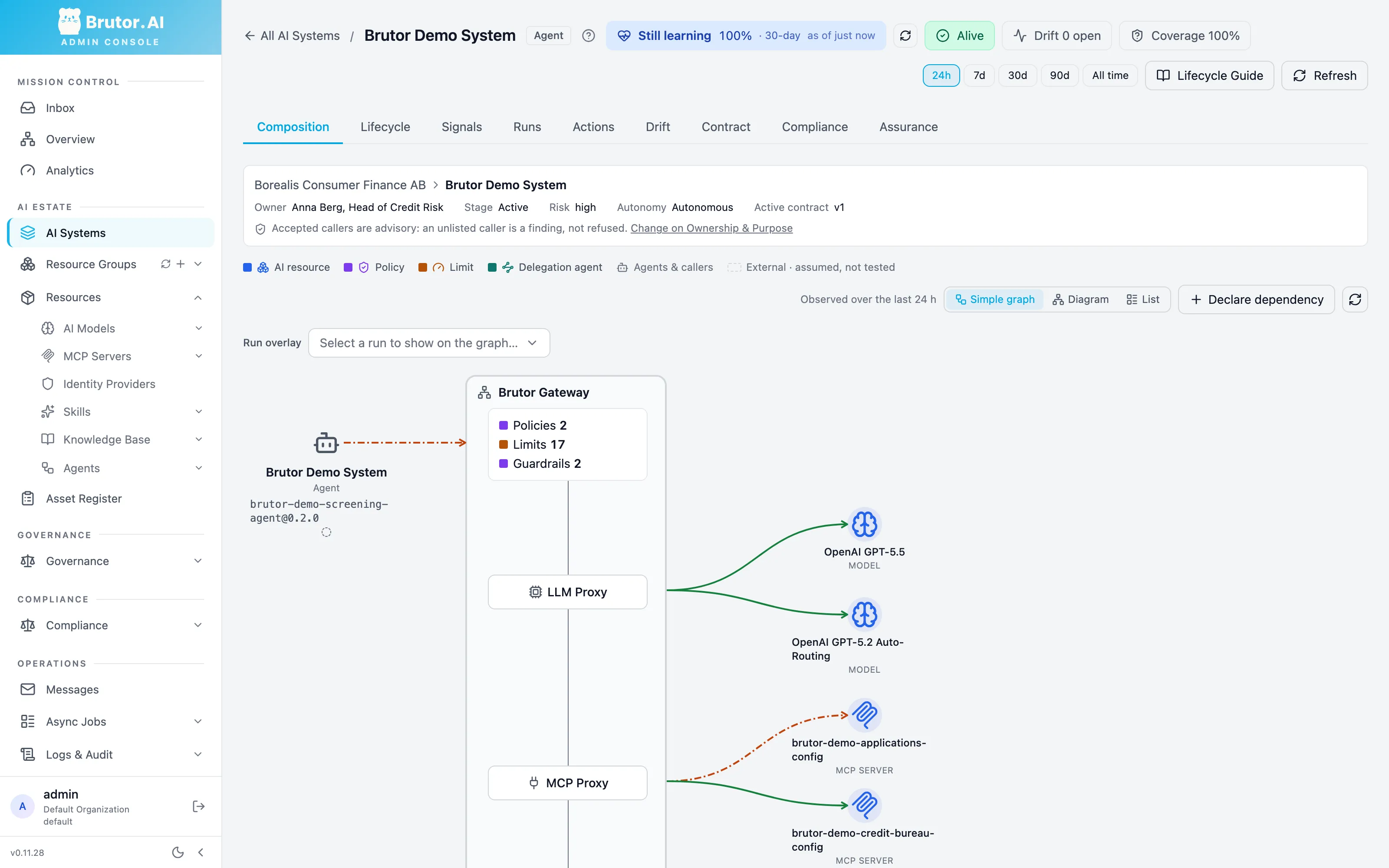
Section titled “Declare the dependency”The Demo System cannot decide a loan without the screener’s verdict, and that verdict can force a decline. That makes the screener part of the high-risk system, whatever its own risk tier says. Declare it, so the platform renders the composite system, carries the screener’s contract into the caller’s, and evaluates the screener’s obligations at the caller’s tier:
curl -X POST http://localhost:5050/v1/admin/ai-systems/$G/dependencies \ -H "Authorization: Bearer $ADMIN_TOKEN" -H "Content-Type: application/json" \ -d '{ "role": "shared_service", "depends_on_system_id": "group-01M61N37B05BXZ6H95P9NSAXXB", "agent_card_id": "agentcard-01M61N3AQMB544RJG0G9G9X4YD", "criticality": "critical", "contributes_to_decision": true, "contract_pin": null, "supplier_legal_entity": null, "expected_outcomes": ["screening_completed.clear", "screening_completed.hit", "screening_completed.review"] }'| Field | Value | Meaning |
|---|---|---|
role |
shared_service |
The screener is its own AI System, serving this one |
criticality |
critical |
The caller cannot do its job without it |
contributes_to_decision |
true |
Its output drives the decision, so it inherits the caller’s effective risk tier (high) |
contract_pin |
null |
Follow the screener’s active contract rather than one pinned version |
supplier_legal_entity |
null |
Same legal entity, so no Art 25(4) supplier agreement is needed |
expected_outcomes |
the three verdicts | Any other answer is an unexpected_delegate_outcome finding on the caller |
The expected outcomes come from the screening agent’s own outcomes.json
(dependencies[].expected_outcomes), the same file the agent validates against at runtime.
The screener’s side accepts the caller through intended_client_systems on its AI System.
The declared dependencies are rendered on the system’s Composition tab, carried into
its contract, and listed in the Assurance Report’s composition
section (Health & the Assurance Report).
Delegate
Section titled “Delegate”def a2a_delegate(self, card_id, capability, payload, *, expected_outcomes=None, step_id=None, step_name=None, turn=None, node=None) -> DelegateAnswer: hdr = self.headers(step_id, step_name, turn=turn) # run, step, turn, release hdr["Content-Type"] = "application/json" body = { "target_card_id": card_id, "capability": capability, # screening.fraud_sanctions "message": { "messageId": str(uuid.uuid4()), "role": "user", "parts": [{"kind": "text", "text": json.dumps(payload)}], }, } response = self.http.post(f"{self.base}/v1/proxy/a2a/outbound", json=body, headers=hdr) out = self._parse_body(response) self._raise_for_status(response, out) task = out.get("task") or out.get("result") or {} state = str((task.get("status") or {}).get("state", "")).upper() if any(s in state for s in ("FAILED", "REJECTED", "CANCELED", "CANCELLED")): raise DelegateFailed(f"a2a task ended {state}", body=out) outcome_id, conformance = self._delegate_outcome(response, task, out) if conformance != "declared": raise DelegateDeviated(f"the delegate's outcome {outcome_id!r} is {conformance}") if expected_outcomes is not None and outcome_id not in expected_outcomes: raise DelegateDeviated(f"the delegate answered {outcome_id!r}") ...The request, as it reaches the gateway:
{ "target_card_id": "agentcard-01M61N3AQMB544RJG0G9G9X4YD", "capability": "screening.fraud_sanctions", "message": { "messageId": "6f1c0d2e-4f43-4e0b-9c9a-0d6a8c1f7b21", "role": "user", "parts": [{"kind": "text", "text": "{\"applicant_id\": \"CUST-1001\", \"full_name\": \"Maja Lindholm\", \"date_of_birth\": \"1987-04-12\", \"country\": \"SE\", \"purpose\": \"Kitchen renovation\", \"amount_eur\": 12000, \"bureau\": {\"inquiries_6m\": 1, \"delinquencies_24m\": 0, \"open_credit_lines\": 2}}"}] }}The response is the delegate’s final Task, plus two headers the gateway adds:
HTTP/1.1 200 OKX-Brutor-Outcome-Id: screening_completed.clearX-Brutor-Outcome-Conformance: declared{"task": {"id": "b9a3...", "contextId": "1d07...", "status": {"state": "TASK_STATE_COMPLETED", "message": {"role": "ROLE_AGENT", "parts": [{"kind": "text", "text": "{\"verdict\": \"clear\", \"sanctions_match\": false, \"reasons\": [\"no sanctions match\", \"no velocity flags\"], \"model_used\": \"gpt-5.2\"}"}]}}, "metadata": {"brutor.outcome.id": "screening_completed.clear"}}}Branch on the checked outcome, not the body
Section titled “Branch on the checked outcome, not the body”The delegate reports its outcome; the gateway decides whether that outcome is one the
delegate’s contract declares, and says so in X-Brutor-Outcome-Conformance:
| Conformance | Meaning | The screening agent |
|---|---|---|
declared |
The outcome is in the delegate’s active contract | Accepts it, if it is also one of its expected_outcomes |
undeclared |
The delegate reported an outcome its contract does not declare | DelegateDeviated: the run errors |
unreported |
The delegate reported nothing | DelegateDeviated: the run errors |
The checked pair arrives on two carriers, the response headers (synchronous calls) and the
final Task’s metadata (streamed or asynchronous tasks); when both are present they must
agree. The graph then branches on the variant of the checked outcome, never on the
verdict field of the body:
answer = gw.a2a_delegate(settings.fraud_card_id, settings.fraud_capability, payload, expected_outcomes=fraud_expected, **hdr("fraud_screen"))head, _, v = answer.outcome_id.partition(".") # screening_completed . clearif head != "screening_completed" or v not in ("clear", "review", "hit"): raise DelegateDeviated(f"fraud screener outcome {answer.outcome_id!r} names no verdict")verdict = dict(answer.verdict)if str(verdict.get("verdict", "")).lower() != v: log.warning("the body says %r, the checked outcome says %r; the outcome wins", ...)verdict["verdict"] = vThat is the point of declared outcomes across a delegation: the body is the delegate’s word, the outcome is a fact the gateway checked against what Financial Crime approved. A delegate that starts answering something nobody approved fails the caller’s run, like an unreachable delegate does, instead of silently changing lending decisions.
What the delegate has to do
Section titled “What the delegate has to do”The screener’s code is given, but these four rules are what make the delegation show up as one run, and they apply to any agent you put behind A2A:
- Echo the chain. The gateway signs the delegation into
x-brutor-delegation-root,-parent,-depth,-sig(and-actor,-subjectfor an agent caller). On its own model call the delegate copies everyx-brutor-delegation-*header unchanged. The HMAC would not verify if a value were rewritten. - Send no run id. The signed chain places the delegate’s call in the caller’s run at
depth 1 with
trace_continuity=verified. An assertedx-brutor-run-idwould at best be ignored. - Declare a turn, not a step.
X-Brutor-Turn-IdandX-Brutor-Turn-Seq: 1are fine. Steps are the orchestrator’s phases; a delegate cannot know which phase it serves, and a delegate step would inflate the caller’s step count. - Use its own key, and report its outcome. The delegate authenticates as itself, so its
model call is attributed to the Fraud Screener AI System (which then appears in the
caller run’s
via_system_ids), and it returnsX-Brutor-Outcome-Idandmetadata["brutor.outcome.id"]on every completed task.
A completed screening run therefore reads 3 steps, 3 turns and 9 actions: eight from the screening agent and one, the screener’s model call, at depth 1. The chain must be fresh (about 11 minutes) and the gateway’s outbound timeout is 30 s, so the delegate answers promptly. The full protocol is in A2A agents.