

Contract, gate and go-live
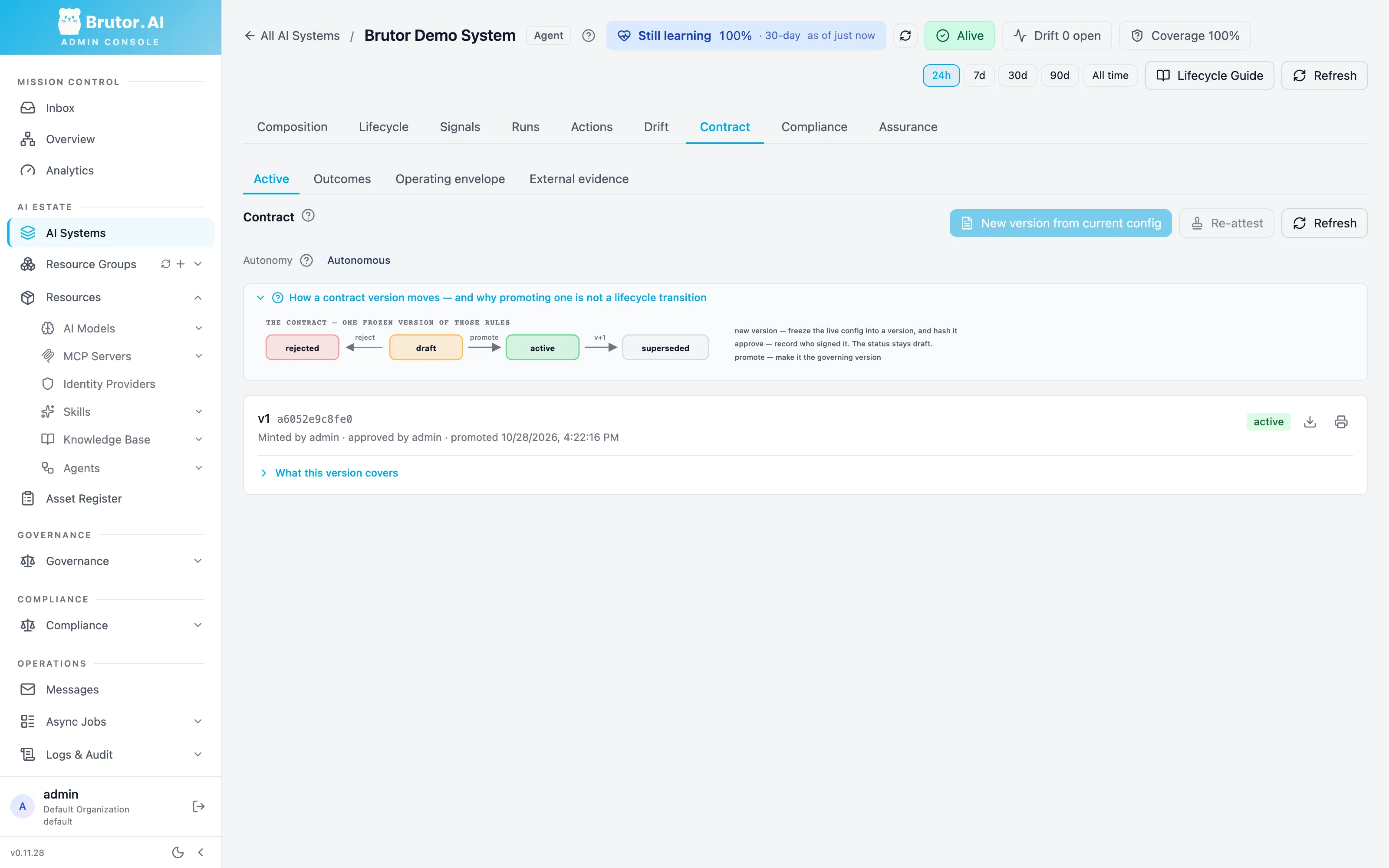
Everything on the previous pages is live configuration, and configuration changes. The contract is a snapshot of it at the moment someone accountable approved it, generated from the live configuration (never written by hand) and pinned by a SHA-256 hash. From then on, every run is executed under a contract version, and anything that differs from the approved one is drift. Concepts: Contracts.
The Demo System’s contract closure covers what this section configured: the models, MCP servers and tools, the skill, the agent card and its dependency (with the fraud screener’s active contract hash), the agent identity and its approved release, the resolved limits, guardrails and policies, the operating envelope and the declared outcomes. The underwriter group is not in it.
Put the compliance evidence on file
Section titled “Put the compliance evidence on file”A high-risk system cannot even be approved without evidence that people produced outside the
platform. setup.py step 13 enables the frameworks, writes the EU AI Act profile, and
records four documents from brutor-demo-setup/docs/ as external evidence, each with its
SHA-256:
| Evidence kind | Document | Article |
|---|---|---|
impact_assessment |
fria.md: fundamental rights impact assessment |
Art 27 |
risk_assessment |
risk-assessment.md: the risk management file |
Art 9 |
data_governance |
data-governance.md |
Art 10 |
eval_report |
evaluation-report.md: accuracy, robustness, oversight rate |
Art 15 |
It also configures the Art 50 transparency notice (“You are interacting with an AI system operated by Borealis Consumer Finance AB…”), which the drafter’s letter must carry; the agent appends the disclosure sentence if the model leaves it out. What each of these is and how the obligations are checked is in the Compliance section; the evidence lives on the system’s Contract → External evidence sub-tab.
Mint, approve and promote the contract
Section titled “Mint, approve and promote the contract”-
Mint a version from the current configuration. It is a no-op that returns the existing version when nothing changed, so it is safe to call on every provisioning run:
Terminal window curl -X POST http://localhost:5050/v1/admin/ai-systems/$G/contracts \-H "Authorization: Bearer $ADMIN_TOKEN" -H "Content-Type: application/json" -d '{}'{"created": true,"contract": {"id": "ctr-01M61N3H5N84380NC6ZZJ6WP6N","ai_system_id": "group-01M61N376V2RR6J2TV7Q7EVRET","version": 1,"status": "draft","contract_hash": "sha256:a6052e9c8fe0be17704f2dc9d5d100e953d771f2171999e11d52eab2683044e5","short_hash": "a6052e9c8fe0","diff_from_version": null}} -
Approve it. The approver is the admin making the call; a second approval of an unchanged version must be a second person.
Terminal window curl -X POST http://localhost:5050/v1/admin/contracts/ctr-01M61N3H5N84380NC6ZZJ6WP6N/approve \-H "Authorization: Bearer $ADMIN_TOKEN" -H "Content-Type: application/json" \-d '{"note": "Approved by Anna Berg, Head of Credit Risk"}' -
Promote it to the active version, the one runs are judged against:
Terminal window curl -X POST http://localhost:5050/v1/admin/contracts/ctr-01M61N3H5N84380NC6ZZJ6WP6N/promote \-H "Authorization: Bearer $ADMIN_TOKEN" -H "Content-Type: application/json" -d '{}'
Admin UI: AI Estate → AI Systems → Brutor Demo System → Contract: the active version, its diff, the outcomes, the operating envelope and the external evidence.
Pass the gate
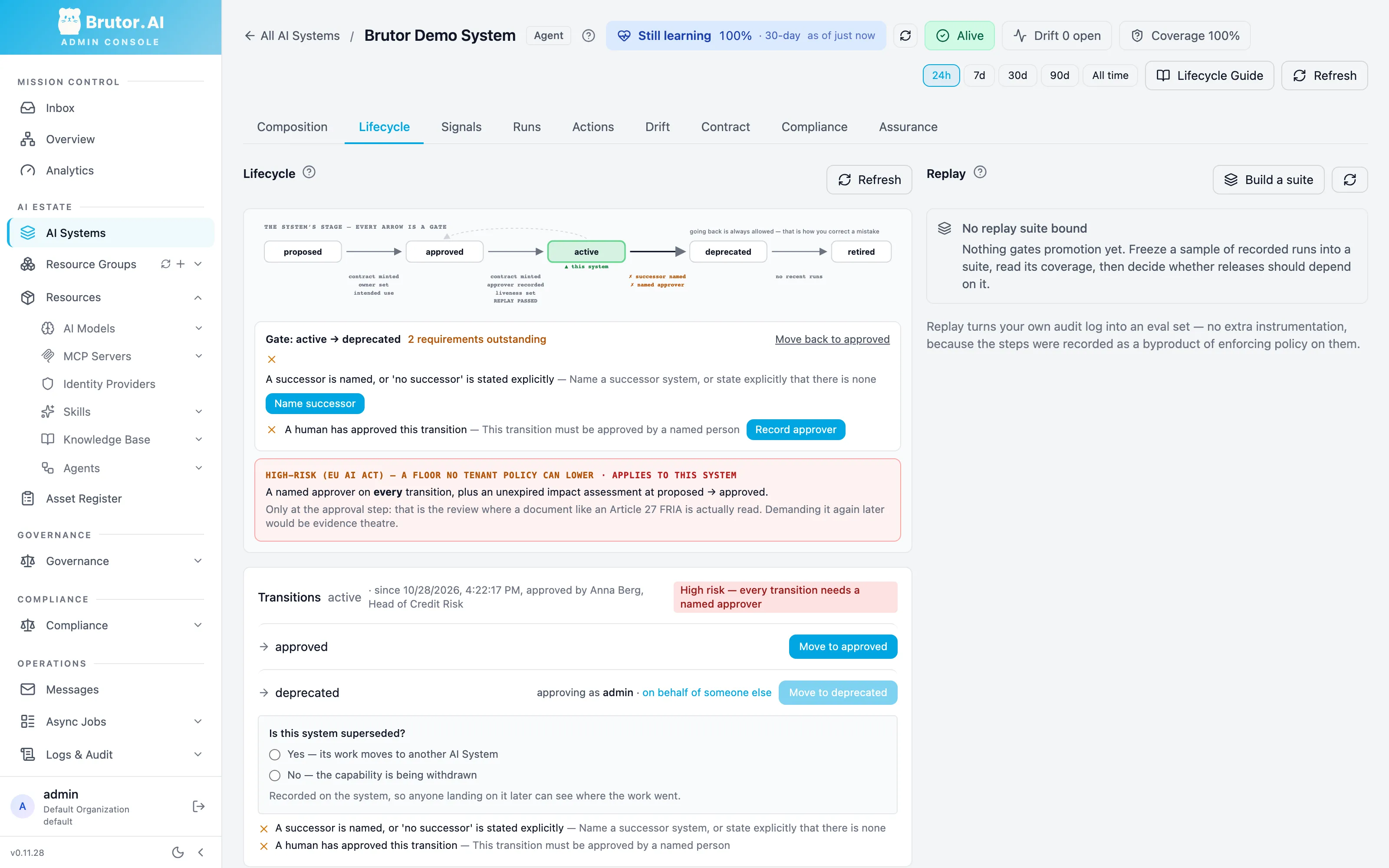
Section titled “Pass the gate”An AI System moves proposed → approved → active → deprecated → retired, and each forward
transition demands evidence. Ask the gate what it needs:
curl http://localhost:5050/v1/admin/ai-systems/$G/lifecycle \ -H "Authorization: Bearer $ADMIN_TOKEN"{ "ai_system_id": "group-01M61N376V2RR6J2TV7Q7EVRET", "current_stage": "approved", "eu_ai_act_risk_tier": "high", "autonomy_level": "autonomous", "transitions": [ {"to_stage": "active", "allowed": true, "requirements": [...], "unmet": []}, {"to_stage": "deprecated", "allowed": false, "unmet": [{"key": "successor_named", "label": "A successor is named, or 'no successor' is stated explicitly", "satisfied": false, "detail": "Name a successor system, or state explicitly that there is none"}, {"key": "human_approval", "label": "A human has approved this transition", "satisfied": false, "detail": "This transition must be approved by a named person"}]} ]}| Transition | Requires |
|---|---|
proposed → approved |
A contract minted for the current config; an owner; an intended use; for a high-risk system, an unexpired impact assessment attached as evidence |
approved → active |
The contract still current; an approver recorded on it; a liveness decision; the bound replay suite passed (satisfied, and said to be, while none is bound) |
active → active (re-attest) |
No unapproved widening since the last approved contract |
active → deprecated |
A successor named, or “no successor” stated |
deprecated → retired |
No runs for the quiet period (30 days) |
The high risk tier adds human_approval to every transition. Transition, naming the
human who signed off:
curl -X POST http://localhost:5050/v1/admin/ai-systems/$G/lifecycle \ -H "Authorization: Bearer $ADMIN_TOKEN" -H "Content-Type: application/json" \ -d '{"to_stage": "approved", "approved_by": "Anna Berg, Head of Credit Risk"}'# then {"to_stage": "active", ...}A refused transition answers 409 with detail.decision.unmet, the same list as above;
setup.py prints it and stops. Every transition records who approved it and, separately,
who recorded it (always the authenticated session). On an AI System, lifecycle_stage cannot
be changed through the plain group PATCH; there is no ungated path. Admin UI: the
Lifecycle tab, the default tab of the system, shows the stage diagram, the open gate
with each requirement satisfied or missing, and the history.
Then start the agent
Section titled “Then start the agent”docker compose up -d screening-agent # what ./demo.sh up does lastThe first tick runs at start. From here the agent is what the platform judges against the
contract: a new release of the agent (a version bump in pyproject.toml) raises
agent.new_release and, until it is approved, agent.unapproved_release; a change to any
binding makes Contract show drifted and enables New version from current config;
and the version history keeps exactly what each approver approved.
Changing it later
Section titled “Changing it later”A deliberate change (a new tool, a tighter cap, a new release) is a new contract version. The diff the approver sees separates widened from narrowed: adding a tool needs scrutiny, tightening a budget does not. Before promoting a widening, replay re-evaluates the authorisation decisions of a sample of real recorded runs under the candidate configuration, without dispatching anything, and reports any call that would now be denied or held.
Next: watch it run.