

Register and run a skill
Step 4 of every run, affordability, applies Borealis’s affordability policy: an annuity
installment, debt-to-income ratios, disposable income, and one of comfortable, tight or
unaffordable. It is arithmetic, not judgement, so it must not be a model call. It is also
a company policy with an owner and a version, so it should not be a function buried in the
agent either. It is an Agent Skill: a versioned package (SKILL.md, a script and a
reference document) published to the gateway and run in its sandbox.
brutor-demo-affordability-skill/├── SKILL.md name, description, inputs, outputs, workflow├── scripts/affordability.py the policy, stdlib only└── references/policy.md the thresholds, for an underwriterThe skill itself is given. This page publishes it and calls it. For everything about writing skills, see Agent Skills.
Publish the skill
Section titled “Publish the skill”setup.py step 7. Create the skill from its SKILL.md, attach the script and the
reference, validate, publish:
-
Create.
Terminal window curl -X POST http://localhost:5050/v1/admin/agent-skills \-H "Authorization: Bearer $ADMIN_TOKEN" -H "Content-Type: application/json" \-d "$(jq -n --rawfile md SKILL.md '{name: "affordability-check",description: "Deterministic affordability assessment for a consumer loan application (annuity installment, DTI, disposable income; comfortable / tight / unaffordable).",skill_md_content: $md,version: "1.0.0"}')"{"skill": {"id": "skill-01M61N3A7RB6CWZ8CM8PCEP4SN", "name": "affordability-check","version": "1.0.0", "status": "draft", "disclosure_mode": "progressive"}} -
Attach the script.
execution_mode: "sandbox"runs it in the skill runner, isolated from the gateway and the agent.Terminal window SK=skill-01M61N3A7RB6CWZ8CM8PCEP4SNcurl -X POST http://localhost:5050/v1/admin/agent-skills/$SK/scripts \-H "Authorization: Bearer $ADMIN_TOKEN" -H "Content-Type: application/json" \-d "$(jq -n --rawfile src scripts/affordability.py '{filename: "affordability.py", language: "python", execution_mode: "sandbox",description: "Borealis affordability policy (stdlib only).", script_content: $src}')" -
Attach the reference.
Terminal window curl -X POST http://localhost:5050/v1/admin/agent-skills/$SK/resources \-H "Authorization: Bearer $ADMIN_TOKEN" -H "Content-Type: application/json" \-d "$(jq -n --rawfile md references/policy.md '{filename: "policy.md", resource_type: "reference",content: $md, mime_type: "text/markdown"}')" -
Validate, then publish. Validation returns
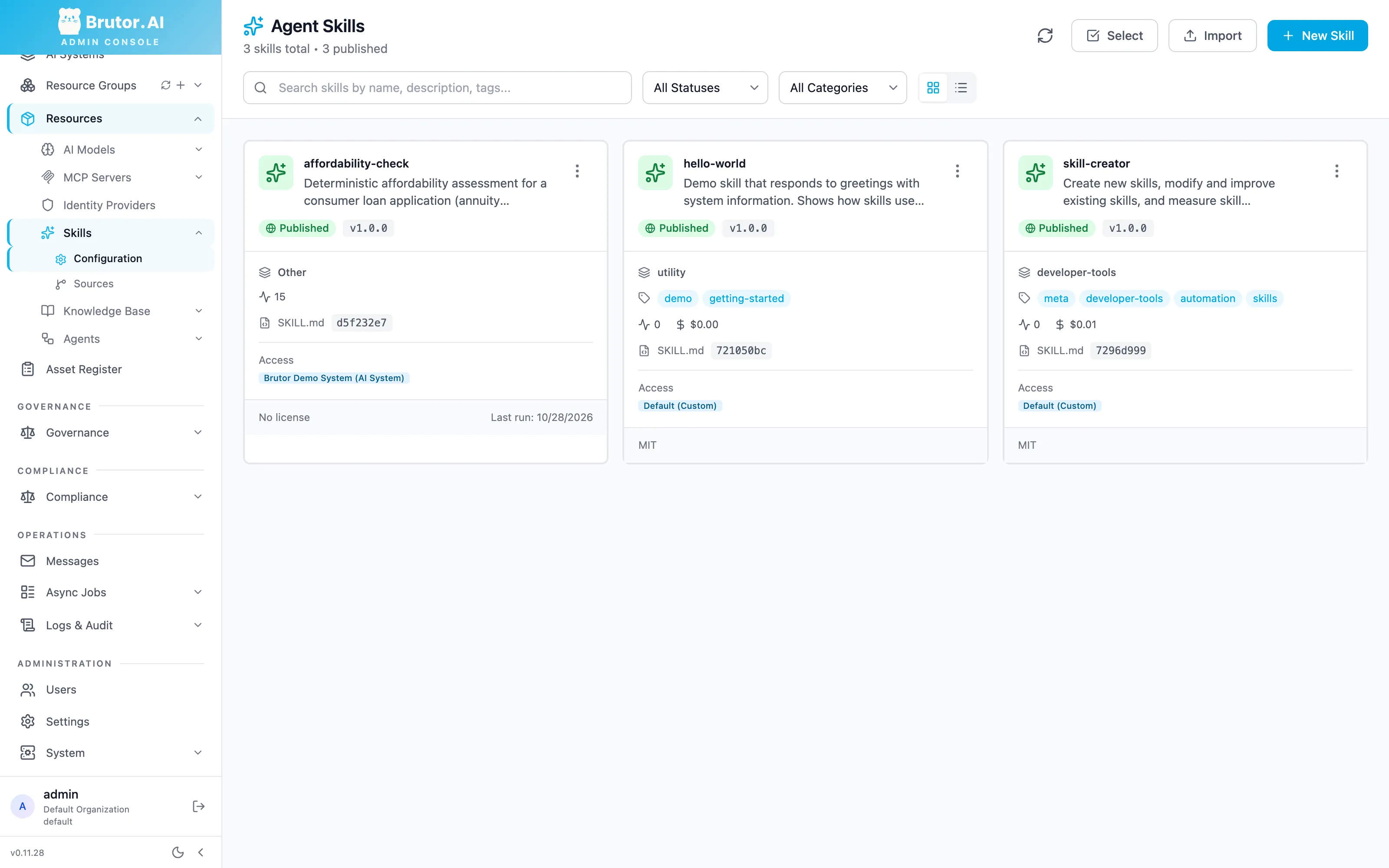
errorswhen the package is not publishable; only a published skill can run.Terminal window curl -X POST http://localhost:5050/v1/admin/agent-skills/$SK/validate \-H "Authorization: Bearer $ADMIN_TOKEN" -H "Content-Type: application/json" -d '{}'curl -X POST http://localhost:5050/v1/admin/agent-skills/$SK/publish \-H "Authorization: Bearer $ADMIN_TOKEN" -H "Content-Type: application/json" -d '{}'{"skill": {"id": "skill-01M61N3A7RB6CWZ8CM8PCEP4SN", "status": "published","published_at": "2026-10-28T16:22:09.671487+00:00","skill_md_hash": "d5f232e70787452441247d374c5f551bfcaff57c425e90b06b900de7ae0d974c"}}
Admin UI: AI Estate → Resources → Skills → Configuration.
Give the AI System access
Section titled “Give the AI System access”Skills have no access list of their own. Access is a resource-group binding, like every other resource, so the AI System’s inheritance, limits and audit apply to it:
curl -X POST http://localhost:5050/v1/admin/agent-skills/$SK/groups \ -H "Authorization: Bearer $ADMIN_TOKEN" -H "Content-Type: application/json" \ -d '{"group_ids": ["group-01M61N376V2RR6J2TV7Q7EVRET"]}'Skills are reached through the tenant’s skills MCP server,
system-agent-skill-server-default (the tenant id is the suffix). Bind its server config
to the AI System, exactly like the MCP servers on the previous page:
curl -X POST http://localhost:5050/v1/admin/resource-groups/$G/server-configs \ -H "Authorization: Bearer $ADMIN_TOKEN" -H "Content-Type: application/json" \ -d '{"server_config_id": "system-agent-skill-server-config-default"}'Grant it to the agent identity, twice
Section titled “Grant it to the agent identity, twice”The demo grants the skill at two layers: the skills server’s tools, and the skill itself.
A=agent-01M61N3B1GHVSCARE5CJZ5KEZ3
# 1. the skills server's tools (declared; see the note below)for tool in skills__list skills__load skills__run_script; do  curl -s -X POST http://localhost:5050/v1/admin/agent-identities/$A/grants \    -H "Authorization: Bearer $ADMIN_TOKEN" -H "Content-Type: application/json" \    -d '{"action_type": "mcp_tool", "target": "'$tool'", "effect": "allow"}'done
# 2. the skill orchestrator: this skill, by idcurl -X POST http://localhost:5050/v1/admin/agent-identities/$A/grants \ -H "Authorization: Bearer $ADMIN_TOKEN" -H "Content-Type: application/json" \ -d '{"action_type": "skill_exec", "target": "skill-01M61N3A7RB6CWZ8CM8PCEP4SN", "effect": "allow"}'A skill_exec grant can also be approval_required, which parks the run for a human the
same way a tool call is parked: Human oversight.
Run the script
Section titled “Run the script”Skills use progressive disclosure: a model-driven agent calls skills__list to see what is
available, skills__load to read a skill’s instructions, then skills__run_script. The
screening agent’s graph already knows which skill it needs and what the inputs are (they
are in SKILL.md), so it goes straight to the run:
def skill_run(self, skill_name: str, script: str, args: dict, **hdr) -> Any: """Run one skill script on the skills MCP server (tool skills__run_script).""" return self.mcp_call( self.settings.skills_mcp_server_id, # system-agent-skill-server-default "skills__run_script", {"skill_name": skill_name, "script": script, "args": args}, **hdr, )def affordability(state: ScreeningState) -> ScreeningState: app = state["application"] args = { "monthly_income_eur": _number(app.get("monthly_income_eur"), "monthly_income_eur"), "monthly_expenses_eur": _number(app.get("monthly_expenses_eur"), "monthly_expenses_eur"), "existing_debt_monthly_eur": _number(app.get("existing_debt_monthly_eur", 0), "existing_debt_monthly_eur"), "requested_amount_eur": _number(app.get("requested_amount_eur"), "requested_amount_eur"), "term_months": int(_number(app.get("term_months"), "term_months")), } result = _require_dict( gw.skill_run("affordability-check", "affordability.py", args, **hdr("affordability")), "affordability skill") cls = str(result.get("affordability_class", "")).lower() if cls not in AFFORDABILITY_CLASSES: # comfortable | tight | unaffordable raise ToolError(f"affordability skill returned unknown class {cls!r}") result["affordability_class"] = cls return {"affordability": result}The request is an ordinary MCP tools/call, with the same run, step and turn headers as
the tool calls around it:
{"jsonrpc": "2.0", "id": 4, "method": "tools/call", "params": {"name": "skills__run_script", "arguments": {"skill_name": "affordability-check", "script": "affordability.py", "args": {"monthly_income_eur": 4200, "monthly_expenses_eur": 1650, "existing_debt_monthly_eur": 310, "requested_amount_eur": 12000, "term_months": 48}}, "_meta": {"io.modelcontextprotocol/clientInfo": {"name": "brutor-demo-screening-agent", "version": "0.2.0"}}}}The runner hands args to the script as {"input_params": {...}} on stdin; the script’s
stdout comes back as the tool result’s text:
{"jsonrpc": "2.0", "id": 4, "result": {"content": [{"type": "text", "text": "{\"affordability_class\": \"comfortable\", \"disposable_after_eur\": 1938.52, \"dti_after\": 0.1456, \"dti_before\": 0.0738, \"flags\": [], \"inputs\": {\"annual_rate_pct\": 9.5, ...}, \"monthly_installment_eur\": 301.48, \"policy_version\": \"2026.09\"}"}], "isError": false}}The script never fails open: on invalid inputs it still exits 0 and returns
{"error": "<reason>"}, which has no affordability_class, so the node raises and the run
errors. “Could not assess” is never read as “affordable”. An unaffordable result is then
a hard decline in rules.py, whatever either model says afterwards.
Refusals arrive as tool errors whose text names the cause, for example
skill_error_403: agent_not_authorized (missing skill_exec grant),
skill_error_403 (also when the AI System’s skill-execution quota is spent, with the refusal recorded as skill_quota_exceeded), or
skill_error_202: approval_required (the run was parked; if autonomy has been demoted, a
skill run can be held too). Failures shows how the agent tells
these apart.
What the gateway does on a skill run
Section titled “What the gateway does on a skill run”skills__run_script is fully governed, in this order: the input guardrail and argument
policies on args (the skill_input surface); the identity’s skill_exec grant, the
AI System’s skill quota and any approval requirement; the sandbox run; the output guardrail
(skill_output); and an audit row that attributes the execution to the skill and the
AI System. The skill grant is part of the AI System’s contract,
so giving the system another skill is a widening someone has to approve.