

Create the AI System
The agent never decides what it may do. The API key it presents does: the key belongs to
an AI System (a resource group with
group_type: "ai_system") and acts as an agent identity. So the first thing to build is
not code. It is the place the code runs.
For the screening agent that is four objects, created by setup.py steps 3 to 5 and 9:
Borealis Consumer Finance AB organization gpt-5.2 · org limits · baseline guardrails└── Brutor Demo System ai_system gpt-5.5 · tighter limits · the agent's resources ├── brutor-demo-screening-worker agent identity (default-deny, release 0.2.0 approved) └── brutor-demo-screening-agent API key → agent_id = the identity aboveEvery call in this page goes to the Control Plane Admin API (:5050) with an admin
token. Get one with the tenant admin login:
ADMIN_TOKEN=$(curl -s -X POST http://localhost:5050/v1/admin-users/tenant/login \ -H "Content-Type: application/json" \ -d '{"username": "admin", "password": "Admin123!", "tenant_id": "default"}' \ | jq -r .access_token)The same objects can be created in the Admin UI; each step names where.
1. The organisation
Section titled “1. The organisation”Company-wide rules belong above the agent, so that no single team can loosen them. The organisation unit carries the model every system may use, the company budget and the baseline guardrails (Guardrails, limits and the envelope covers the last two):
curl -X POST http://localhost:5050/v1/admin/resource-groups \ -H "Authorization: Bearer $ADMIN_TOKEN" -H "Content-Type: application/json" \ -d '{ "name": "borealis-consumer-finance", "display_name": "Borealis Consumer Finance AB", "group_type": "organization", "inherit_resources": false, "owner": "Group Risk Office" }'2. The AI System
Section titled “2. The AI System”The AI System is a child of the organisation. Its declarations are not decoration: the lifecycle gate requires an owner and an intended use, the EU AI Act risk tier changes what the gate demands, and the compliance machinery reads the role and the sensitive-data flag.
curl -X POST http://localhost:5050/v1/admin/resource-groups \ -H "Authorization: Bearer $ADMIN_TOKEN" -H "Content-Type: application/json" \ -d '{ "name": "brutor-demo-system", "display_name": "Brutor Demo System", "description": "Governed loan pre-screening agent (LangGraph). High-risk under Annex III 5(b).", "group_type": "ai_system", "system_kind": "agent", "parent_group_id": "group-01M61N36QYK1HVPN41KAE35PHP", "inherit_resources": true, "owner": "Anna Berg, Head of Credit Risk", "intended_use": "Pre-screens consumer loan applications for Borealis Consumer Finance AB. ...", "intended_client_labels": [], "eu_ai_act_risk_tier": "high", "eu_ai_act_role": "provider_and_deployer", "sensitive_data": true, "autonomy_level": "autonomous" }'{ "id": "group-01M61N376V2RR6J2TV7Q7EVRET", "name": "brutor-demo-system", "group_type": "ai_system", "system_kind": "agent", "parent_group_id": "group-01M61N36QYK1HVPN41KAE35PHP", "inherit_resources": true, "lifecycle_stage": "proposed", "autonomy_level": "autonomous", "eu_ai_act_risk_tier": "high", "sensitive_data": true}| Field | Value here | Why it matters |
|---|---|---|
system_kind |
agent |
Selects the signal profile: for an agent every assurance signal, liveness included, counts toward health (the kinds) |
parent_group_id |
the organisation | The organisation’s limits and policies apply automatically, and can only tighten |
inherit_resources |
true |
The system also sees resources bound to the organisation, here gpt-5.2 |
intended_client_labels |
[] |
Its only caller is its own agent, which is judged on its release, not on a client label |
eu_ai_act_risk_tier |
high |
Every lifecycle transition then needs a named human approver |
sensitive_data |
true |
Sensitive reads (the credit report) are sealed as evidence |
autonomy_level |
autonomous |
The master dial. A response policy can lower it on drift; only a human raises it again |
An optional run_idle_timeout_seconds (5 to 86400; the platform default is 120) sets how
long a run may sit idle before the gateway closes it as abandoned. It is a PATCH-only
field.
The fraud screener gets an AI System of its own, brutor-demo-fraud-screener
(eu_ai_act_risk_tier: "minimal"), whose intended_client_systems names the Demo
System. It is a separate system because it is a separate piece of software with its own
owner, budget and contract; Delegate over A2A connects
the two.
Admin UI: AI Estate → Resource Groups → Create group, Type AI System. The new system then appears under AI Estate → AI Systems, where its lifecycle and assurance tabs live.
3. The models
Section titled “3. The models”Model access is set on the binding, and inheritance is additive. The classifier
(gpt-5.2) is bound to the organisation, so every AI System under it inherits it; the
drafter (gpt-5.5) is bound only to the Demo System:
G=group-01M61N376V2RR6J2TV7Q7EVRET     # the Demo System
curl -X POST http://localhost:5050/v1/admin/resource-groups/$G/llm-models \  -H "Authorization: Bearer $ADMIN_TOKEN" -H "Content-Type: application/json" \  -d '{"llm_model_id": "<gpt-5.5 model id>", "portal_visible": false}'
portal_visible: false keeps the model out of the User Portal’s model picker; it does not
affect API access. Check what the system actually resolves to, inheritance included:
curl http://localhost:5050/v1/admin/resource-groups/$G/effective-llm-models \ -H "Authorization: Bearer $ADMIN_TOKEN"{ "direct_models": [{"id": "llm-01M61N...", "model_name": "gpt-5.5"}], "inherited_models": [{"id": "llm-01M61M...", "model_name": "gpt-5.2"}]}Admin UI: AI Estate → Resources → AI Models → Configuration, edit the model, Access Control.
4. The agent identity
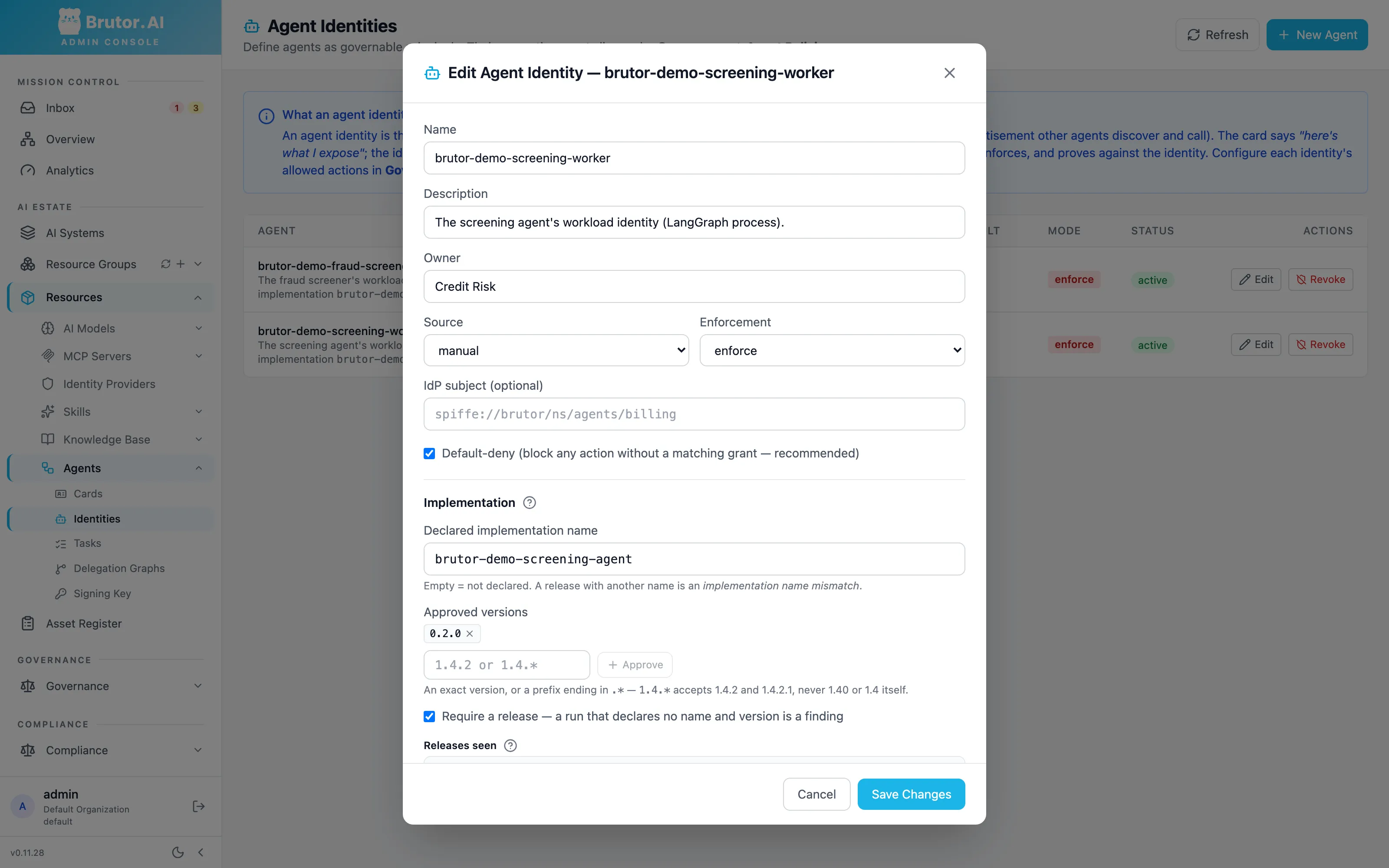
Section titled “4. The agent identity”An API key on its own lets its holder use everything the AI System can reach. An agent identity narrows that to the actions you grant, default-deny, and records which software is allowed to hold the key:
curl -X POST http://localhost:5050/v1/admin/agent-identities \ -H "Authorization: Bearer $ADMIN_TOKEN" -H "Content-Type: application/json" \ -d '{ "name": "brutor-demo-screening-worker", "description": "The screening agent'\''s workload identity (LangGraph process).", "owner_label": "Credit Risk", "source": "manual", "default_deny": true, "enforcement_mode": "enforce", "implementation_name": "brutor-demo-screening-agent", "approved_versions": ["0.2.0"], "require_release": true }'{ "id": "agent-01M61N3B1GHVSCARE5CJZ5KEZ3", "name": "brutor-demo-screening-worker", "status": "active", "default_deny": true, "enforcement_mode": "enforce", "implementation_name": "brutor-demo-screening-agent", "approved_versions": ["0.2.0"], "require_release": true}The last three fields are the agent implementation
declaration. The agent names itself on every call (next page); a call from a release not in
approved_versions, or with no release at all when require_release is on, raises an
agent.unapproved_release finding. Declarations describe; they never authorise. setup.py
reads the approved version from the agent’s own pyproject.toml, so the identity and the
code can never disagree about which release was approved.
Make the identity a member of the AI System, so the system’s governance stack applies to it:
A=agent-01M61N3B1GHVSCARE5CJZ5KEZ3curl -X POST http://localhost:5050/v1/admin/agent-identities/$A/memberships \ -H "Authorization: Bearer $ADMIN_TOKEN" -H "Content-Type: application/json" \ -d '{"group_id": "group-01M61N376V2RR6J2TV7Q7EVRET", "role": "member"}'Grants are added per capability on the pages that register each one. In full, the screening agent ends up with:
action_type |
target |
effect |
Constraints | Added on |
|---|---|---|---|---|
llm_call |
* |
allow |
{"rate": {"max": 300, "window": "hour"}} |
this page |
mcp_tool |
each of the 7 application and bureau tools | allow |
MCP servers | |
mcp_tool |
skills__list, skills__load, skills__run_script |
allow |
The skill | |
skill_exec |
the skill’s id | allow |
The skill | |
a2a_call |
the fraud screener’s card id | allow |
{"max_delegation_depth": 2} |
A2A |
curl -X POST http://localhost:5050/v1/admin/agent-identities/$A/grants \ -H "Authorization: Bearer $ADMIN_TOKEN" -H "Content-Type: application/json" \ -d '{"action_type": "llm_call", "target": "*", "effect": "allow", "constraints": {"rate": {"max": 300, "window": "hour"}}}'{ "id": "grant-01M61N3B8SSKGF4CB0ZV8T9NQ5", "agent_id": "agent-01M61N3B1GHVSCARE5CJZ5KEZ3", "action_type": "llm_call", "target": "*", "effect": "allow", "constraints": {"rate": {"max": 300, "window": "hour"}}, "enabled": true}Admin UI: AI Estate → Resources → Agents → Identities (identity, grants, memberships and the implementation fields).
5. The API key
Section titled “5. The API key”Mint the key on the AI System and bind it to the identity with agent_id:
curl -X POST http://localhost:5050/v1/admin/resource-groups/$G/api-keys \ -H "Authorization: Bearer $ADMIN_TOKEN" -H "Content-Type: application/json" \ -d '{ "name": "brutor-demo-screening-agent", "description": "Workload credential for screening, bound to its agent identity.", "access_mode": "shared", "agent_id": "agent-01M61N3B1GHVSCARE5CJZ5KEZ3" }'{ "id": "key-01M61N3C...", "key_value": "sk_brutor_api_Xq3...", "key_prefix": "sk_brutor_api_Xq3", "name": "brutor-demo-screening-agent", "scope": "global", "access_mode": "shared", "group_id": "group-01M61N376V2RR6J2TV7Q7EVRET", "group_name": "brutor-demo-system", "agent_id": "agent-01M61N3B1GHVSCARE5CJZ5KEZ3", "enabled": true, "expires_at": null}key_value is returned once. Put it straight into the agent’s secret store; setup.py
writes it to .demo.env as BRUTOR_API_KEY.
From now on, every call with this key is:
- attributed to the Brutor Demo System (its budget, its ledger, its health), because the key belongs to it;
- authorised as
brutor-demo-screening-worker, default-deny, because ofagent_id.
Who is acting always comes from the credential. The agent never sends a header that claims an AI System or an identity.
What you have
Section titled “What you have”-
An organisation that holds the company-wide model, budget and guardrails.
-
An AI System,
proposed, that declares what it is for, who owns it and how risky it is. -
An agent identity that may make model calls and nothing else yet, and that knows which release of which software is allowed to act as it.
-
One API key that carries all of that.
Next, the code that presents the key: the gateway client.