

Source connectors
A connector pulls content from an external system on a cron schedule and feeds it into
a collection through the same ingestion pipeline as uploads. The KB Connector Sync
service claims connectors that are due, decrypts their credential, calls the source API,
and upserts one kb_documents row per source item (source: "connector", plain text, with
the source URL and the source’s permissions as an ACL). The KB Uploader
then chunks and embeds it.
Connector documents carry source permissions: at retrieval time a signed-in user only gets connector chunks their mapped source identities could open. See Source permissions.
Endpoints
Section titled “Endpoints”Base http://localhost:5050/v1/admin/kb-connectors, admin JWT.
| Method | Path | Purpose |
|---|---|---|
| GET | /catalog |
Every connector type with its config and credential schema |
| GET | /catalog/{connector_type} |
One catalog entry (404 for an unknown type) |
| GET | (base path) | List connectors (?connector_type=slack&enabled_only=true) |
| POST | (base path) | Create a connector (201) |
| GET | /{connector_id} |
Get one connector |
| PATCH | /{connector_id} |
Partial update; a credential replaces the stored one |
| DELETE | /{connector_id} |
Delete, cascading to credential, checkpoints and run logs (204) |
| PUT | /{connector_id}/groups |
Replace the connector’s resource-group bindings |
| POST | /{connector_id}/test-connection |
Check that a credential is configured |
| POST | /{connector_id}/sync |
Queue an immediate run |
| GET | /{connector_id}/runs |
Run history (?limit=50, 1–500) |
The eight connector types
Section titled “The eight connector types”connector_type |
credential_kind |
Config keys (example) | ACL principals stamped | Default schedule |
|---|---|---|---|---|
confluence |
oauth |
base_url (required, https://acme.atlassian.net/wiki), space_keys, include_archived |
confluence:user:<accountId>, confluence:group:<id>, confluence:space:<KEY> |
0 */6 * * * |
notion |
api_key |
root_page_ids, include_databases |
always public |
0 */6 * * * |
google_drive |
oauth |
folder_ids, include_shared_drives, mime_types |
gdrive:user:<email>, gdrive:group:<email>, gdrive:domain:<domain>, public |
0 */6 * * * |
slack |
oauth |
channels (#engineering), include_threads, lookback_days (30) |
slack:user:<U…> per channel member, slack:channel:<C…> |
0 */6 * * * |
github |
oauth |
repos (acme/platform), include_issues, include_pull_requests, include_markdown_files, enterprise_base_url |
github:user:<login>, github:team:<slug>, public |
0 */6 * * * |
jira |
oauth |
base_url (required, https://acme.atlassian.net), project_keys, jql_filter (updated >= "-30d"), include_comments |
jira:project:<KEY>:role:<name>, jira:project:<KEY>:group:<id>, jira:security:<KEY>:<level> |
0 */6 * * * |
sharepoint |
oauth |
tenant_id (required, Entra directory ID), site_urls, include_subsites, file_types |
sp:user:<oid>, sp:group:<oid>, sp:tenant:<tenantId>, public |
0 */6 * * * |
web_crawler |
api_key (none needed) |
seed_urls (required, https://docs.example.com), allowed_hosts, max_depth (3), max_pages (500), respect_robots_txt, request_delay_ms (250) |
always public |
0 3 * * * |
text_multi config fields take a JSON array of strings. The catalog entry for each type
(GET /catalog/{type}) carries the field schema, defaults, capabilities and the setup
instructions (scopes to grant, where to create the app) that the Admin UI shows.
Credential payloads
Section titled “Credential payloads”The credential object is {"credential_kind": …, "fields": {…}}. Its kind must equal the
catalog entry’s credential_kind, otherwise 400. The sync runtime reads these field
names:
| Type | fields the runtime reads |
Example |
|---|---|---|
confluence, jira, google_drive |
access_token (or token) |
{"access_token": "eyJ…"} (OAuth token or Data Center personal access token) |
slack |
bot_token (or access_token, token) |
{"bot_token": "xoxb-…"} |
github |
installation_token (or access_token, token) |
{"token": "github_pat_…"} |
notion |
token (or access_token) |
{"token": "ntn_…"} |
sharepoint |
client_id, client_secret (with config tenant_id) |
{"client_id": "…", "client_secret": "…"} |
web_crawler |
none | {} |
Credentials are encrypted at rest with ENCRYPTION_KEY and never returned: responses carry
only credential_kind and credential_configured.
Create and run a connector
Section titled “Create and run a connector”-
Create the target collection and bind it to the groups that should retrieve the content (Collections & access). The connector writes into exactly one collection.
-
Create the connector with
collection_idset:Terminal window curl -s -X POST http://localhost:5050/v1/admin/kb-connectors \-H "Authorization: Bearer $ADMIN_JWT" -H "Content-Type: application/json" \-d '{"name": "eng-slack","description": "Engineering channels","connector_type": "slack","collection_id": "01K8ZQ3V7M2T4N6P8R0S2U4W6Y","config": {"channels": ["#engineering", "#incidents"], "include_threads": true, "lookback_days": 30},"schedule_cron": "0 */6 * * *","enabled": true,"credential": {"credential_kind": "oauth", "fields": {"bot_token": "xoxb-1234-5678-abcd"}},"group_ids": ["group-01M61N36QYK1HVPN41KAE35PHP"]}'import requestsr = requests.post(f"{BASE}/v1/admin/kb-connectors",headers={"Authorization": f"Bearer {ADMIN_JWT}"},json={"name": "eng-slack","connector_type": "slack","collection_id": coll_id,"config": {"channels": ["#engineering"], "lookback_days": 30},"schedule_cron": "0 */6 * * *","credential": {"credential_kind": "oauth", "fields": {"bot_token": SLACK_BOT_TOKEN}},},)r.raise_for_status()connector = r.json()const res = await fetch(`${BASE}/v1/admin/kb-connectors`, {method: "POST",headers: { Authorization: `Bearer ${ADMIN_JWT}`, "Content-Type": "application/json" },body: JSON.stringify({name: "eng-slack",connector_type: "slack",collection_id: collId,config: { channels: ["#engineering"], lookback_days: 30 },schedule_cron: "0 */6 * * *",credential: { credential_kind: "oauth", fields: { bot_token: process.env.SLACK_BOT_TOKEN } },}),});const connector = await res.json(); // 201Response
201:{"id": "kbconn-01K8ZS6E2G4J6L8N0Q2S4U6W8Y","tenant_id": "default","name": "eng-slack","description": "Engineering channels","connector_type": "slack","config": {"channels": ["#engineering", "#incidents"], "include_threads": true, "lookback_days": 30},"collection_id": "01K8ZQ3V7M2T4N6P8R0S2U4W6Y","schedule_cron": "0 */6 * * *","enabled": true,"auto_derive_from_oidc": false,"next_run_at": "2026-10-28T09:31:07.551203+00:00","last_run_started_at": null,"last_run_finished_at": null,"last_run_status": null,"last_run_error": null,"latest_run": null,"credential_kind": "oauth","credential_configured": true,"group_ids": ["group-01M61N36QYK1HVPN41KAE35PHP"],"groups": [{"id": "group-01M61N36QYK1HVPN41KAE35PHP", "name": "borealis-consumer-finance", "display_name": null, "parent_group_id": null, "is_active": true}],"created_at": "2026-10-28T09:31:07.551203+00:00","updated_at": "2026-10-28T09:31:07.551203+00:00","created_by": "admin","updated_by": "admin"}An enabled connector with a schedule gets
next_run_at = now, so the first run starts on the sync service’s next poll (every 15 seconds by default). Errors:400for acredential_kindthat does not match the catalog,400for group IDs outside the tenant,409for a duplicate name,422for an unknownconnector_typevalue. -
Trigger a run now (optional):
Terminal window curl -s -X POST http://localhost:5050/v1/admin/kb-connectors/kbconn-01K8ZS6E2G4J6L8N0Q2S4U6W8Y/sync \-H "Authorization: Bearer $ADMIN_JWT"{"accepted": true, "run_log_id": "kbrun-01K8ZS8H4K6M8P0R2T4V6X8Z0B", "detail": null}400when the connector is disabled (Connector is disabled; enable it before triggering a sync.) or has no stored credential (Credential not configured; cannot start sync.). -
Watch the run:
Terminal window curl -s "http://localhost:5050/v1/admin/kb-connectors/kbconn-01K8ZS6E2G4J6L8N0Q2S4U6W8Y/runs?limit=5" \-H "Authorization: Bearer $ADMIN_JWT"{"runs": [{"id": "kbrun-01K8ZS8H4K6M8P0R2T4V6X8Z0B","connector_id": "kbconn-01K8ZS6E2G4J6L8N0Q2S4U6W8Y","started_at": "2026-10-28T09:32:00.104911+00:00","finished_at": "2026-10-28T09:33:12.880412+00:00","status": "success","trigger": "manual","docs_seen": 418,"docs_indexed": 418,"docs_failed": 0,"error_message": null}],"total": 1}Run
statusisrunning,success,failureorcancelled;triggerisschedule,manualorinitial. The emitted documents then appear in the collection’s document list and move toreadylike uploads.
Sync behaviour
Section titled “Sync behaviour”- Upsert by source item. Each document is keyed
{connector_id}::{source_doc_id}. A changed source item updates the same row and sets it back topending, so it is re-chunked and re-embedded. - Incremental cursors are kept per connector: Confluence
lastModified, Notionlast_edited_time, Google Drive Changes API page token, Slack messagets, GitHub and Jiraupdated, SharePoint Graph delta links. The web crawler has no cursor; each run is a full crawl from the seeds, capped bymax_pages. - Schedules are 5-field cron expressions evaluated in UTC. An expression that does
not parse leaves
next_run_atempty, so the connector only runs on manual sync. - Disable (
PATCH {"enabled": false}) clearsnext_run_at; enabling a scheduled connector again primes it to run on the next poll. - Outbound policy. Config URLs are checked before any request. Link-local addresses
(cloud metadata) are always refused; set
BRUTOR_OUTBOUND_DENY_PRIVATE=trueto refuse private ranges too, and list exceptions inBRUTOR_OUTBOUND_ALLOW_HOSTS. - Run time is capped by
KB_CONNECTOR_SYNC_MAX_RUN_SECS(one hour by default).
POST …/test-connection only checks that a credential is stored
({"ok": true, "detail": "Credential present. Real probing is performed on the next sync run."});
the first sync run is the real test of the credential and scopes.
Resource-group bindings on a connector
Section titled “Resource-group bindings on a connector”group_ids on a connector (and PUT …/groups) record which groups the connector is
associated with; they appear in the group’s Knowledge Base tab and in policy-as-code
exports. Retrieval access is decided by the target collection’s group bindings plus the
source ACL, not by the connector’s own bindings. Bind the collection to the groups that
should retrieve the content.
In the Admin UI
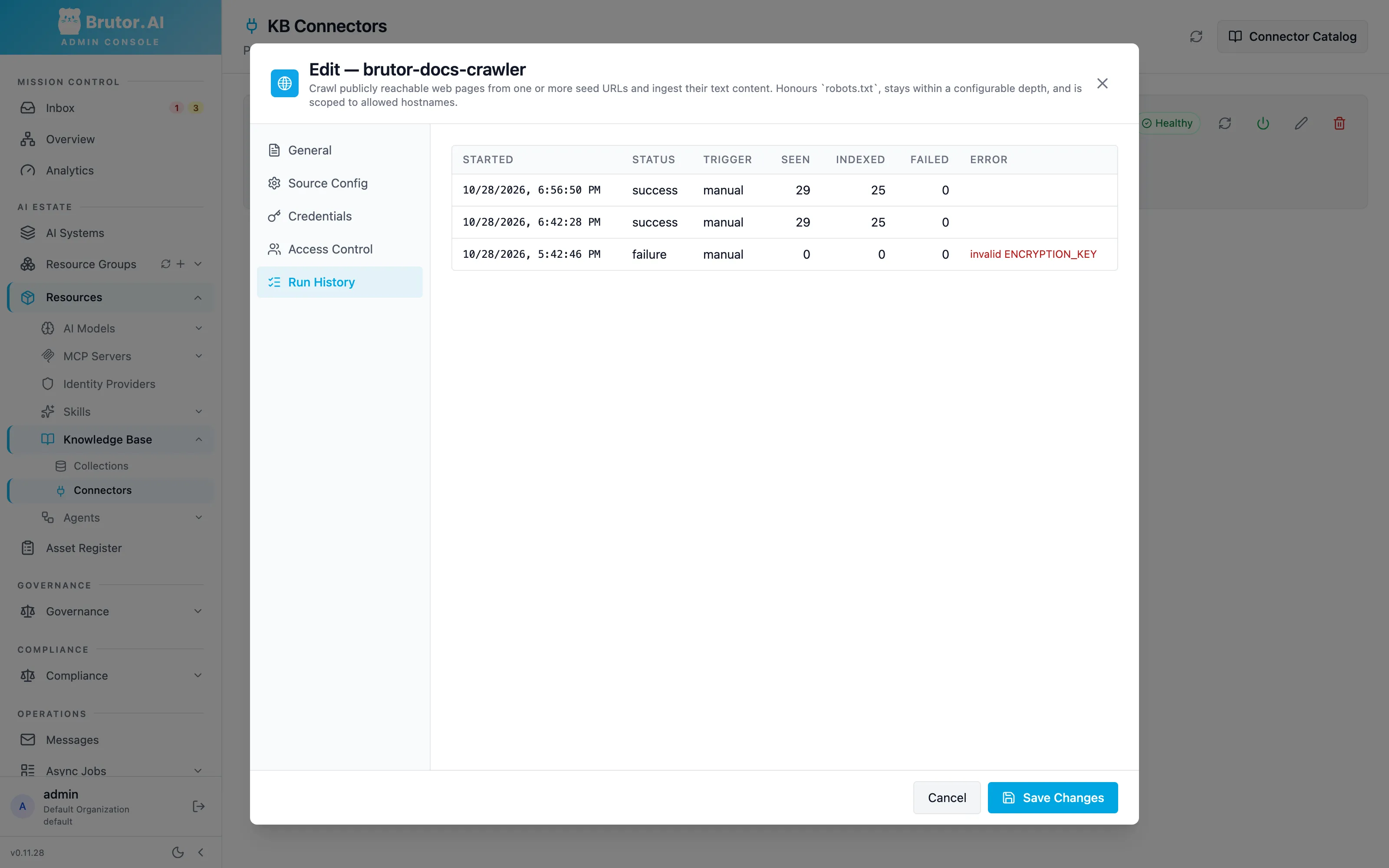
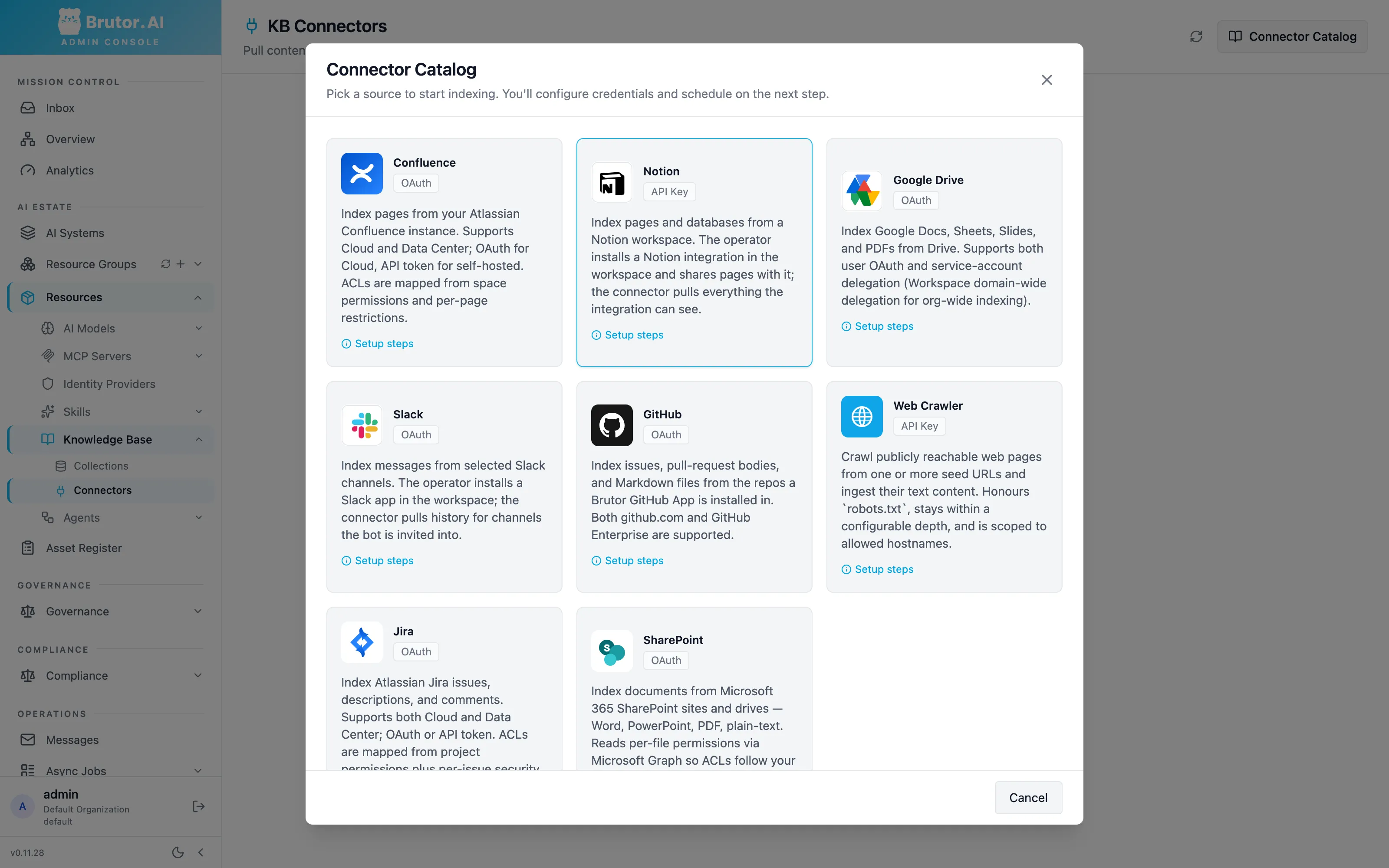
Section titled “In the Admin UI”AI Estate → Resources → Knowledge Base → Connectors lists the configured connectors with status badges (Healthy, Failed, Syncing, Cancelled, Never run), Sync Now, Enable/Disable and Delete. Browse Catalog opens the Connector Catalog with the eight types and their setup instructions; importing one opens the edit form with tabs General (name, description, Schedule (cron), Enabled), Source Config, Credentials (with Test Connection), Access Control and Run History (Started, Status, Trigger, Seen, Indexed, Failed, Error). For Google Drive the form also offers the OIDC auto-derive option described in Source permissions.
KB Connector Sync configuration
Section titled “KB Connector Sync configuration”| Variable | Default | Example | Purpose |
|---|---|---|---|
DATABASE_URL |
required | postgresql://brutor:…@postgres:5432/ai_gateway |
Shared database |
ENCRYPTION_KEY |
required | same value as the Control Plane | Decrypts connector credentials |
DB_POOL_SIZE |
8 |
16 |
Connection pool size |
KB_CONNECTOR_SYNC_POLL_INTERVAL_SECS |
15 |
30 |
How often due connectors are claimed |
KB_CONNECTOR_SYNC_MAX_CONCURRENT |
4 |
8 |
Connectors synced in parallel |
KB_CONNECTOR_SYNC_MAX_RUN_SECS |
3600 |
7200 |
Hard cap on one run |
KB_CONNECTOR_SYNC_SHUTDOWN_GRACE_SECS |
30 |
60 |
Time to finish runs on shutdown |
KB_CONNECTOR_SYNC_LISTEN_ADDR |
0.0.0.0:8200 |
0.0.0.0:8201 (compose) |
/health and /metrics |
BRUTOR_OUTBOUND_DENY_PRIVATE |
false |
true |
Refuse loopback, RFC 1918, CGNAT and ULA destinations |
BRUTOR_OUTBOUND_ALLOW_HOSTS |
unset | confluence.internal,*.corp.example |
Hosts exempt from the address checks |
GET /health answers {"status": "ok", "service": "brutor-kb-connector-sync"} (or
"db_unreachable").
Related
Section titled “Related”- Source permissions: make the stamped ACLs match your users
- Upload & ingestion: the pipeline connector documents join
- Collections & access: the binding that decides who retrieves