OAuth behind a Virtual MCP
A Virtual MCP server (/v1/proxy/vmcp/{virtual_server_id})
is a delegating aggregator. tools/list is answered from the tool definitions stored on
the Virtual MCP, filtered to what the caller’s resource groups allow. Each tools/call is
mapped back to the member server and original tool name and sent over an internal loopback
to /v1/proxy/mcp/{member_server_id}, where the full MCP pipeline runs: access check,
guardrails, approvals, logging and OAuth token injection.
The Virtual MCP forwards the caller’s Authorization, X-Gateway-Authorization,
X-API-Key, X-Tenant-ID, X-Resource-Group and X-Approval-Token headers to that
inner call. It holds no tokens of its own and runs no OAuth flow of its own.
What that means for OAuth members
Section titled “What that means for OAuth members”An MCP JWT names exactly one MCP server (mcp_server_id), and a request carries one
Authorization header. So:
| Caller sends | Call routed to OAuth member A | Call routed to any other member B |
|---|---|---|
| API key only | No user token is selected. A gets its static auth_token if it has one, otherwise no credential, and normally answers 401 |
Works if B needs no per-user OAuth |
| API key + MCP JWT for A | Uses the user’s stored A token | The gateway injects the user’s stored A token into the call to B, because the lookup follows the server named in the MCP JWT |
In the User Portal
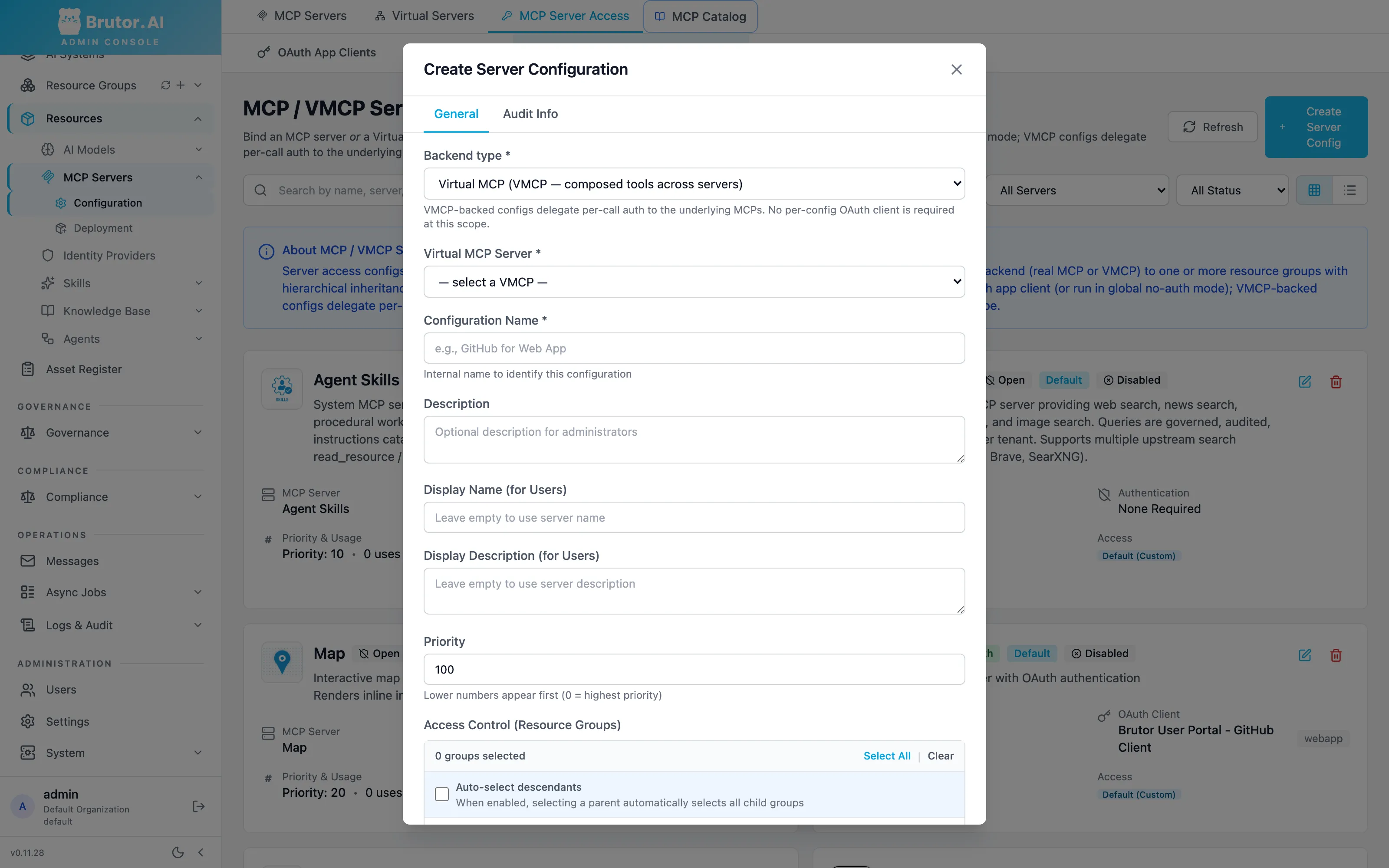
Section titled “In the User Portal”A Virtual MCP-backed access configuration never carries an OAuth App Client: the Admin UI
clears it when you pick Virtual MCP (VMCP — composed tools across servers), and the
portal API reports such entries with oauth_required: false and
mcp_server.auth_type: "delegated". The portal therefore offers a plain Connect and
sends no MCP JWT, so tools of OAuth-backed members appear in the list but their calls reach
the upstream without the user’s token. Give users OAuth-backed servers through their own
MCP access configurations.