

The graph: runs, steps and turns
The previous pages made individual calls work. This one makes them one task. An agent that drives its own loop makes many gateway calls to do one job, and the gateway cannot know which belong together unless the agent says so. If it does not, one application lands in the run ledger as eight one-action “runs”, and every signal built on runs (cost per processed outcome, run length, drift baselines, replay) is computed over fragments.
The vocabulary
Section titled “The vocabulary”The ledger counts four things, nested (Runs, steps, turns & actions):
| Unit | In the screening agent | Header |
|---|---|---|
| Run | One application, start to recorded recommendation | x-brutor-run-id |
| Step | A phase of the task: gather, assess, decide |
X-Brutor-Step-Id, X-Brutor-Step-Name |
| Turn | A model pass, with the calls it feeds or triggers: t1, t2 |
X-Brutor-Turn-Id, X-Brutor-Turn-Seq |
| Action | One governed call | (each request) |
Steps are phases of the task, not graph nodes. Naming steps after nodes would make a refactor of the graph look like a change in behaviour.
The node map
Section titled “The node map”NODES = ["intake", "verify_identity", "credit_report", "affordability", "classify", "fraud_screen", "decide", "record"]
STEP_NAMES = { "gather": "Gather the application facts", "assess": "Assess risk and fraud", "decide": "Decide and record",}TURNS = {"t1": ("t1", 1), "t2": ("t2", 2)}
# node -> (step id, turn id)NODE_MAP = { "intake": ("gather", "t1"), "verify_identity": ("gather", "t1"), "credit_report": ("gather", "t1"), "affordability": ("gather", "t1"), "classify": ("assess", "t1"), # the classifier call the four reads feed "fraud_screen": ("assess", "t2"), "decide": ("decide", "t2"), "record": ("decide", "t2"), # the last action carries X-Brutor-Run-End}
def node_headers(node: str) -> dict: step, turn = NODE_MAP[node] return {"step_id": step, "step_name": STEP_NAMES[step], "turn": TURNS[turn], "node": node}Every node passes **hdr("<node>") to its gateway call, as you saw on the
MCP, skill and
A2A pages. The node name itself is not a header; it
appears as node= in the agent’s log line.
The graph is compiled linearly. There is no conditional edge and no loop, which is why a
run of this agent can never end exhausted:
graph = StateGraph(ScreeningState)previous = STARTfor node in NODES: graph.add_node(node, nodes[node]) graph.add_edge(previous, node) previous = nodegraph.add_edge(previous, END)return graph.compile()The decision logic between the nodes is deterministic and lives in rules.py: a policy
floor computed from the identity check, the affordability class, the fraud verdict and the
risk band, given to the drafter before it writes (so the letter matches the outcome), and
applied again after it, overriding the model. The rationale says which rule fired.
One run per application
Section titled “One run per application”process_application opens the run, invokes the graph, and makes sure the run is closed
whatever happens:
def process_application(gw, settings, store, application_id, *, graph=None) -> RunResult: compiled = graph or build_graph(gw, settings, store) run_id = f"bds-{application_id}-{new_ulid()}" # ≤ 128 chars, unique per attempt with gw.run(run_id) as ctx: try: final_state = compiled.invoke({"application_id": application_id}) outcome = final_state["outcome_id"] result = RunResult(application_id, run_id, "completed", outcome, ...) if not ctx.closed: gw.end_run("completed", outcome) # the header close did not take except PolicyBlocked as exc: gw.end_run("errored") # cause: blocked_by_policy result = RunResult(..., "errored", None, failure=classify_failure(exc), blocked_by_policy=True) except Exception as exc: gw.end_run("errored") result = RunResult(..., "errored", None, failure=classify_failure(exc)) return resultThe run id is the agent’s, and a new one per attempt: a retried application is a second
run, not a continuation of the first. The trace id (traceparent) is per run too, with a
new span id per call, so OpenTelemetry tooling sees the same shape the ledger does.
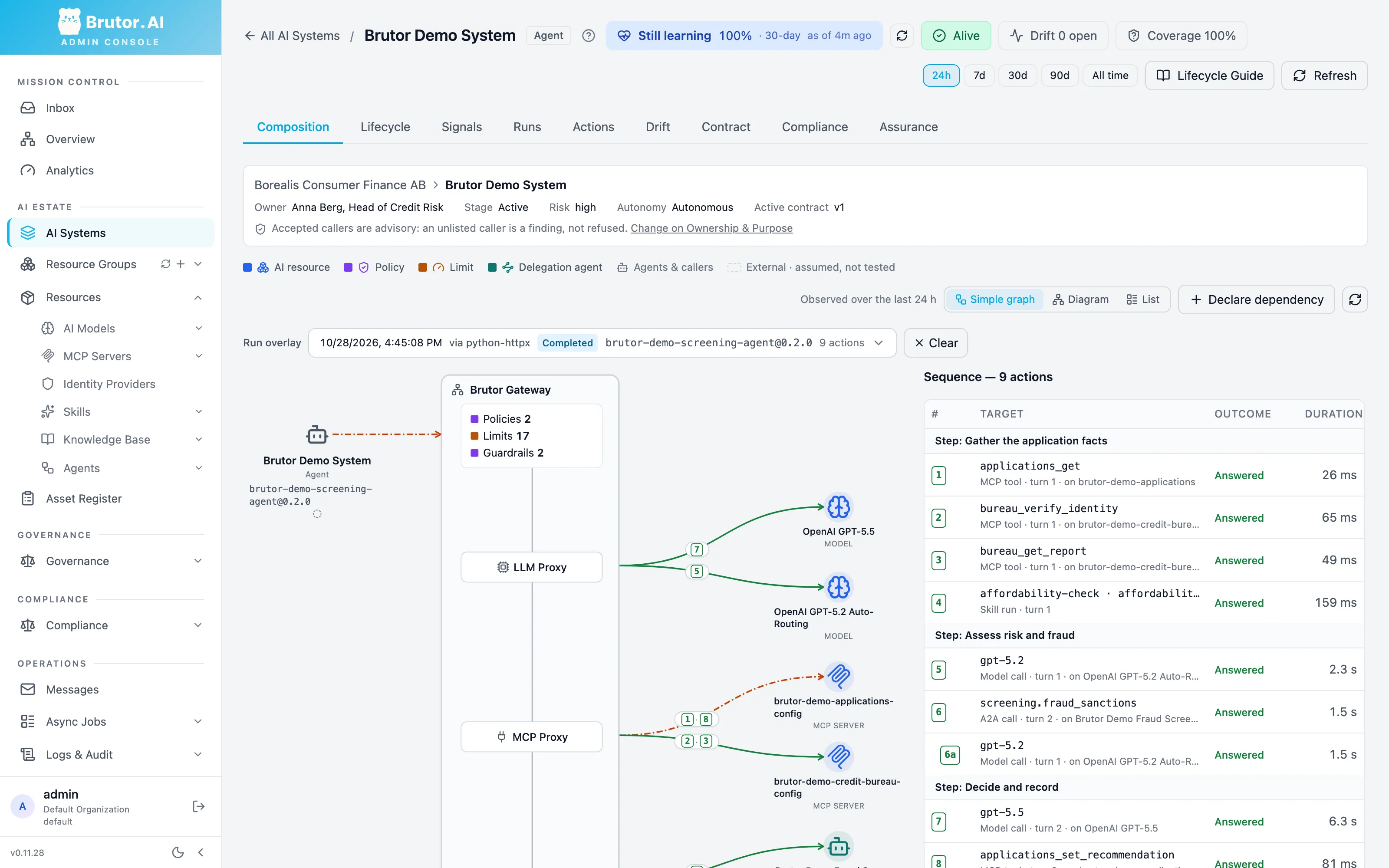
What one application’s run looks like on the wire:
| # | Node | Step | Turn (seq) | Run end |
|---|---|---|---|---|
| 1 | intake |
gather |
t1 (1) |
|
| 2 | verify_identity |
gather |
t1 (1) |
|
| 3 | credit_report |
gather |
t1 (1) |
|
| 4 | affordability |
gather |
t1 (1) |
|
| 5 | classify |
assess |
t1 (1) |
|
| 6 | fraud_screen |
assess |
t2 (2) |
|
| screener’s model call, depth 1 | none | its own turn | ||
| 7 | decide |
decide |
t2 (2) |
|
| 8 | record |
decide |
t2 (2) |
completed + outcome |
A completed run reads 3 steps, 3 turns and 9 actions; 10 when held for an underwriter, because of the extra note. Those counts are what the run-length baseline learns, so a change in them is a drift signal with a cause.
The scheduler’s own run
Section titled “The scheduler’s own run”Every ten minutes the scheduler polls for work. That poll is a governed call too
(applications_list_pending), and a call with no run headers makes the gateway mint a run
of its own that the idle sweeper later closes as abandoned, skewing the completion and
abandonment rates the envelope grades. So the tick is a run of its own,
bds-tick-<ulid>, with a single step poll_pending:
out = self.gw.mcp_call( self.settings.applications_mcp_server_id, "applications_list_pending", args, # {"limit": 50, "after": ...} step_id="poll_pending", step_name="Tick: poll pending applications", run_end="completed" if outcome_id else None, # closes the tick run on the last page outcome_id=outcome_id, # no_applications_available | applications_dispatched)It closes with one of two no-work outcomes, no_applications_available or
applications_dispatched, before any application is screened. Each application is then a
run of its own. No-work outcomes do not count toward the baseline, so an empty poll is
never read as a success of the work and does not dilute cost per processed outcome
(next page).
The other housekeeping runs (applying an approved decision, re-raising a lapsed hold,
handing an application off) are single-step, single-turn, single-action runs with
self-describing step ids: apply_approved_decision, reraise_approval, give_up,
approval_closed.
The headers’ grammar, limits and what a bad value does are in the Agent header reference; how the gateway derives and sweeps runs is in Run lifecycle.