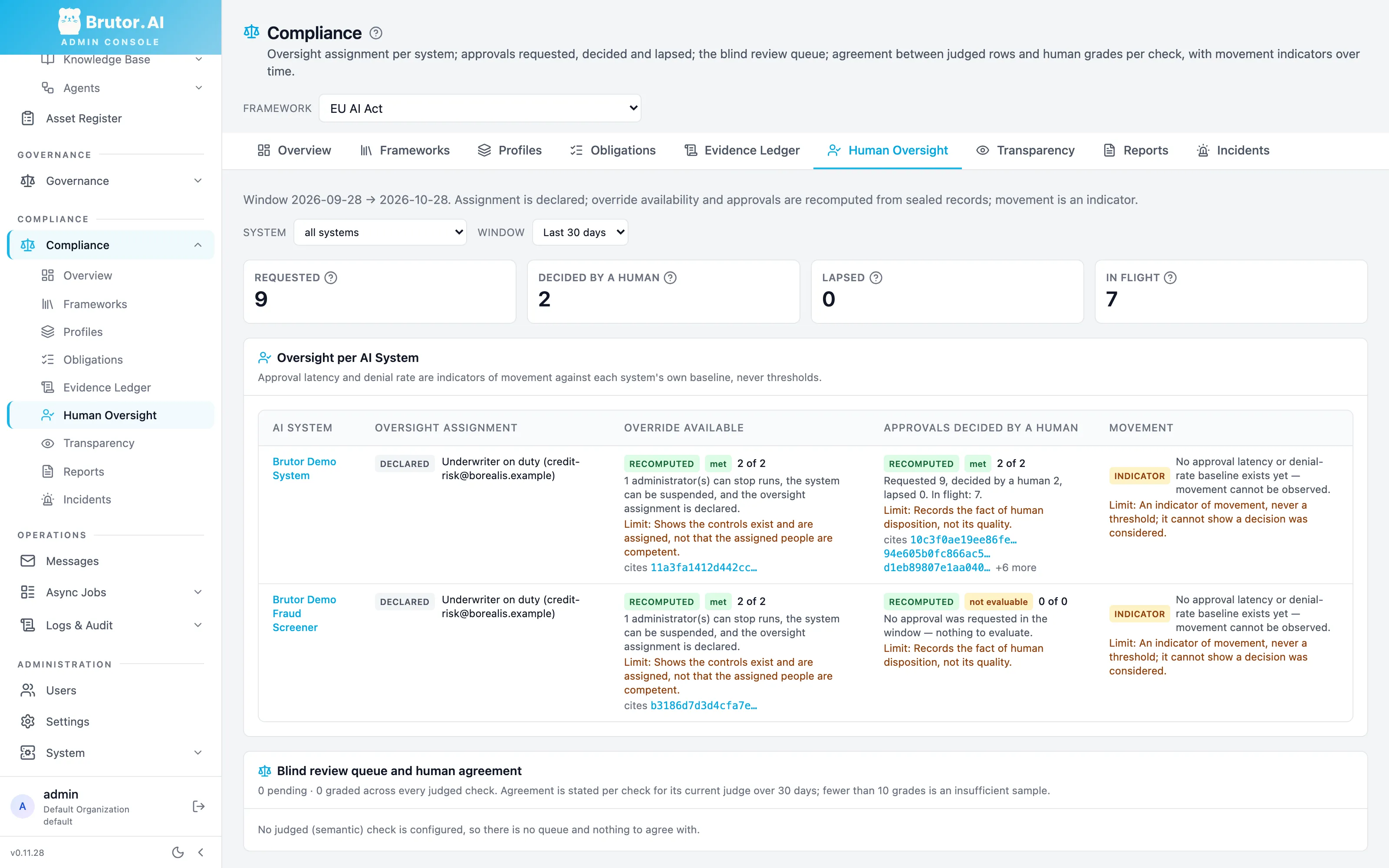
Human oversight: approvals
A creditworthiness system that declines people on its own is exactly what EU AI Act Art 14 is about. The screening agent may recommend a decline, but it may not record one until a named human has looked at it. The same goes for any loan above 25,000 EUR.
None of the decision about what needs a human is in the agent. The gateway holds the call; the agent only has to handle being held, which every agent behind a governance team eventually has to do.
record ── applications_set_recommendation ──▶ gateway: argument policy │ decline, or amount_eur > 25000 ◀── 202 approval_required ───────────┘ → approval request, held note + close run "held_for_underwriter" underwriter (User Portal → Inbox → Approvals) approves ─────────────▶ approval_token mintednext tick: GET /v1/portal/approvals/{id}/poll ◀─────────────────┘ new run: the identical call + X-Approval-Token ──▶ executed, matched to what was approvedThe policy that holds the call
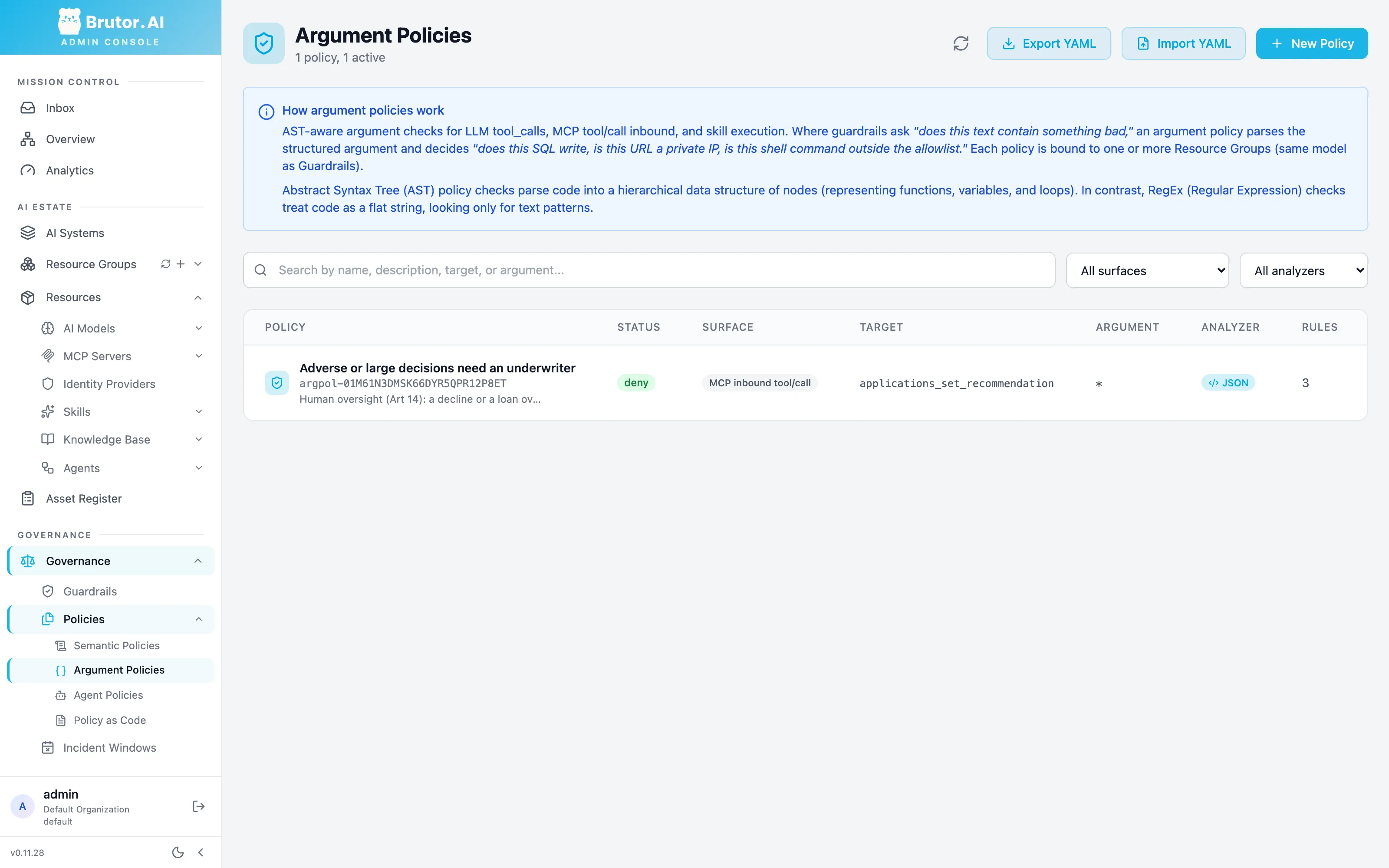
Section titled “The policy that holds the call”An argument policy on applications_set_recommendation (setup.py step 11). It
first guards the shape, then holds two cases:
curl -X POST http://localhost:5050/v1/admin/argument-policies \ -H "Authorization: Bearer $ADMIN_TOKEN" -H "Content-Type: application/json" \ -d '{ "name": "Adverse or large decisions need an underwriter", "description": "Human oversight (Art 14): a decline or a loan over 25,000 EUR is held for an underwriter.", "surface": "mcp_input", "target": "applications_set_recommendation", "argument_key": "*", "analyzer": "json", "analyzer_config": {"schema": {"required": ["recommendation", "amount_eur"]}}, "severity": "deny", "enabled": true, "rules": [ {"deny_if": "schema_invalid", "severity": "deny", "message": "recommendation and amount_eur are required."}, {"deny_if": "field_eq", "field": "recommendation", "value": "decline", "severity": "approval_required", "message": "Adverse recommendations are reviewed by an underwriter."}, {"deny_if": "field_gt", "field": "amount_eur", "value": 25000, "severity": "approval_required", "message": "Loans over 25,000 EUR are reviewed by an underwriter."} ], "group_ids": ["group-01M61N376V2RR6J2TV7Q7EVRET"] }'A rule’s severity is what happens when it matches: deny refuses the call,
approval_required holds it. Everything else (an approve or refer up to 25,000 EUR)
is recorded straight away. Policy reference: Argument & semantic policies.
Admin UI: Governance → Policies → Argument Policies.
How long a hold waits
Section titled “How long a hold waits”A hold that names no window of its own expires after the approval window resolved for the AI System: the smallest window stated on the group chain, then the tenant, then the platform default of 300 seconds. Five minutes is not enough for an underwriter, so the demo sets a day on the organisation, which both AI Systems inherit:
curl -X PUT http://localhost:5050/v1/admin/resource-groups/$ORG/approval-window \ -H "Authorization: Bearer $ADMIN_TOKEN" -H "Content-Type: application/json" \ -d '{"approval_window_seconds": 86400}'{ "group_id": "group-01M61N36QYK1HVPN41KAE35PHP", "group_name": "borealis-consumer-finance", "approval_window_seconds": 86400, "inherited_window_seconds": null, "effective_seconds": 86400}It applies to every hold without a window of its own: this policy’s, a held skill run’s,
and every hold raised while a response policy
has demoted the system to approval_required. Admin UI: AI Estate → Resource Groups →
Borealis Consumer Finance AB → Governance → Approvals.
Who decides
Section titled “Who decides”Approvals are decided in the User Portal, by a member of the AI System’s resource group.
There is no approvals queue in the Admin UI. setup.py step 10 creates the portal user
underwriter (Anna Berg), puts her in the end-user group borealis-underwriters, and binds
that group to the Demo System:
curl -X POST http://localhost:5050/v1/admin/resource-groups/$G/end-user-groups \ -H "Authorization: Bearer $ADMIN_TOKEN" -H "Content-Type: application/json" \ -d '{"end_user_group_ids": ["<borealis-underwriters id>"]}'The end-user group binding is outside the contract closure: who may decide is staffing, not part of what the system was approved to do.
Handle the hold
Section titled “Handle the hold”The gateway answers the held call with HTTP 202 and a plain JSON body (not a JSON-RPC envelope):
{ "approval_required": true, "approval_request_id": "01m61r8k2c4wq3j0t9e6yvb7zd", "capability_type": "tool", "capability_name": "applications_set_recommendation", "server_name": "brutor-demo-applications", "surface": "mcp", "timeout_seconds": 86400, "expires_at": "2026-10-29T16:41:07Z", "poll_url": "/v1/portal/approvals/01m61r8k2c4wq3j0t9e6yvb7zd/poll", "message": "Tool 'applications_set_recommendation' requires approval. Submit with X-Approval-Token header after approval."}The gateway client turns it into
ApprovalRequired. The record node then does three things, and the run ends completed:
being held is the agent doing its job correctly, not a failure.
except ApprovalRequired as held: note = (f"Held for underwriter, approval id {held.approval_id}: recommendation " f"'{final['recommendation']}' for EUR {tool_args['amount_eur']} awaits human approval " f"(rule: {final.get('rule_fired') or 'none'}).") # 1. a note on the application, which closes the run as held gw.mcp_call(settings.applications_mcp_server_id, "applications_add_note", {"application_id": state["application_id"], "note": note}, run_end="completed", outcome_id=HELD_FOR_UNDERWRITER, **hdr("record")) # 2. remember exactly what was held store.add(state["application_id"], held.approval_id, tool_args, gw.ctx.run_id) return {"tool_args": tool_args, "outcome_id": HELD_FOR_UNDERWRITER, "approval_id": held.approval_id}The pending store (DATA_DIR/pending_approvals.json, written atomically) keeps the
approval id and the exact tool arguments. A held application is left out of every
tick’s batch, so it costs no model calls while it waits and is never re-screened into a
second, different recommendation.
The underwriter decides
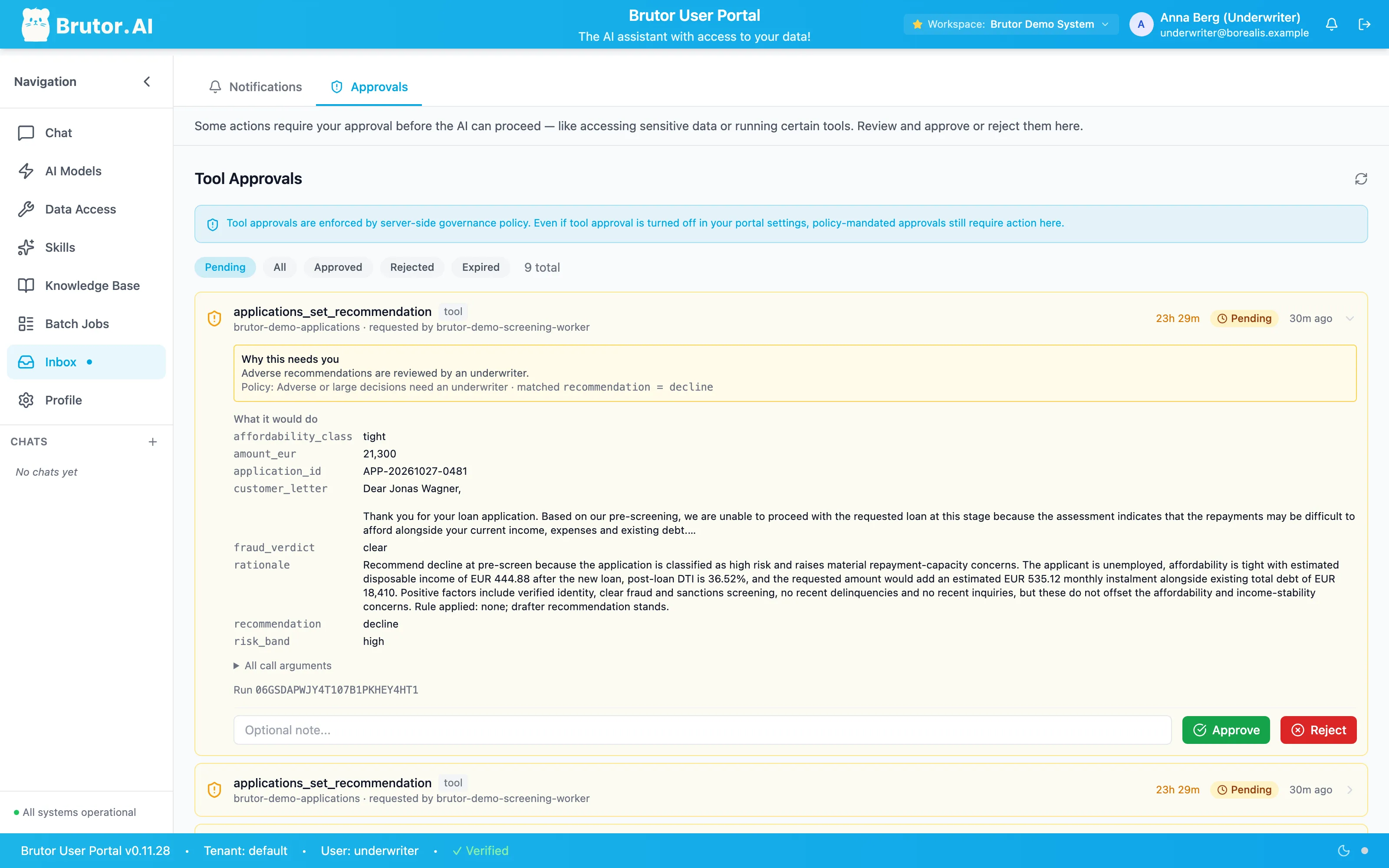
Section titled “The underwriter decides”The underwriter logs in to the portal (http://localhost:3001, underwriter /
Underwriter123!) and opens Inbox → Approvals. Each request shows the tool, the full
arguments (recommendation, amount, rationale, affordability class, fraud verdict, the
customer letter) and which policy rule held it. She approves, optionally with a note, or
rejects.
Her client calls the Portal API with her portal JWT:
curl -X POST http://localhost:8100/v1/portal/approvals/$APPROVAL_ID/approve \ -H "Authorization: Bearer $PORTAL_JWT" -H "Content-Type: application/json" \ -d '{"note": "Checked the bureau file; decline stands."}'Apply the decision
Section titled “Apply the decision”On every tick, before it looks for new work, the agent polls each pending approval with its own API key (the one Portal endpoint an agent may call):
curl http://localhost:8100/v1/portal/approvals/$APPROVAL_ID/poll \ -H "Authorization: Bearer $BRUTOR_API_KEY"{ "id": "01m61r8k2c4wq3j0t9e6yvb7zd", "status": "approved", "decision": "approved", "token_used": false, "approval_token": "kQ3vY8...Xw", "expires_at": "2026-10-29T16:41:07Z"}status |
What the agent does | Run | Outcome |
|---|---|---|---|
pending |
Keeps it for the next tick | none | |
approved |
Re-issues the identical call with X-Approval-Token |
bds-<app>-approval-<ulid>, step apply_approved_decision |
underwriter_decision_applied |
rejected |
Hands the application off to manual review (applications_hand_off) |
a short run, step approval_closed |
sent_to_manual_review |
expired |
Re-raises the hold: the identical call again, without a token | bds-<app>-rehold-<ulid>, step reraise_approval |
underwriter_hold_renewed |
def apply_approved(gw, settings, entry, token) -> str: run_id = f"bds-{entry['application_id']}-approval-{new_ulid()}" with gw.run(run_id): try: gw.mcp_call(settings.applications_mcp_server_id, "applications_set_recommendation", dict(entry["tool_args"]), # the identical arguments step_id="apply_approved_decision", step_name="Apply underwriter-approved decision", run_end="completed", outcome_id=UNDERWRITER_DECISION_APPLIED, approval_token=token) # X-Approval-Token except Exception: gw.end_run("errored") raise return run_idThe token is one-time and bound to what was approved: the gateway matches the retried call against the approved arguments. Nothing can change between what the underwriter saw and what is recorded, which is why the agent stores the arguments rather than recomputing them.
Two more rules keep the oversight honest:
- An outage never drops a human’s approval. An approved decision that cannot be applied is kept and retried; only application-class failures count toward its three attempts (Failures).
- A lapsed hold is re-raised, not re-screened. The underwriter’s queue always holds the
current decision until a human acts.
RERAISE_MAX(default0, unlimited) can cap the re-raises, after which the application is handed off.
What the evidence shows
Section titled “What the evidence shows”Every hold, decision and applied call lands on the audit row in one call chain, and each governed verdict is sealed as a signed action record. The Compliance → Human Oversight tiles count requested, decided by a human and lapsed holds, and the oversight health signal scores whether the loop actually worked: approvals that expired with nobody answering, and decisions concentrated on one approver. See Human oversight.