

Upload & ingestion
Uploading is asynchronous. The Control Plane stores the raw file and creates a document
row with status: "pending"; the KB Uploader worker claims it, extracts the text,
chunks it, embeds it through the Core Proxy and writes the vectors to Qdrant. A 201 from
the upload means queued, not searchable.
| Method | Path (base http://localhost:5050/v1/admin/knowledge-base) |
Purpose |
|---|---|---|
| POST | /collections/{collection_id}/documents |
Upload one file (multipart/form-data, 201) |
| GET | /collections/{collection_id}/documents |
List the collection’s documents |
| GET | /documents/{document_id} |
Get one document (poll this) |
| PATCH | /documents/{document_id} |
Update name, version, author |
| POST | /documents/{document_id}/reembed |
Drop the document’s chunks and vectors and queue it again |
| DELETE | /documents/{document_id} |
Delete the document, its chunks and its vectors (204) |
Upload a document
Section titled “Upload a document”Form fields: file (required), and optional name (display name, defaults to the
filename), version and author.
curl -s -X POST \ http://localhost:5050/v1/admin/knowledge-base/collections/01K8ZQ3V7M2T4N6P8R0S2U4W6Y/documents \ -H "Authorization: Bearer $ADMIN_JWT" \ -F "file=@q3-playbook.pdf" \ -F "name=Q3 Playbook" \ -F "version=2026.3" \ -F "author=Sales Enablement"import requests
with open("q3-playbook.pdf", "rb") as fh: r = requests.post( f"{BASE}/v1/admin/knowledge-base/collections/{coll_id}/documents", headers={"Authorization": f"Bearer {ADMIN_JWT}"}, files={"file": ("q3-playbook.pdf", fh, "application/pdf")}, data={"name": "Q3 Playbook", "version": "2026.3"}, )r.raise_for_status()doc = r.json() # doc["status"] == "pending"import { readFile } from "node:fs/promises";
const form = new FormData();form.append( "file", new Blob([await readFile("q3-playbook.pdf")], { type: "application/pdf" }), "q3-playbook.pdf",);form.append("name", "Q3 Playbook");form.append("version", "2026.3");
const res = await fetch( `${BASE}/v1/admin/knowledge-base/collections/${collId}/documents`, { method: "POST", headers: { Authorization: `Bearer ${ADMIN_JWT}` }, body: form },);const doc = await res.json(); // doc.status === "pending"Response 201:
{ "id": "01K8ZR1B9D3F5H7K9M1P3R5T7V", "collection_id": "01K8ZQ3V7M2T4N6P8R0S2U4W6Y", "tenant_id": "default", "name": "Q3 Playbook", "filename": "q3-playbook.pdf", "version": "2026.3", "author": "Sales Enablement", "content_type": "application/pdf", "file_size_bytes": 482113, "status": "pending", "error_message": null, "chunk_count": 0, "embedding_model": null, "created_at": "2026-10-28T09:20:41.902114+00:00", "updated_at": "2026-10-28T09:20:41.902114+00:00", "created_by": "admin", "updated_by": null}Errors: 404 {"detail": "Collection not found"}; 400 for an unsupported type
(Unsupported content type: application/zip. Supported: …).
Supported formats
Section titled “Supported formats”The upload is accepted by MIME type. When the client sends application/octet-stream
(browsers often do for .md, .txt, .docx), the Control Plane falls back to the file
extension.
| Format | Extensions | MIME type | Extracted with |
|---|---|---|---|
.pdf |
application/pdf |
pdftotext (poppler); author from pdfinfo |
|
| Word | .docx |
application/vnd.openxmlformats-officedocument.wordprocessingml.document |
ZIP + XML parse; author from docProps/core.xml |
| Excel | .xlsx, .xls |
…spreadsheetml.sheet, application/vnd.ms-excel |
calamine |
| PowerPoint | .pptx |
…presentationml.presentation |
ZIP + XML parse |
| Legacy Word / PowerPoint | .doc, .ppt |
application/msword, application/vnd.ms-powerpoint |
LibreOffice headless |
| HTML | .html, .htm |
text/html |
scraper |
| CSV | .csv |
text/csv |
delimiter auto-detected (, ; tab), rendered as header: value per row |
| Plain text, Markdown | .txt, .md, .markdown |
text/plain, text/markdown |
passthrough |
Poll until ready
Section titled “Poll until ready”-
Poll
GET /documents/{document_id}every few seconds:Terminal window curl -s http://localhost:5050/v1/admin/knowledge-base/documents/01K8ZR1B9D3F5H7K9M1P3R5T7V \-H "Authorization: Bearer $ADMIN_JWT" -
Stop when
statusisreadyorerror:{"id": "01K8ZR1B9D3F5H7K9M1P3R5T7V","name": "Q3 Playbook","status": "ready","chunk_count": 42,"embedding_model": "text-embedding-3-small","error_message": null} -
On
error, readerror_message(for exampletext extraction failed: pdftotext timed out after 60s and was killed …), fix the cause and callPOST /documents/{document_id}/reembedto queue it again.
Lifecycle: pending → processing → ready | error. The uploader polls every 5 seconds by
default, so a small file is usually ready within seconds once the embedding provider
answers.
import time, requests
def wait_ready(doc_id, timeout=300): deadline = time.time() + timeout while time.time() < deadline: d = requests.get(f"{BASE}/v1/admin/knowledge-base/documents/{doc_id}", headers={"Authorization": f"Bearer {ADMIN_JWT}"}).json() if d["status"] in ("ready", "error"): return d time.sleep(3) raise TimeoutError(doc_id)What ingestion does
Section titled “What ingestion does”For each claimed document the uploader:
- Resolves the embedding model: the tenant’s
default_embedding_model_id, falling back to its ownEMBEDDING_MODELname when the tenant has none set. - Extracts text with the extractor for the content type, under hard deadlines and output caps. Any timeout, cap or killed converter fails the document closed; nothing partial is indexed.
- Chunks the text: split on blank lines, then on sentence boundaries for long paragraphs, accumulating sentences to about 500 tokens (4 characters per token) with about 50 tokens of overlap.
- Builds BM25 sparse tokens for each chunk, for keyword matching.
- Embeds the chunks in batches of 50 through
POST /v1/proxy/llm/embeddingson the Core Proxy, so the traffic is logged and metered. - Writes one Qdrant point per chunk into
brutor_kb_{tenant_id}with a dense and a sparse vector and the payloadtenant_id,collection_id,document_id,chunk_index,content,source,acl,metadata. The Qdrant collection is created on first write with the model’s dimension. - Stores the chunk rows, sets
status: "ready",chunk_countandembedding_model, and publishes aknowledge_baseinvalidation on Redis so the Core Proxy clears the tenant’s response cache and reloads group configuration.
Change a document
Section titled “Change a document”- Metadata only:
PATCH /documents/{document_id}with any ofname(1–512),version(≤50),author(≤255). Content is untouched. - Re-process the same content (after an extraction fix or a model switch for one
document):
POST /documents/{document_id}/reembed. Response is the document withstatus: "pending"andchunk_count: 0. - New content: delete the document and upload the new file. There is no in-place content replace or version history on a document. The Admin UI’s Upload new version action does exactly this: it deletes the old document and uploads the new file under the same name with the version you enter.
DELETE /documents/{document_id} returns 204 and removes the vectors from Qdrant.
In the Admin UI
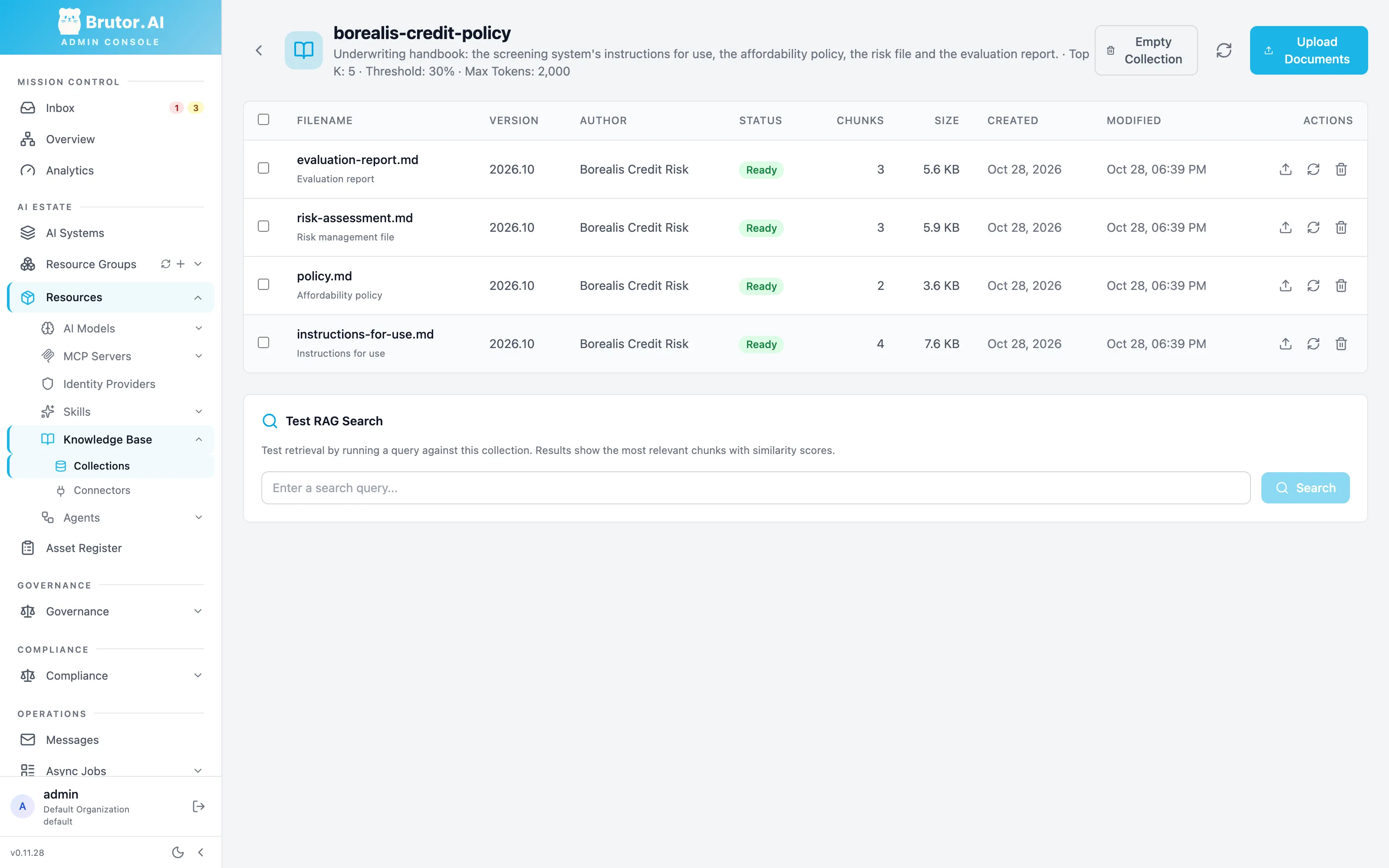
Section titled “In the Admin UI”AI Estate → Resources → Knowledge Base → Collections → View Documents on a collection
shows the documents table (Filename, Version, Author, Status, Chunks, Size, Created,
Modified, Actions) with Upload Documents (multi-file; the picker accepts
.pdf,.txt,.md,.html,.csv,.docx,.xlsx,.pptx,.doc,.xls,.ppt). Uploads made in the console
are labelled version 1.0. The page polls statuses while documents are pending and shows
Ready / Processing / Pending / Error badges. Row actions are Upload new version,
Re-embed and Delete; a header action deletes all documents in the collection. The
same page has Test RAG Search (see the preview).
KB Uploader configuration
Section titled “KB Uploader configuration”Set on the kb-uploader service. Values shown are the defaults unless marked.
| Variable | Default | Example | Purpose |
|---|---|---|---|
DATABASE_URL |
required | postgresql://brutor:…@postgres:5432/ai_gateway |
Shared database |
QDRANT_URL |
http://qdrant:6334 |
http://qdrant:6334 |
Qdrant gRPC endpoint |
QDRANT_JWT_SIGNING_SECRET |
required | 32+ random chars | Mints the per-tenant Qdrant JWTs; must match Qdrant’s API key |
PROXY_INTERNAL_URL |
required | http://gateway-core:8100 |
Core Proxy base URL; all embedding traffic goes through it |
PROXY_SERVICE_API_KEY |
required | the PROXY_HEALTH_CHECK_API_KEY value |
Service key for the proxy; also guards /api/v1/jobs |
EMBEDDING_MODEL |
nomic-embed-text |
text-embedding-3-small |
Model name used only when the tenant has no default model |
POLL_INTERVAL_SECS |
5 |
2 |
Seconds between polls for pending documents |
MAX_CONCURRENT_JOBS |
4 |
8 |
Documents processed in parallel |
CLAIM_BATCH_SIZE |
8 |
16 |
Documents claimed per poll |
STALE_PROCESSING_SECS |
1800 |
3600 |
Re-claim a document stuck in processing |
MAX_DOCUMENT_BYTES |
52428800 (50 MiB) |
104857600 |
Largest document read; larger fails with a message |
CHUNK_SIZE_TOKENS |
500 |
800 |
Target chunk size |
CHUNK_OVERLAP_TOKENS |
50 |
100 |
Overlap between consecutive chunks |
EMBEDDING_BATCH_SIZE |
50 |
100 |
Chunks per embedding call |
EMBEDDING_CONCURRENCY |
4 |
2 |
Parallel embedding calls |
EXTRACT_PDF_TIMEOUT_SECS |
60 |
120 |
Deadline per pdftotext / pdfinfo run (1–3600) |
EXTRACT_OFFICE_TIMEOUT_SECS |
120 |
300 |
Deadline per LibreOffice conversion (1–3600) |
EXTRACT_PARSE_TIMEOUT_SECS |
120 |
60 |
Deadline per in-process parse (1–3600) |
EXTRACT_MAX_OUTPUT_BYTES |
67108864 |
134217728 |
Cap on converter output (1–1073741824) |
REDIS_URL |
unset | redis://redis:6379 |
Cache-invalidation publish (best effort) |
LISTEN_ADDR |
0.0.0.0:8200 |
0.0.0.0:8200 |
Health and jobs API |
Every EXTRACT_*_TIMEOUT_SECS must be shorter than STALE_PROCESSING_SECS, or the service
refuses to start. Changing the chunk size affects new and re-embedded documents only.
The jobs API (GET /api/v1/jobs?tenant_id=default, GET /api/v1/jobs/{document_id}?tenant_id=default,
with X-API-Key: $PROXY_SERVICE_API_KEY) returns the latest 50 documents for a tenant:
{ "jobs": [ { "id": "01K8ZR1B9D3F5H7K9M1P3R5T7V", "name": "Q3 Playbook", "filename": "q3-playbook.pdf", "status": "ready", "error_message": null, "chunk_count": 42, "created_at": "2026-10-28T09:20:41.902114", "updated_at": "2026-10-28T09:20:49.113870" } ]}Related
Section titled “Related”- Source connectors: documents emitted by connectors go through the same pipeline
- Embeddings & re-embedding: the model used in step 1
- Ports and services