

Declare and report outcomes
Whether a run executed is something the gateway can see: every call answered, nothing was blocked, the run was closed. Whether it did its job is something only the agent knows. A screening run that recorded a recommendation did its job; a tick that found nothing to screen executed perfectly and produced nothing. If the ledger cannot tell those apart, the success rate, the cost per task and the drift baselines all lie.
So the agent declares how its runs may end, and says on the last call of each run which of those it was. That is a declared outcome. The full model is in Declared outcomes; this page is how the screening agent does it.
One catalogue, three readers
Section titled “One catalogue, three readers”screening_agent/outcomes.json ships inside the agent’s package. The same file is read by
the agent (to validate what it sends), by setup.py (to declare it on the AI System) and,
through the contract, by the gateway (to judge each run):
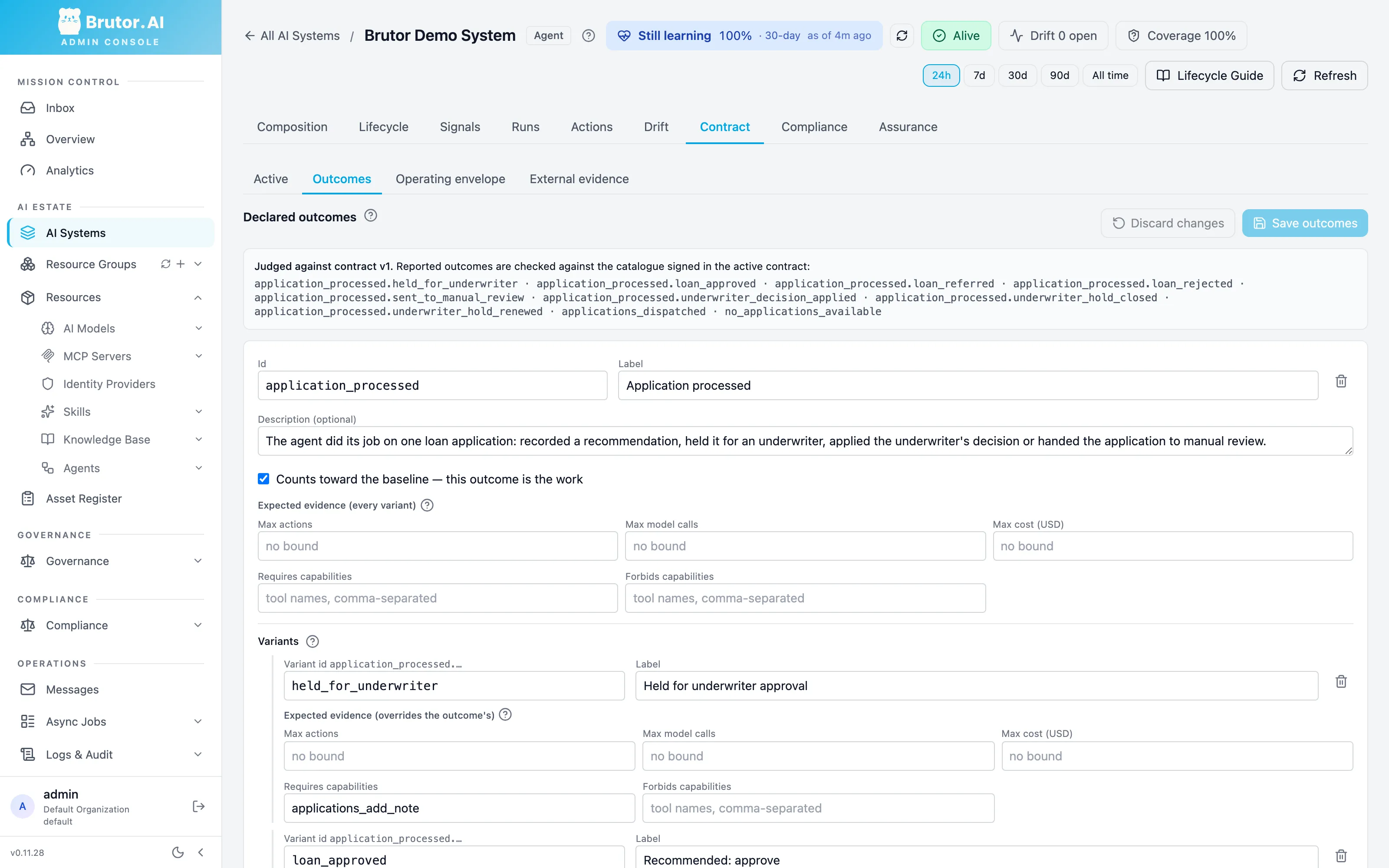
{ "outcomes": [ { "id": "application_processed", "label": "Application processed", "counts_toward_baseline": true, "variants": [ {"id": "loan_approved", "label": "Recommended: approve", "expect": {"requires_capabilities": ["applications_set_recommendation"]}}, {"id": "loan_rejected", "label": "Recommended: decline", "expect": {"requires_capabilities": ["applications_set_recommendation"]}}, {"id": "loan_referred", "label": "Recommended: refer", "expect": {"requires_capabilities": ["applications_set_recommendation"]}}, {"id": "held_for_underwriter", "label": "Held for underwriter approval", "expect": {"requires_capabilities": ["applications_add_note"]}}, {"id": "underwriter_decision_applied", "label": "Underwriter-approved decision applied", "expect": {"max_actions": 2, "max_model_calls": 0}}, {"id": "underwriter_hold_renewed", "label": "Lapsed underwriter hold re-raised", "expect": {...}}, {"id": "underwriter_hold_closed", "label": "Underwriter hold closed with a note", "expect": {...}}, {"id": "sent_to_manual_review", "label": "Sent to manual review", "expect": {"max_model_calls": 0, "requires_capabilities": ["applications_hand_off"]}} ] }, { "id": "no_applications_available", "label": "Nothing to screen", "counts_toward_baseline": false, "expect": {"max_model_calls": 0, "max_cost_usd": 0, "forbids_capabilities": ["applications_set_recommendation", "applications_add_note", "applications_hand_off"]} }, {"id": "applications_dispatched", "label": "Applications handed to screening runs", "counts_toward_baseline": false, "expect": {...}} ], "dependencies": [ {"delegate": "brutor-demo-fraud-screener-agent", "capability": "screening.fraud_sanctions", "expected_outcomes": ["screening_completed.clear", "screening_completed.review", "screening_completed.hit"]} ]}Three things in it carry most of the weight:
counts_toward_baseline.application_processedis work; the two tick outcomes are not. A no-work run never counts as a success of the work and never dilutes cost per processed outcome.- Variants. The recorded recommendation is a variant, so the outcome mix (approve / decline / refer / held) is a signal of its own. An outcome with variants is never sent bare.
expect. What a run reporting this outcome must look like: aloan_approvedthat never calledapplications_set_recommendation, or ano_applications_availablethat spent money, is a finding. The agent cannot claim an outcome its own actions contradict.
Declare it on the AI System
Section titled “Declare it on the AI System”setup.py step 9c PUTs the outcomes list, verbatim, before the contract is minted:
curl -X PUT http://localhost:5050/v1/admin/ai-systems/$G/outcomes \ -H "Authorization: Bearer $ADMIN_TOKEN" -H "Content-Type: application/json" \ -d "$(jq '{outcomes: .outcomes}' screening_agent/outcomes.json)"{ "ai_system_id": "group-01M61N376V2RR6J2TV7Q7EVRET", "outcomes": [ {"id": "application_processed", "label": "Application processed", "counts_toward_baseline": true, "expect": null, "variants": [{"id": "held_for_underwriter", "label": "Held for underwriter approval", ...}, ...]}, ... ]}It PUTs only when the stored catalogue differs. The catalogue is part of the
contract, so an unchanged re-run must not drift it, and a
changed catalogue drifts it exactly once, to be approved. Every new AI System starts with a
starter catalogue (task_completed, nothing_to_do); replace it with what your agent
really produces. Admin UI: the outcomes are edited on the system’s Contract tab.
Report it on the closing call
Section titled “Report it on the closing call”The last call of a run carries X-Brutor-Run-End: completed and the outcome. In the
screening run that is record, and the outcome follows from the recommendation:
outcome_id = RECOMMENDATION_OUTCOMES.get(final["recommendation"])# approve → application_processed.loan_approved# decline → application_processed.loan_rejected# refer → application_processed.loan_referredtry: gw.mcp_call(settings.applications_mcp_server_id, "applications_set_recommendation", tool_args, run_end="completed", outcome_id=outcome_id, **hdr("record"))except ApprovalRequired as held: # held for a human: the note becomes the closing call instead gw.mcp_call(settings.applications_mcp_server_id, "applications_add_note", {"application_id": state["application_id"], "note": note}, run_end="completed", outcome_id=HELD_FOR_UNDERWRITER, **hdr("record"))POST /v1/proxy/mcp/mcp-01M61N37VYTSY0ETNQWW0DMRFYx-brutor-run-id: bds-APP-20261028-004-01M61Q2W7ZK3DN6E8R4T5V9XB2X-Brutor-Step-Id: decideX-Brutor-Turn-Id: t2X-Brutor-Run-End: completedX-Brutor-Outcome-Id: application_processed.loan_approvedThe client validates the id before the call is sent, against the same file:
# grammar: ^[a-z0-9_-]{1,48}(\.[a-z0-9_-]{1,48})?$
def validate(value: Any) -> str:    """The id, if it is well formed and declared by this agent's catalogue;    otherwise raise (UndeclaredOutcome is a ValueError)."""    check_grammar(value)    if value not in full_ids():               # every declared <outcome>[.<variant>]        raise UndeclaredOutcome(f"outcome {value!r} is not declared in {CATALOGUE_FILE.name}; ...")    return value
and gateway.headers() refuses an outcome without X-Brutor-Run-End: completed, or with
any other terminal state. A failed run reports no outcome. Errors are execution, not
outcomes: a run that errored is closed errored and the gateway records its error cause
(blocked_by_policy for a guardrail or policy refusal).
Every exit has an outcome
Section titled “Every exit has an outcome”| How the run ended | Closing call | Outcome |
|---|---|---|
| Recommendation recorded | applications_set_recommendation |
application_processed.loan_approved / loan_rejected / loan_referred |
| Recommendation held for an underwriter | applications_add_note |
application_processed.held_for_underwriter |
| Approved decision applied | applications_set_recommendation + token |
application_processed.underwriter_decision_applied |
| Lapsed hold re-raised | applications_set_recommendation |
application_processed.underwriter_hold_renewed |
| Hold closed with a note | applications_add_note |
application_processed.underwriter_hold_closed |
| Handed off to manual review | applications_hand_off |
application_processed.sent_to_manual_review |
| Tick, nothing to screen | applications_list_pending |
no_applications_available |
| Tick, work handed to per-application runs | applications_list_pending |
applications_dispatched |
| Anything failed | the failed call, or POST /v1/runs/{root}/end |
none, state errored |
When the last call is not the close
Section titled “When the last call is not the close”Sometimes the run cannot close on its last call: a node raised, or the closing call
answered 202. The client then closes explicitly:
curl -X POST http://localhost:8100/v1/runs/$ROOT/end \ -H "Authorization: Bearer $BRUTOR_API_KEY" -H "Content-Type: application/json" \ -d '{"state": "errored"}'$ROOT is the x-brutor-run-id response header from an earlier LLM call of the run,
which the client keeps. Only LLM responses carry it, so a run that fails before any model
call has answered cannot be closed this way. The agent logs a warning and the gateway
sweeps the run after the AI System’s idle window as errored, because its last action
failed. That is also why the tick run, which makes no model call, always closes with
headers on a final listing call.
What the gateway does with it
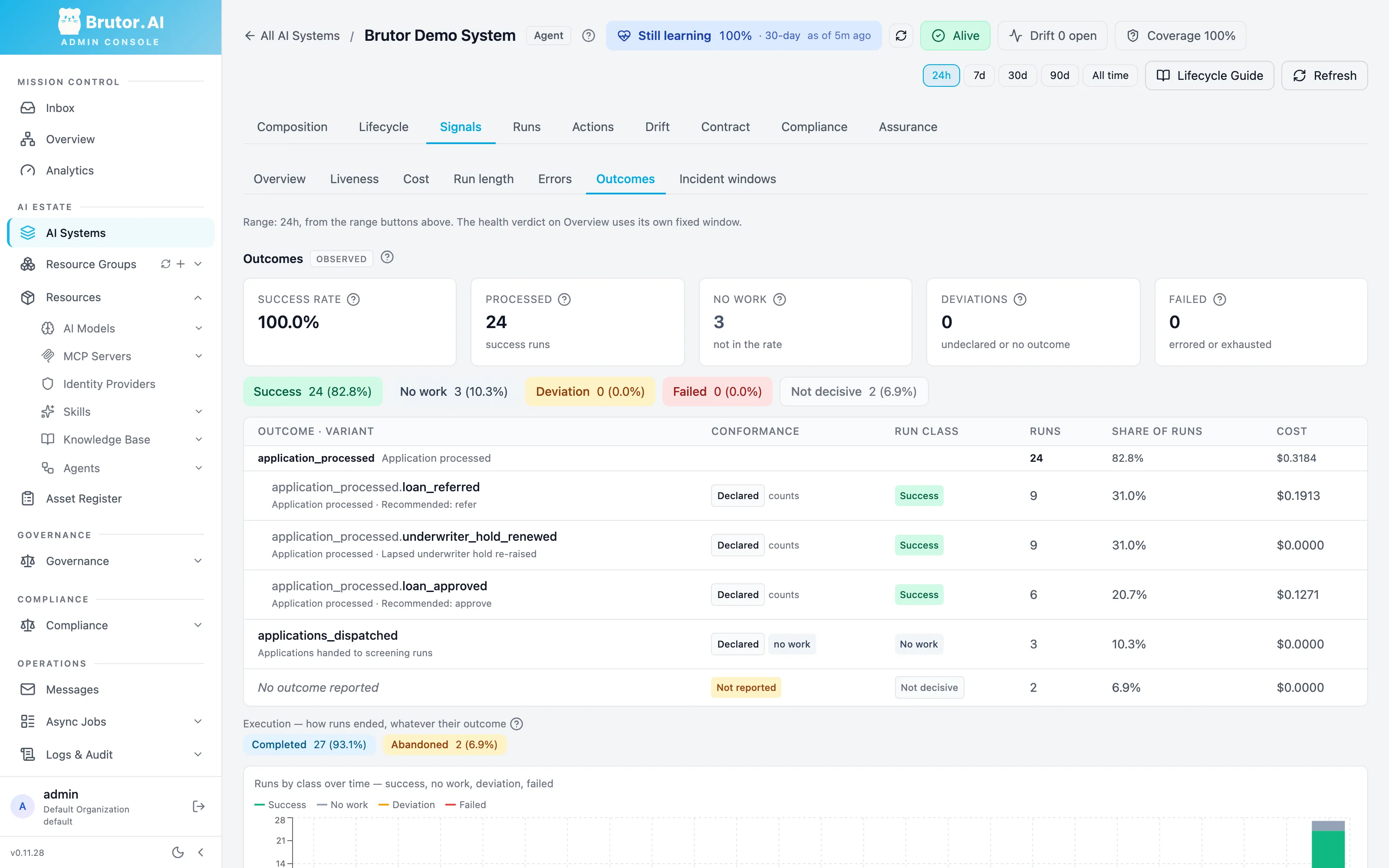
Section titled “What the gateway does with it”The gateway judges each reported outcome against the active contract’s catalogue and
records an outcome_conformance (declared, undeclared, unreported) on the run.
Together with the execution state and counts_toward_baseline, that gives every run a
run class, and the run class is what the Signals read: completion rate, cost per
processed outcome, run length per outcome, the outcome mix and its drift. Details:
Run lifecycle and
Declared outcomes.
Next: human oversight, where the held outcomes come from.