

Declared outcomes
A screening agent that recorded a recommendation, a poll that found nothing to screen and
an approved decision being applied all end completed. They are not the same kind of
run: the first is ten actions and two cents, the other two are one action and nothing.
Averaged together they produce a cost and a reliability that describe no real run — and
during an outage the empty polls keep “succeeding” while every real task fails.
Declared outcomes fix that. The AI System’s contract lists the ways a run may end; the agent names the one it ended in; the gateway checks the claim. Every finished run is then judged on three separate questions:
| # | Question | Who answers | Values |
|---|---|---|---|
| 1 | Did the run complete without errors? | the gateway, from what it saw | terminal_state + error_cause (run lifecycle) |
| 2 | Was the outcome one the contract declares? | the gateway, checking X-Brutor-Outcome-Id against the active contract |
declared · undeclared · unreported |
| 3 | Does the outcome count toward the operating baseline? | the contract, per declared outcome | counts_toward_baseline: true (real work) / false (nothing to do) |
A run succeeds when it completed without errors and ended in a declared outcome that counts. A completed run with an undeclared or missing outcome is a deviation: a conformance finding, and not a success.
Quick start
Section titled “Quick start”- Declare the catalogue on the AI System — Admin UI AI Systems → your system → Contract → Outcomes, or
PUT /v1/admin/ai-systems/{id}/outcomes(below). - Mint, approve and promote a contract so the catalogue is signed. Until a contract that carries it is active, every reported id is judged
undeclared(below). - Report the outcome on the run-closing call:
X-Brutor-Run-End: completed+X-Brutor-Outcome-Id: <outcome>[.<variant>](below). - Read it back on the Runs list (Outcome and Run class columns) and Signals → Outcomes (below).
The catalogue
Section titled “The catalogue”The Brutor Demo System’s screening agent ships its catalogue as a file
(brutor-demo-screening-agent/screening_agent/outcomes.json), which the agent validates
against and the setup script declares. Abridged:
{ "outcomes": [ { "id": "application_processed", "label": "Application processed", "counts_toward_baseline": true, "variants": [ { "id": "loan_approved", "label": "Recommended: approve", "expect": { "requires_capabilities": ["applications_set_recommendation"] } }, { "id": "held_for_underwriter", "label": "Held for underwriter approval", "expect": { "requires_capabilities": ["applications_add_note"] } }, { "id": "underwriter_decision_applied", "label": "Underwriter-approved decision applied", "expect": { "max_actions": 2, "max_model_calls": 0 } } ] }, { "id": "no_applications_available", "label": "Nothing to screen", "counts_toward_baseline": false, "expect": { "max_model_calls": 0, "max_cost_usd": 0, "forbids_capabilities": ["applications_set_recommendation", "applications_add_note", "applications_hand_off"] } } ]}The full file declares application_processed with eight variants (loan_approved,
loan_rejected, loan_referred, held_for_underwriter, underwriter_decision_applied,
underwriter_hold_renewed, underwriter_hold_closed, sent_to_manual_review) and two
outcomes that do not count: no_applications_available and applications_dispatched
(a scheduler tick that handed applications to runs of their own — a poll, not the work).
Fields
Section titled “Fields”| Field | On | Rules | Example |
|---|---|---|---|
id |
outcome, variant | [a-z0-9_-]{1,48}, unique in the catalogue / within the outcome |
application_processed |
label |
outcome, variant | required, 1–128 characters | Application processed |
description |
outcome, variant | optional, ≤ 2000 characters | The agent did its job on one loan application… |
counts_toward_baseline |
outcome | required, true or false |
true |
variants |
outcome | optional list, ≤ 32 per outcome | [{"id": "loan_approved", …}] |
expect |
outcome, variant | optional evidence bounds (below) | {"max_model_calls": 0} |
At most 32 outcomes. Unknown keys are refused with 422.
- Variants are domain states of one outcome (approve, decline, refer). When an outcome
declares variants the agent must report one:
application_processedalone isundeclared. An outcome without variants is reported bare (no_applications_available). Baselines and the outcome mix are learned per variant. counts_toward_baselinedecides whether a run that ends there is work.falseis for “nothing to do” ends: they leave the success rate, the cost of the work and the work baselines, and are reported as no-work overhead instead.expectsays what a run reporting the outcome must look like — the agent’s claim is checked against what the gateway saw. A cheap outcome needs evidence, or an agent could report “nothing to do” for anything.
expect key |
Type | A run breaks it when |
|---|---|---|
max_actions |
integer ≥ 0 | it made more governed calls |
max_model_calls |
integer ≥ 0 | it made more LLM calls |
max_cost_usd |
number ≥ 0 | it cost more |
requires_capabilities |
list of capability names (MCP tool names, skills) | one of them was not used |
forbids_capabilities |
list of capability names | one of them was used |
A variant’s expect is merged over its outcome’s (the variant’s keys win). A capability
may not be both required and forbidden. A run that breaks its bounds raises the
outcome_evidence_mismatch conformance finding.
The starter catalogue
Section titled “The starter catalogue”Every new AI System gets an editable draft that you rename and extend:
[ { "id": "nothing_to_do", "label": "Nothing to do", "counts_toward_baseline": false, "expect": { "max_actions": 2, "max_model_calls": 0, "max_cost_usd": 0 } }, { "id": "task_completed", "label": "Task completed", "counts_toward_baseline": true }]It is only a draft: it judges nothing until a contract carrying it is promoted.
Declare the catalogue
Section titled “Declare the catalogue”In the Admin UI
Section titled “In the Admin UI”AI Systems → your system → Contract → Outcomes edits the live catalogue. The banner says which contract outcomes are judged against right now and lists every id an agent may report; Save outcomes stores the edit, which makes the live configuration drift from the active contract until you mint a new version.
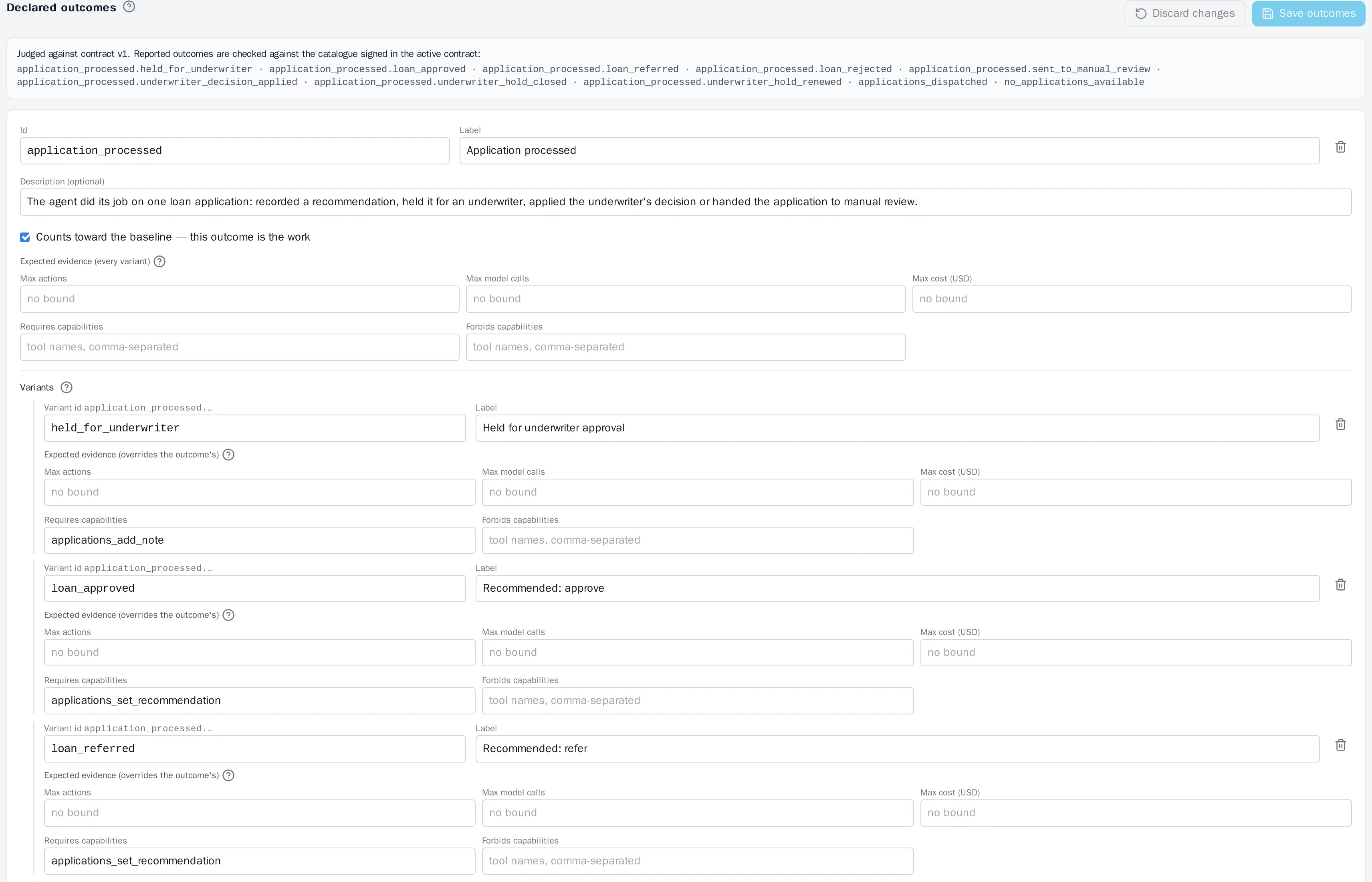
With the Admin API
Section titled “With the Admin API”GET and PUT /v1/admin/ai-systems/{ai_system_id}/outcomes on the Control Plane
(:5050, admin token). PUT replaces the whole catalogue; null or [] clears it.
curl -s -X PUT "http://localhost:5050/v1/admin/ai-systems/$AI_SYSTEM_ID/outcomes" \ -H "Authorization: Bearer $ADMIN_TOKEN" \ -H "Content-Type: application/json" \ -d @- <<'EOF'{"outcomes": [ {"id": "ticket_resolved", "label": "Ticket resolved", "counts_toward_baseline": true, "variants": [{"id": "answered", "label": "Answered"}, {"id": "escalated_to_human", "label": "Escalated to a human", "expect": {"requires_capabilities": ["tickets_assign"]}}]}, {"id": "queue_empty", "label": "Queue empty", "counts_toward_baseline": false, "expect": {"max_model_calls": 0, "max_cost_usd": 0}}]}EOF# brutor-demo-setup/setup.py — step 9c, declared outcomes (only when the stored document differs)want = outcome_catalogue(dist) # outcomes.json → "outcomes"status, have = self.cp.get(f"/v1/admin/ai-systems/{gid}/outcomes", tolerate=(404,))if normalize_catalogue(_stored_catalogue(have)) != normalize_catalogue(want): _, resp = self.cp.put(f"/v1/admin/ai-systems/{gid}/outcomes", {"outcomes": want})const res = await fetch(`http://localhost:5050/v1/admin/ai-systems/${aiSystemId}/outcomes`, { method: "PUT", headers: { Authorization: `Bearer ${adminToken}`, "Content-Type": "application/json" }, body: JSON.stringify({ outcomes: catalogue }),});if (res.status === 422) console.error((await res.json()).detail); // [{loc, msg}, ...]The response (also the GET response) is the normalised catalogue — sorted by id, variants
sorted, empty members dropped, so two saves of the same catalogue hash identically — plus
what is judging runs right now. From the live Demo System:
{ "ai_system_id": "group-01M5WEHAXGQ61T2B2NJ9V6MYRE", "outcomes": [ { "id": "application_processed", "label": "Application processed", "counts_toward_baseline": true, "variants": [ … ] }, … ], "active_outcomes": [ … the catalogue signed in the active contract … ], "active_contract_version": 1, "reportable_ids": [ "application_processed.held_for_underwriter", "application_processed.loan_approved", "application_processed.loan_referred", "application_processed.loan_rejected", "application_processed.sent_to_manual_review", "application_processed.underwriter_decision_applied", "application_processed.underwriter_hold_closed", "application_processed.underwriter_hold_renewed", "applications_dispatched", "no_applications_available" ], "config_drifted": false}reportable_ids are the ids the live catalogue declares; active_outcomes is what the
gateway judges against until the next promotion. A validation failure lists every problem
with its path:
{ "detail": [ { "loc": ["outcomes", 0, "counts_toward_baseline"], "msg": "counts_toward_baseline must be true or false" }, { "loc": ["outcomes", 1, "variants", 0, "id"], "msg": "id must match [a-z0-9_-]{1,48}" }] }Sign it into the contract
Section titled “Sign it into the contract”The gateway judges outcomes against the outcomes section of the system’s active
contract — never against an unapproved edit. After declaring (or changing) the catalogue,
mint a new version from live configuration, approve it and promote it:
CP=http://localhost:5050; AUTH="Authorization: Bearer $ADMIN_TOKEN"CID=$(curl -s -X POST "$CP/v1/admin/ai-systems/$AI_SYSTEM_ID/contracts" -H "$AUTH" | jq -r .contract.id)curl -s -X POST "$CP/v1/admin/contracts/$CID/approve" -H "$AUTH" \ -H "Content-Type: application/json" -d '{"note": "Outcome catalogue reviewed"}'curl -s -X POST "$CP/v1/admin/contracts/$CID/promote" -H "$AUTH"# brutor-demo-setup/setup.py — step 14, contract and gate_, resp = self.cp.post(f"/v1/admin/ai-systems/{gid}/contracts", {}, tolerate=(409,))contract = resp.get("contract") # {"contract": {...}, "created": true|false}cid = contract["id"]if contract.get("status") not in ("approved", "promoted", "active"): self.cp.post(f"/v1/admin/contracts/{cid}/approve", {"note": f"Approved by {owner} (demo)"})self.cp.post(f"/v1/admin/contracts/{cid}/promote", {})const cp = "http://localhost:5050", h = { Authorization: `Bearer ${adminToken}`, "Content-Type": "application/json" };const { contract } = await (await fetch(`${cp}/v1/admin/ai-systems/${aiSystemId}/contracts`, { method: "POST", headers: h })).json();await fetch(`${cp}/v1/admin/contracts/${contract.id}/approve`, { method: "POST", headers: h, body: JSON.stringify({ note: "Outcome catalogue reviewed" }) });await fetch(`${cp}/v1/admin/contracts/${contract.id}/promote`, { method: "POST", headers: h });{ "contract": { "id": "ctr-01M5WEHF1G8W8CBPR8QZZ1DKVQ", "version": 1, "status": "draft", "contract_hash": "sha256:861d062ae9eff0c1f7b296533c4fc80c59bd5606dc769caa3166b8f2942414b6", "diff_summary": null }, "created": true }Minting is idempotent ("created": false when live configuration still hashes to the
latest version). approve and promote answer the ContractResponse; 409 when the
version is not in a state that allows the step. Each version’s What this version
covers shows the signed catalogue and each dependency’s expected outcomes:

Widening and narrowing
Section titled “Widening and narrowing”The contract diff classifies every catalogue change, so an approver sees what loosened:
| Change | Classified as |
|---|---|
| outcome or variant added | widening |
| outcome or variant removed | narrowing |
counts_toward_baseline true → false |
widening, called out — its runs leave the success rate, the cost of the work and drift detection |
counts_toward_baseline false → true |
narrowing |
an expect bound raised, removed, a required capability dropped, a forbidden one allowed |
widening |
an expect bound added or lowered, a capability required or forbidden |
narrowing |
a dependency’s expected_outcomes gains an id / loses one |
widening / narrowing |
| label or description edited | neither (reported as changed) |
Promoting a version that changes a variant’s expect or its baseline flag starts a
baseline epoch for that outcome, so drift re-learns it
instead of flagging the change you just approved.
Report the outcome from your agent
Section titled “Report the outcome from your agent”Send the outcome on the run-closing call, beside X-Brutor-Run-End, or in the body of
POST /v1/runs/{root}/end:
# on the last proxied call of the task-H "X-Brutor-Run-End: completed" \-H "X-Brutor-Outcome-Id: application_processed.loan_approved"
# or, off the gatewaycurl -s -X POST "http://localhost:8100/v1/runs/$RUN_ROOT/end" \  -H "Authorization: Bearer $BRUTOR_API_KEY" -H "Content-Type: application/json" \  -d '{"state": "completed", "outcome_id": "no_applications_available"}'
# screening_agent/graph.py — the recommendation picks the variantRECOMMENDATION_OUTCOMES = { # rules.py: approve | decline | refer "approve": "application_processed.loan_approved", "decline": "application_processed.loan_rejected", "refer": "application_processed.loan_referred",}outcome_id = RECOMMENDATION_OUTCOMES[final["recommendation"]]gw.mcp_call(server_id, "applications_set_recommendation", tool_args, run_end="completed", outcome_id=outcome_id, **hdr("record"))
# screening_agent/scheduler.py — a tick is its own run, closed on one more read-only calloutcome_id = APPLICATIONS_DISPATCHED if todo else NO_APPLICATIONS_AVAILABLEself.list_pending(1, outcome_id=outcome_id)await openai.chat.completions.create( { model: "gpt-5.2", messages }, { headers: { "x-brutor-run-id": runId, "X-Brutor-Run-End": "completed", "X-Brutor-Outcome-Id": "ticket_resolved.answered" } },);How the gateway judges it at finalize:
| What you sent | outcome_conformance |
run_class (on a completed run) |
|---|---|---|
a declared id (loan_approved under application_processed) of an outcome that counts |
declared |
success |
| a declared id of an outcome that does not count | declared |
no_work |
| an id the active contract does not declare, a bare outcome that has variants, an unknown variant, a malformed value, or anything at all while no active contract carries a catalogue | undeclared |
deviation |
| nothing | unreported |
deviation |
- The run is judged against the contract stamped on the run (the one active when it
started), else the active one — a later promotion never rewrites history. The run stores
the id verbatim, its conformance, whether it counts, and
outcome_contract_version. - On a proxy call a malformed value never fails the request: the work is recorded and the
label is judged
undeclared.POST /v1/runs/{root}/endrefuses a malformed value with400. - The outcome is stored on the call’s audit row too (
proxy_logs.outcome_id), so a run finalized later by the sweeper keeps it. - Errored runs report no outcome — errors are execution, not outcomes, and an
erroredrun isfailedwhatever it carries. The demo agent refuses to build an outcome header for anything but a completed run. X-Brutor-Outcome-Idis not read onPOST /v1/proxy/a2a/outbound(that row carries the delegate’s outcome); close your run on another call or with/end.- A run ingested over OpenTelemetry reports its outcome as
the span attribute
brutor.outcome.idon the run-root GenAI span, else on the trace’s top-level span.
Delegated outcomes (A2A)
Section titled “Delegated outcomes (A2A)”Every agent in a composite system is an AI System with its own contract, so a delegate
declares its own catalogue. The Demo Fraud Screener declares screening_completed with
the variants clear, review and hit.
screening agent ──POST /v1/proxy/a2a/outbound──▶ gateway ──message:send──▶ fraud screener │◀── X-Brutor-Outcome-Id: screening_completed.hit │ (or Task metadata "brutor.outcome.id") judge against the SCREENER's active contract◀── X-Brutor-Outcome-Id: screening_completed.hit X-Brutor-Outcome-Conformance: declared Task metadata: brutor.outcome.id / brutor.outcome.conformanceThe delegate reports its outcome on its reply — as a response header for a synchronous
reply, and in the final Task’s metadata, which is the only carrier a streamed or
asynchronous reply has (its headers are sent before the result exists). The header wins
when both are present.
outcome_id = outcome_for(verdict["verdict"]) # screening_completed.<clear|review|hit>return JSONResponse( task_response(verdict, outcome_id=outcome_id), # task.metadata["brutor.outcome.id"] headers={"X-Brutor-Outcome-Id": outcome_id}, # the synchronous carrier)The gateway checks it against the delegate’s active contract and records it on the
delegate’s run segment, so the delegate’s own success rate, mix and baselines are computed
from the calls it served. The delegate is the AI System named by a shared_service
dependency edge for that agent card. Then it hands the caller the checked pair: the
X-Brutor-Outcome-Id response header (when an id was reported), the
X-Brutor-Outcome-Conformance header (always), and the same two keys in the final Task
metadata. If the delegate or its contract cannot be read, the outcome is judged with no
catalogue (undeclared / unreported) — never declared on a guess, and never a failed
request.
The caller branches on the gateway’s verdict, not on the delegate’s body:
outcome_id, conformance = self._delegate_outcome(response, task, out) # header or Task metadataif conformance != "declared": raise DelegateDeviated(f"the delegate's outcome {outcome_id!r} is {conformance}")if expected_outcomes is not None and outcome_id not in expected_outcomes: raise DelegateDeviated(f"the delegate answered {outcome_id!r}, not one this agent handles")head, _, v = answer.outcome_id.partition(".") # screening_completed.hit → "hit"verdict["verdict"] = v # the checked outcome wins over the bodyWhat a deviating delegate does to each side:
| Delegate (fraud screener) | Caller (screening agent) | |
|---|---|---|
| Delegate answered with an undeclared id or none | its segment is undeclared / unreported: an undeclared_outcome finding on the delegate, and the call counts against its reliability |
the delegated call’s error cause is delegate_deviated; if the run errors on it, the run’s cause is delegate_deviated |
| Delegate answered a declared id the caller is not built for | — | unexpected_delegate_outcome finding on the caller (when the dependency declares expected_outcomes) |
| Delegate failed or timed out | segment failed / timed_out |
agent_unreachable |
Declaring what the caller expects back
Section titled “Declaring what the caller expects back”A dependency can list the delegate outcomes the caller is built to handle. An answer
outside the list is a finding on the caller — the composition has drifted from what was
signed off, even when the delegate’s own contract allows the answer. An entry without a
variant covers all its variants. null means not declared (no finding).
curl -s -X PATCH "http://localhost:5050/v1/admin/ai-systems/$DEMO_SYSTEM_ID/dependencies/$EDGE_ID" \ -H "Authorization: Bearer $ADMIN_TOKEN" -H "Content-Type: application/json" \ -d '{"expected_outcomes": ["screening_completed.clear", "screening_completed.review", "screening_completed.hit"]}'# brutor-demo-setup/setup.py — step 9b, compositionwant = { "role": "shared_service", "depends_on_system_id": self.ids["fraud_group_id"], "agent_card_id": self.ids["fraud_card_id"], "criticality": "critical", "expected_outcomes": expected_delegate_outcomes(SCREENING_DIST, FRAUD_DIST),}self.cp.post(f"/v1/admin/ai-systems/{gid}/dependencies", want) # PATCH …/{edge_id} when it existsawait fetch(`${cp}/v1/admin/ai-systems/${demoSystemId}/dependencies/${edgeId}`, { method: "PATCH", headers: h, body: JSON.stringify({ expected_outcomes: ["screening_completed.clear", "screening_completed.review", "screening_completed.hit"] }),});The dependency rows of GET /v1/admin/ai-systems/{id}/dependencies carry
expected_outcomes (a sorted list, or null); ids that do not match the grammar are
refused with 422. In the Admin UI the field is on the dependency dialog of the
Composition tab, and the signed list appears in the contract (screenshot above).
What outcomes feed
Section titled “What outcomes feed”Success rate and health
Section titled “Success rate and health”success rate = success / (success + deviation + failed)Empty polls (no_work) are in neither part, so an agent cannot look more reliable for
having less to do, and every errored or exhausted run counts against the rate. Health’s
reliability is this rate over the health window; beside it, health checks the latest
three finished runs that are evidence, and reads failing when all three failed — during
a model outage the polls keep succeeding and every screening errors, and the system now
reads Failing instead of Healthy. The rule: Health & the Assurance
Report.
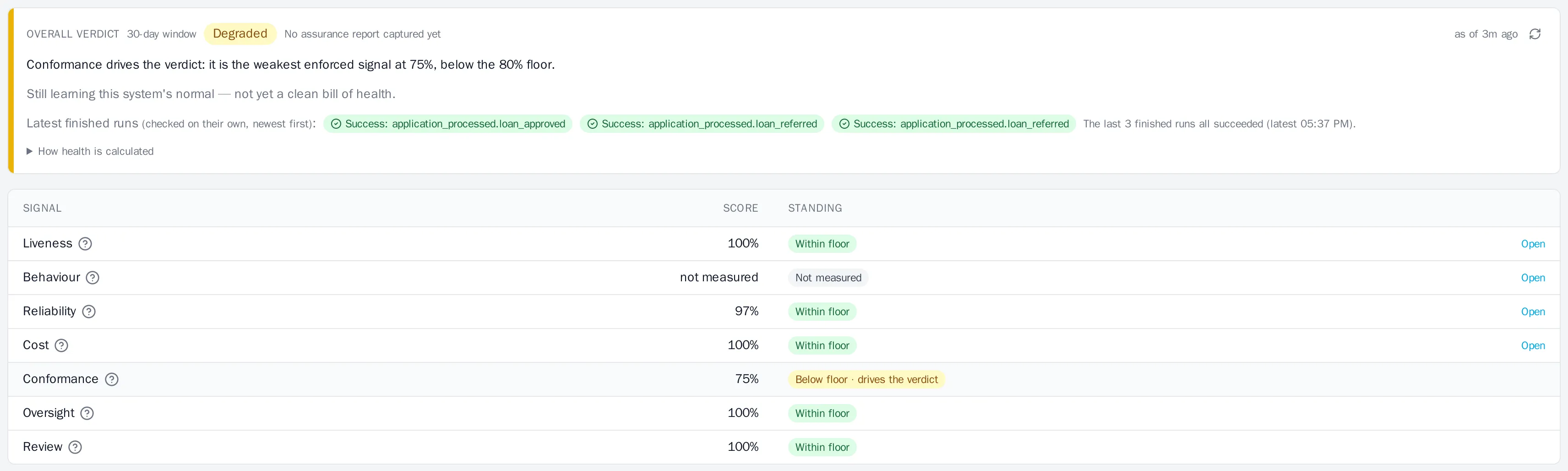
The outcome mix
Section titled “The outcome mix”Signals → Outcomes shows every run of the window by outcome and variant, with its conformance and run class. No-work outcomes are grey, never green; undeclared and unreported ends are listed, not hidden.
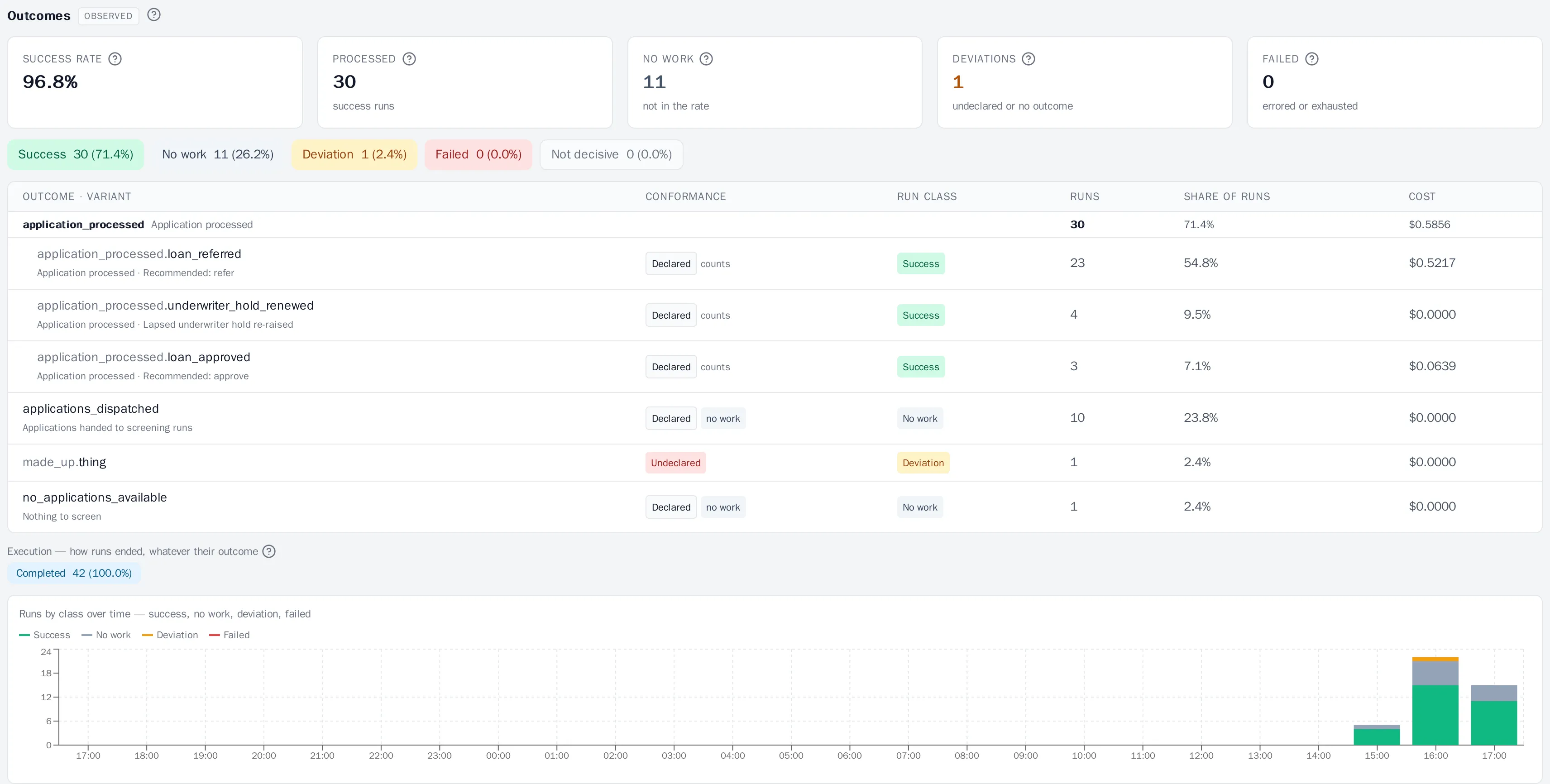
The same numbers come from the run stats API, GET /v1/admin/ai-systems/{id}/runs/stats?period_hours=24:
"outcomes": { "total_runs": 41, "success_rate": 0.966667, "by_class": { "success": 29, "no_work": 11, "deviation": 1, "failed": 0, "not_decisive": 0 }, "by_outcome": [ { "outcome_id": "application_processed.loan_referred", "conformance": "declared", "counts_toward_baseline": true, "run_class": "success", "runs": 23, "share": 0.560976, "cost_usd": 0.5216815 }, { "outcome_id": "applications_dispatched", "conformance": "declared", "counts_toward_baseline": false, "run_class": "no_work", "runs": 10, "share": 0.243902, "cost_usd": 0.0 }, { "outcome_id": "made_up.thing", "conformance": "undeclared", "counts_toward_baseline": null, "run_class": "deviation", "runs": 1, "share": 0.02439, "cost_usd": 0.0 } ]},"error_causes": { "failed_runs": 0, "by_cause": [] }share is the share of all runs in the window; error_causes.by_cause[] is
{cause, runs, share} (a failed run with no cause reads unknown).
Cost and run length per outcome
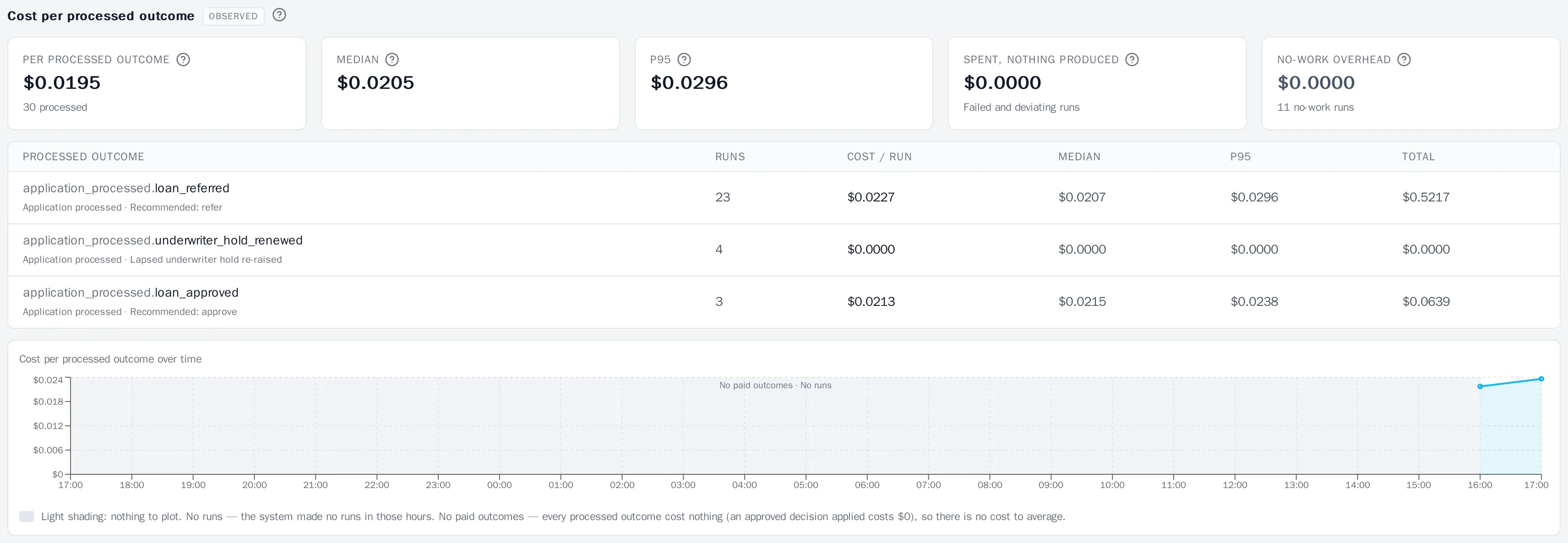
Section titled “Cost and run length per outcome”Cost per processed outcome replaces cost per completed run: it averages only success
runs, and is broken down per outcome and variant, so eight $0 “decision applied” runs never
blend with two $0.02 screenings into a $0.004 that describes neither.
Card / field (cost.* in run stats) |
Population |
|---|---|
cost_per_processed_outcome, median_…, p95_…, tokens_per_processed_outcome |
success runs |
by_outcome[] — outcome_id, runs, cost_usd, cost_per_run, median_cost_usd, p95_cost_usd |
success runs, per full outcome id |
wasted_cost_usd (spent, nothing produced) |
failed + deviation runs |
no_work_runs, no_work_cost_usd (no-work overhead) |
no_work runs |
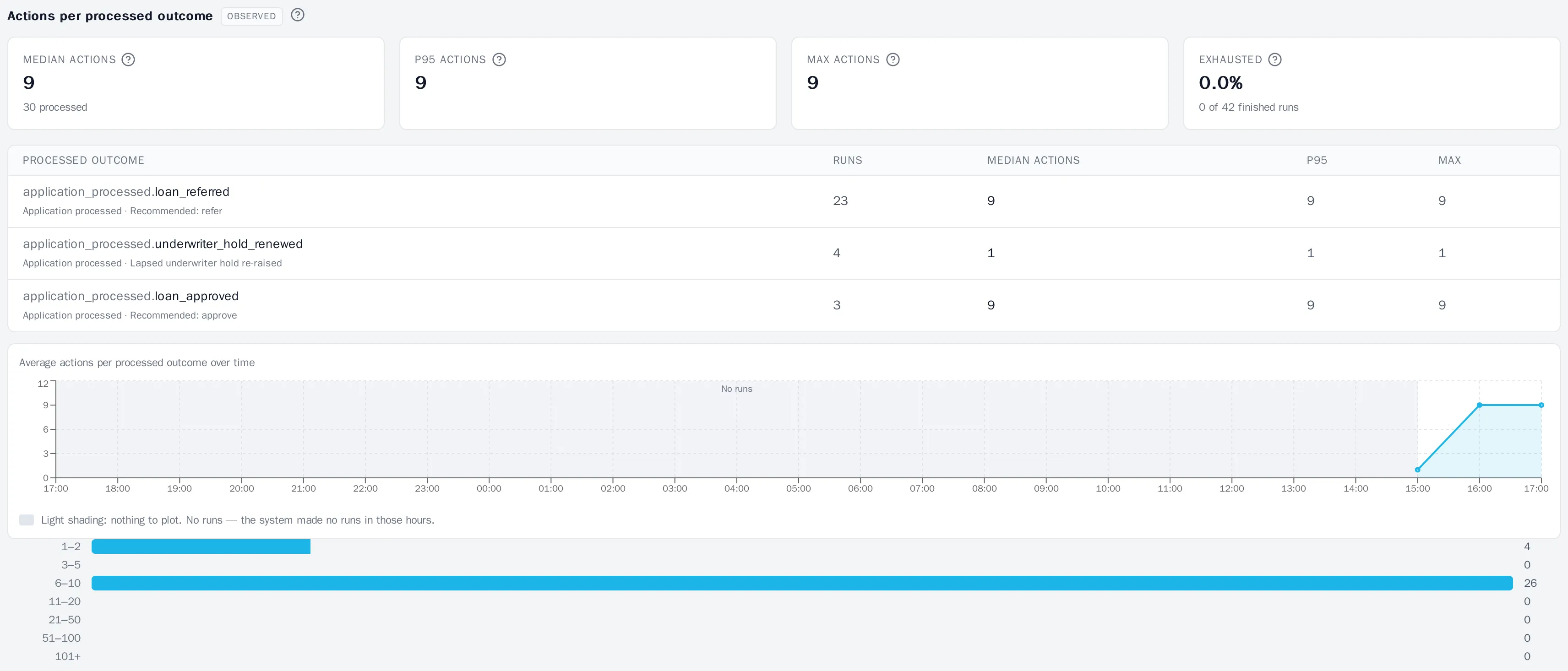
Signals → Run length does the same for actions (actions.by_outcome[] with median,
p95 and max), so a one-action “hold renewed” never pulls down the length of a nine-action
screening:
Signals → Errors shows failed runs by error cause above calls by type (the error causes):
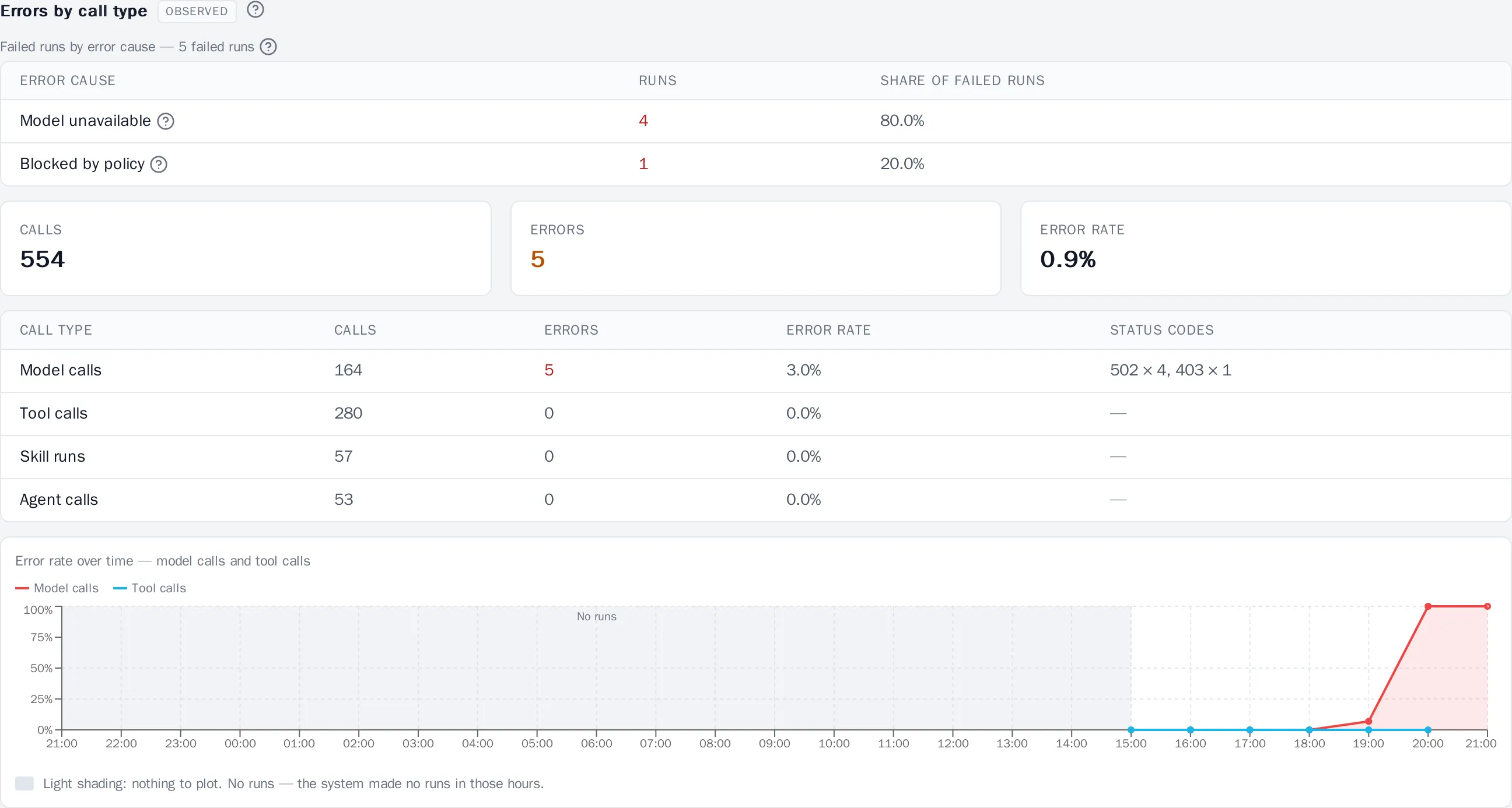
Continuous metrics are learned per outcome id as well as system-wide, and two new
categorical metrics, outcome_mix and error_cause_mix, catch a shift in which outcomes
or causes occur without mistaking it for a change inside one of them. No-work runs get a
baseline of their own, and baseline readiness counts success runs only. See
Behavioural drift → per outcome, and the mix.
Operating envelope
Section titled “Operating envelope”min_completion_rate reads the success rate above. Two graded terms take an outcome id
in their key (an id without a variant covers its variants):
{ "operating_envelope": { "min_completion_rate": 0.9, "max_outcome_share:no_applications_available": 0.9, "avg_cost_per_outcome:application_processed.loan_approved": 0.05 } }max_outcome_share bounds the share of declared-outcome runs that ended in that outcome —
a jump in the “nothing to do” share is how an upstream feed that silently stopped
delivering shows up. avg_cost_per_outcome bounds the mean cost of one kind of work.
Both are graded in the Assurance Report, never enforced on a call. See
Contracts → the operating envelope.
Conformance findings
Section titled “Conformance findings”Conformance (a health component, and a section of the Assurance Report) compares what the system did with what its active contract declares, over a 30-day window:
| Finding | Severity | Lowers the score by | Raised when |
|---|---|---|---|
undeclared_outcome |
high | 0.25 per distinct id | runs ended in an id the contract does not declare — the system ended somewhere it was never approved to |
outcome_unreported |
medium | 0.1 | completed runs reported no outcome |
outcome_evidence_mismatch |
medium | 0.1 per outcome | runs reporting an outcome broke its expect (the finding quotes the broken bounds and up to three run ids) |
unexpected_delegate_outcome |
medium | 0.1 per dependency | a delegate answered outside the dependency’s expected_outcomes |
unused_outcome |
low | 0 | a declared outcome or variant no run ended in, once the system has made at least 20 calls in the window |
An unused declared outcome is a precision hint, not a fault: it never lowers the score,
because penalising a rare-but-legitimate end would push owners to declare fewer outcomes
— and the rare end would then arrive undeclared. The Demo System’s single made_up.thing
run is exactly one undeclared_outcome finding, which is why its conformance reads 75 %:
[ { "kind": "undeclared_outcome", "severity": "high", "subject": "made_up.thing", "detail": "1 run(s) ended in 'made_up.thing', an outcome the active contract does not declare — the system ended somewhere it was never approved to." }, { "kind": "unused_outcome", "severity": "low", "subject": "application_processed.loan_rejected", "detail": "'application_processed.loan_rejected' is declared but no run ended there in this window — an approved path nobody exercises." }]Liveness: last run and last processed run
Section titled “Liveness: last run and last processed run”Liveness keeps two timestamps: last run (any outcome — the agent is alive and
checking) and last processed run (the latest success — work is getting done). A
scheduled system can bound the second with max_quiet_processed_seconds, which raises
work_quiet without ever making the system silent. See
Liveness → last run, and last processed run.
Runs list, run detail and OpenTelemetry
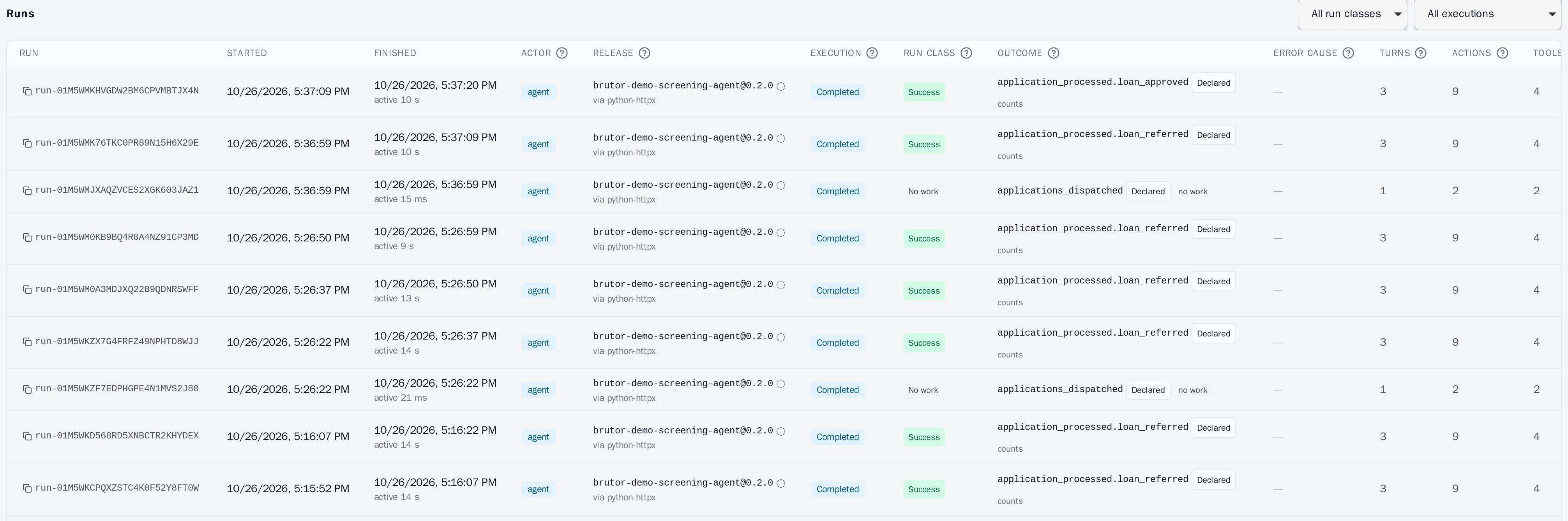
Section titled “Runs list, run detail and OpenTelemetry”The Runs tab shows Execution (terminal state), Run class, Outcome (with its
conformance and whether it counts) and Error cause per run, and filters by run class
(GET /v1/admin/ai-systems/{id}/runs?run_class=deviation). Each row carries
outcome_id, outcome_conformance, outcome_counts_toward_baseline,
outcome_contract_version, run_class and error_cause.
With OTEL_EXPORTER_OTLP_ENDPOINT set, the core exports one brutor.run span per
finalized run with brutor.outcome.id, brutor.outcome.conformance,
brutor.outcome.counts_toward_baseline, brutor.error.cause, brutor.run.class and
brutor.run.terminal_state, plus a gen_ai.evaluation.result event named
brutor.declared_outcome whose gen_ai.evaluation.score.label is the run class — so any
OTel backend can read the outcome.
Walkthrough: the Brutor Demo System
Section titled “Walkthrough: the Brutor Demo System”The Brutor Demo System is a loan pre-screening agent that delegates fraud screening to a second agent over A2A. Start it against the trial (see Your first assured AI System), then follow one application and one deviation end to end.
-
Setup declares both catalogues. Step 9b declares the dependency on the Fraud Screener with
expected_outcomesscreening_completed.clear|review|hit; step 9c PUTs each agent’soutcomes.jsonto/v1/admin/ai-systems/{id}/outcomes; step 14 mints, approves and promotes both contracts — the screener’s first, because the Demo System’s contract pins the screener’s active contract hash. -
A scheduler tick is its own run. Every tick runs as
bds-tick-<ulid>: it pages the pending queue, then closes with one more read-onlyapplications_list_pendingcall carryingX-Brutor-Run-End: completedandno_applications_available(nothing to screen) orapplications_dispatched. Both are declared, do not count, and expect no model call, no cost and none of the writing tools — so they read No work. -
Each application gets a run
bds-<application id>-<ulid>. The graph gathers facts over MCP (stepgather), runs the affordability skill, classifies risk with a model and delegates to the Fraud Screener over/v1/proxy/a2a/outbound(stepassess). The screener answersX-Brutor-Outcome-Id: screening_completed.<verdict>; the gateway checks it against the screener’s contract and returnsX-Brutor-Outcome-Conformance: declared, and the graph branches on that variant. -
The run closes on its last call. The record step’s
applications_set_recommendationcarriesX-Brutor-Run-End: completedandapplication_processed.loan_approved(orloan_rejected,loan_referred). A recommendation the argument policy holds for an underwriter (202) is noted instead, and that note closes the run asapplication_processed.held_for_underwriter. On the graph, the run’s nine actions are numbered in order, the screener’s own model call nested as 6a: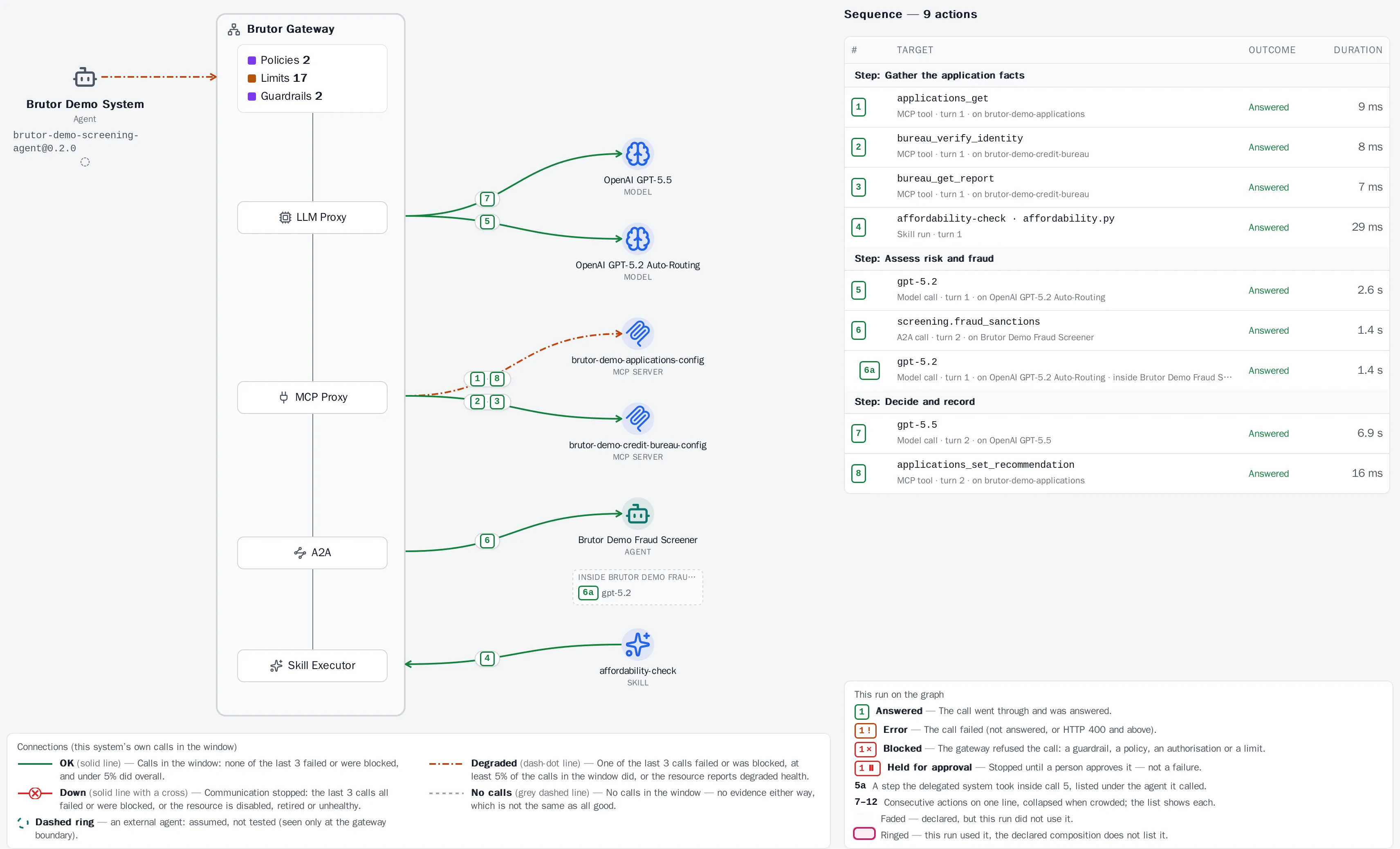
-
Approvals and hand-offs end in their own variants. When an underwriter approves a hold, a short run re-issues the call with the approval token and closes as
underwriter_decision_applied(expect: ≤ 2 actions, no model call); a rejection closes assent_to_manual_review; a lapsed hold re-raised closes asunderwriter_hold_renewed. -
A deviation shows up everywhere it should. One run on this trial closed with
X-Brutor-Outcome-Id: made_up.thing(sent by hand with curl). The gateway judged itundeclared, so the run is a Deviation: it is in the success-rate denominator (30 successes of 31 decisive runs when the screenshots were taken: 96.8 %; the eleven no-work ticks are in neither), listed in the outcome mix, raises a high-severityundeclared_outcomefinding and pulls conformance to 75 %, which drives the health verdict to Degraded.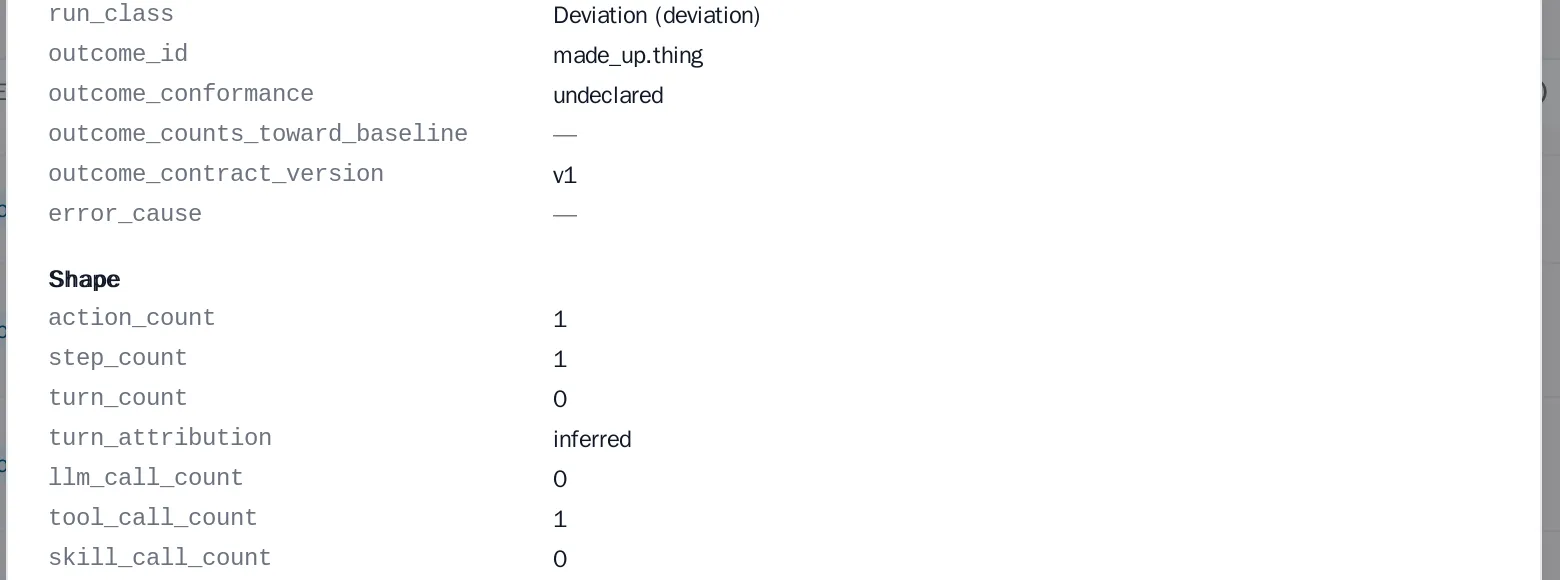
Related
Section titled “Related”- Run lifecycle — terminal states, error causes, the run class
- Agent header reference
- Contracts and Health & the Assurance Report
- A2A agents — building and calling delegates